Synthetic research for agencies: make the creative recommendation inspectable
Connect a client brief, audience comparison and creative revision. Use modeled research to make an agency recommendation clear, inspectable and bounded.
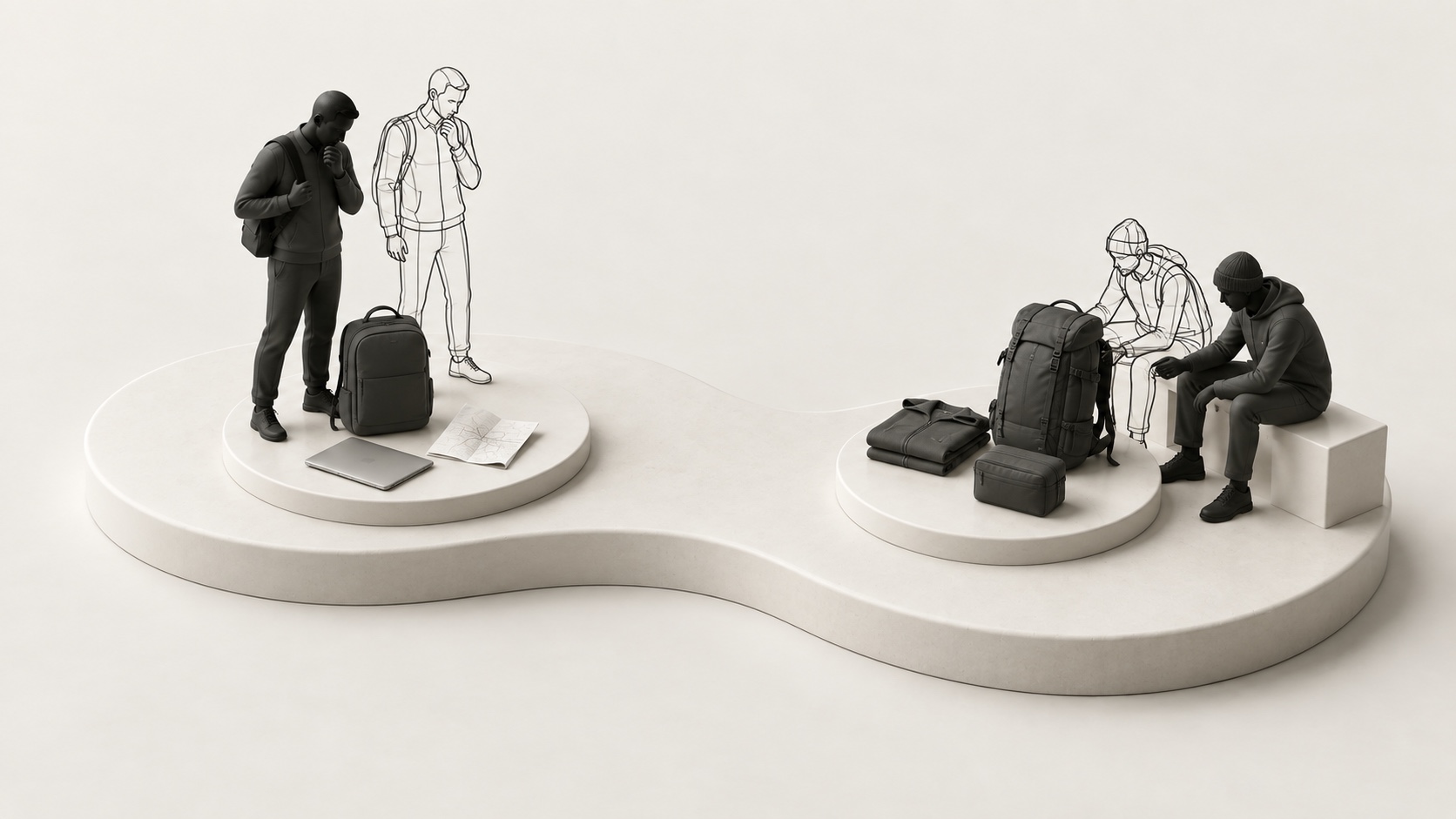
The client prefers the emotional route. The creative team worries that nobody will understand the product. Another round of “Which one do you like?” could give the meeting more opinions without resolving the disagreement.
Research helps when it gives the agency a more precise recommendation: keep this idea, change this moment, supply this proof, then test the revised execution. The client should be able to follow that reasoning from the material shown to the action being proposed.
Consider Morrow, a fictional commuter-bag brand, and its agency. The bag has a removable work organizer. The campaign is aimed at people who move between work and evening activities, and the agency must choose a route to develop before the client approves production. The example below describes a proposed comparison, with no audience findings collected.
Put the creative disagreement into the brief
Route A opens with “Leave work behind” and shows the closed bag beside a restaurant table. Route B opens with “Lift out work. Make room for the evening” and shows the organizer being removed. Both carry the same product name and a line explaining that the commuter bag has a removable work organizer.
The disagreement is useful. A leads with an occasion and an emotional benefit. B makes the mechanism visible. The research question is whether the intended audience understands the product and sees a reason to consider it, and which part of either route needs development.
Write that decision into the brief. Approval could release a revised storyboard, rather than the entire campaign. A favorable reaction to an early route cannot settle every later choice about casting, editing, media or product performance.
Also establish what remains fixed: the bag, its verified features, the intended audience and the next development commitment. If the client changes the product halfway through, record a new offer version rather than combining responses to different bags.
Give both routes a truthful product to describe
Before involving an audience, the agency and client need to agree what the organizer actually does. Where can it be placed after removal? Which items does it hold? What stays in the bag? Use verified product information and suitable demonstrations to answer those questions.
The closed-bag restaurant scene does not show the removable mechanism. That is visible in the creative itself; it does not require a research result. The team can decide whether the omission is intentional or whether the route needs one additional moment before testing.
Avoid solving the problem by adding an unsupported benefit. “No more back pain” needs different evidence from a demonstration of an organizer being lifted out. Audience enthusiasm cannot establish physical comfort or durability. Keep the research about the promise the product can support.
Present the two routes at a comparable stage of finish. A polished film against a rough sentence would mix the idea with execution quality. Since A and B change both the line and the visual, describe their results as reactions to complete creative routes. They cannot isolate the effect of the headline alone.
Ask for an interpretation before a verdict
First show each person one route in the intended encounter. Ask what is being offered, what changes when they use it and which detail led them to that interpretation. Then explore whether it fits their own work-to-evening routine, what seems unconvincing and what they would need to see next.
Keep those questions neutral. “Did the removable organizer look useful?” teaches the feature to someone who may not have noticed it. AAPOR's questionnaire guidance recommends avoiding leading wording and checking how questions and their order influence answers. Our message testing guide shows how to distinguish accurate understanding from enthusiasm for an imagined offer.
The relevant audience is defined by the situation, not just a label such as urban professional. Someone who leaves the organizer at a fixed desk has a different practical question from someone who works wherever a seat is available. Include the routines that could make the proposition useful or unsuitable. A memorable response from an irrelevant routine should not decide the route.
Showing the alternative later can reveal a relative preference, but preserve the first reaction separately. B may explain the organizer and make A easier to understand afterward. That later understanding does not show what A communicated on its own.
Let the interpretation choose the next edit
Different reactions would lead the agency to different work. If A is read as a restaurant bag with no work function, the route needs the product connection made visible. If B is understood but leaves people asking where the removed organizer goes, the next task is to show a credible transition, provided the product can support it.
Someone who already carries a separate work pouch might understand both routes and still prefer their current arrangement. More explanation would miss that objection. Investigate what the complete Morrow bag improves, and whether the proposed audience actually needs it.
These are branches to investigate, not findings to place in the pitch. Preserve contradictory accounts and identify which routines they describe. A route can be promising for one buying situation while remaining a poor fit for another.
When the team revises the storyboard, test the changed version. Do not combine the liked line from A with the understood demonstration from B and report the combination as a tested winner. The new sequence may explain the bag differently or introduce another expectation.
Make the client recommendation easy to challenge
The useful client readout connects the exact creative, the interpretation behind the recommendation and the proposed next edit. Show the response source and the audience definition alongside it. Explain which opposing account would change the recommendation, rather than using an attractive average to dismiss it.
For modeled research, say that the responses came from a simulated audience. Do not turn a generated comment into a customer quotation or imply that people handled the bag. If the client needs to know whether the organizer works during a real commute, that question needs suitable evidence with the physical product.
Keep creative approval separate from product substantiation. A client may approve a clearer storyboard while still withholding a comfort claim until the evidence exists. It is useful research if it narrows the production decision and reveals that dependency before money is committed.
The same discipline applies in a competitive pitch. Research can support the agency's argument for a route, but it should not be described as a completed client engagement or a guaranteed campaign result. Make the status of any illustrative output unmistakable.
Use Sapien for the comparison the agency needs
At Sapien, our team builds data-grounded simulated audiences, runs the agreed study and helps interpret the findings. We can compare concepts and creative, examine differences between audience groups and explore individual responses through interactive findings and follow-up questions. Our market research services guide explains the managed engagement.
For Morrow's decision, the agency would bring the client-approved product facts, the actual creative routes, the intended routines and the choice the research must inform. Agree the audience grounding and validation relevant to the task. The agency continues to own the creative work and the client relationship; the client must confirm what the product can truthfully promise.
Once a route is clear enough to progress, assess the finished execution in its actual campaign context. Our ad testing guide connects creative findings to the elements a team can change and the later campaign test. A modeled preference is not a prediction of sales, and an approved storyboard is not proof that the media execution works.
Bring the brief that is holding up the next creative decision. Book a demo to explore how Sapien can help the agency make a clearer recommendation and show the reasoning behind it.