
Synthetic vs human respondents: choose the source for the decision
Choose human accounts, modeled comparisons or observed use for the claim you need, with a complete meal-planner instrument and task-specific validation.
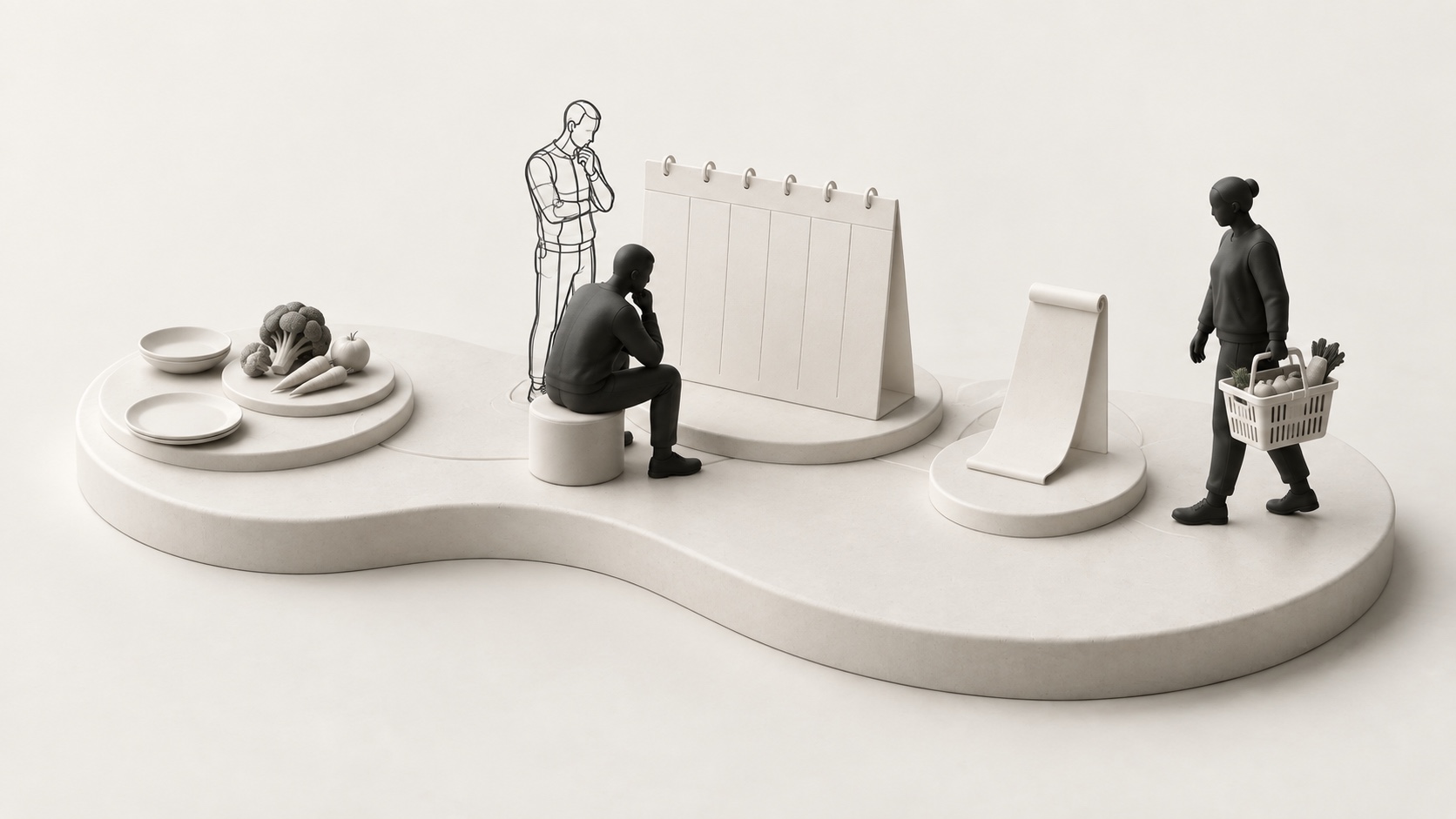
Choose the response source for the claim you need to establish. Grounded synthetic research can compare modeled reactions to complete offers; human interviews provide accounts of lived events; observation and transaction records establish actions. Combine them at a clear handoff when the next question changes, preserving each source and its denominator.
Imagine you are developing a meal planner for households and need to choose its description before testing the shopping-list workflow. This illustrative program has three questions: which description explains the offer, what happened during the last grocery shop, and whether the list works in use. One questionnaire can ask all three, but the same response source cannot establish all three in the same way.
In this guide, synthetic respondents supply modeled answers conditioned on specified audience information and stimuli. Human respondents are people answering the instrument. The source label identifies what produced an answer; the study design determines which conclusion it can support.
A grounded modeled comparison can evaluate descriptions and audience reactions. Human interviews supply accounts of a recent shopping episode. Human use or appropriately captured behavior supplies the task outcome. Choose the next source by the unresolved question, rather than making every study a contest between AI and people.
Choose the evidence for each research job
Requirement | Human and synthetic routes |
|---|---|
Recent lived experience | Human route: Recruit people with the relevant experience and ask or observe Synthetic route: Depends on the grounding available; cannot create an observed experience |
Physical product use | Human route: People can handle or use the product Synthetic route: Expectations from supplied information, unless linked to separate physical evidence |
Comparison of proposed offers | Human route: Collect stated reactions from eligible people Synthetic route: Compare modeled distributions, audience differences and explanations when grounding and task-relevant validation fit the decision |
Population proportions | Human route: Require a suitable sampling and inference design Synthetic route: Require task-specific validation; generated counts do not supply conventional human sampling precision |
Explanation | Human route: Human accounts with probing and interpretation Synthetic route: Generated explanations that need checking against the model’s evidence and behavior |
Costs | Human route: Recruitment, incentives, collection tools, design and analysis Synthetic route: Study or usage fees, grounding, design, review and any human validation |
Human research can also fail through poor eligibility, leading questions, nonresponse or weak analysis. The AAPOR best-practice guidance addresses study design and quality across the research process. A paid panel is not automatically representative simply because its respondents are human.
The question changes. The evidence source changes with it.
Decision question | Source and onward artifact |
|---|---|
What happened on the last shop? | Source: Human episode interview Artifact passed onward: Constraint and needs record |
Which description explains the offer? | Source: Grounded modeled comparison Artifact passed onward: Complete tested concept |
Does the list work in use? | Source: Appropriate human use task Artifact passed onward: Task outcome and failure record |
Proposed meal-planner research program. Each handoff preserves what the source actually supplies.
Use one instrument and preserve the source labels
Show the same complete meal-planning card under both routes: “A weekly plan supplies five dinner recipes, a consolidated shopping list and substitutions for selected ingredients. Price: $8 per month. Groceries are purchased separately.”
- In your own words, what does this service provide?
- Who, if anyone, would find it useful, and why?
- How useful would it be for planning dinners in your household? Not at all / slightly / moderately / very / extremely / cannot judge.
- What would make it unsuitable for your household? Open response.
- At $8 per month, how likely would you be to consider subscribing? Very unlikely / somewhat unlikely / neither / somewhat likely / very likely / cannot judge.
- What information would you need before deciding? Open response.
For human recruitment, define the role in meal planning, market, age eligibility and relevant household conditions. For a synthetic study, document how those conditions are grounded or assumed. Retain “cannot judge” and missing information in both routes rather than forcing a favorable answer.
Plan a useful comparison
Keep the stimulus and instrument fixed. Hold human reference evidence out of model construction when evaluating generalization. Compare comprehension codes, response distributions, concept rankings if relevant and barriers by the audience groups that matter. Inspect where the routes disagree, including low-interest responses and rare but consequential constraints.
Set tolerances before examining the results, based on what could change your decision. A five-point error matters differently when two concepts are almost tied than when one direction is clearly unsuitable. Use independent human evidence to evaluate the model where the decision requires it; do not turn agreement on a few questions into a universal accuracy claim.
Our foldable-iPhone study reports 138 qualifiers among 4,200 modeled core smartphone buyers. These are not independently sampled humans. The qualifier count alone does not compare the model with independent human answers to the meal-planning card; request that separate evidence when evaluating accuracy for this task.
See validation evidence for the decision
Before commissioning a comparison, inspect a task that resembles the question your team needs answered. Our accuracy comparisons show the human references, modeled results and interpretation in each task's units. An ad-liking comparison, a willingness-to-pay estimate and a comprehension task support different conclusions. Choose the comparison relevant to your proposed action.
For the meal planner, that means asking about the meaning of the complete offer and the audience for whom it was tested. A result about a different product or a dollar-price estimate does not establish agreement on these six questions. Ask the supplier to identify the matching evidence and any important gap.
Use four questions to make that review concrete:
- Who was represented? Compare buying situation, geography and eligibility with the audience in your brief. Record what is grounded, assumed or unknown.
- What was compared? Inspect the complete stimulus, answer options, scale and exposure. Agreement on a simplified offer may not carry into a different promise or price.
- What does agreement mean? Look for error in the relevant units, audience differences and a consequential miss. Matching the order of concepts and matching every response share are separate findings.
- Would a miss change the action? A small difference may be tolerable for choosing the next draft and material when committing production. Set that threshold before reviewing the result.
Keep the reference evidence separate from the information used to construct the model. A credible evaluation lets you see where the prediction could fail. It gives an insights lead or agency strategist something they can examine alongside the recommendation.
Build one workflow with clear handoffs
Define which source resolves which uncertainty. Human episodes can identify lived constraints; a suitably grounded modeled comparison can explore offer alternatives; independent reference data can evaluate a specified output; actual usage or payment can test behavior. A combined report should preserve those jobs instead of presenting one blended respondent count.
Choose the next source around the consequential unresolved claim. If it is actual grocery-list use, observe appropriate human use. If it is which complete description communicates the service under grounded audience conditions, scope a comparison with its task-specific validation. This makes combination purposeful while retaining the evidence needed for the final commercial action.
Compare complete project costs and timelines
Record fees, internal hours and validation separately. A human project might include a collection license, screening and incentives, plus researcher time. A modeled project might include a managed study fee and additional human validation. Neither example establishes a universal price advantage.
Use our guide to market research services and costs to compare actual quotes and the work each includes. Log the time from a usable brief to a decision-ready report, including revisions. Comparing only data-generation time with an entire human project creates a misleading speed claim.
A disagreement can identify the missing part of the offer
Suppose modeled concept responses favor the meal-planning explanation, while a human interview raises an ingredient problem. First inspect whether both saw the same complete card and represented the same buying situation. A response to a tidy shopping-list promise and an account of ingredients unavailable in the local shop answer different questions.
Bring the constraint into the next stimulus if it belongs to the real offer. Then compare feasible alternatives: substitutions, a different recipe set or a narrower initial audience. Preserve the human account as the evidence for the lived episode, and the modeled comparison as evidence about supplied alternatives.
When the outputs concern the same held-out question, evaluate that output directly. Ranking agreement, distribution calibration and explanation plausibility are distinct checks. A fluent explanation does not repair the wrong ranking; agreement on a ranking does not establish every response share.
One research program, three clear handoffs
The meal-planner program can begin with recent shopping episodes to identify constraints, compare complete descriptions and feasible offers with a grounded audience, then observe the selected workflow in use. Each handoff passes an actual artifact: a needs record, the tested concept and the task specification.
Commission the next step around the remaining choice. If the selected list workflow is still technically unreliable, a larger attitude study does not resolve it. If the workflow works but the proposition is misunderstood, a complete message comparison is useful. This keeps the combination of sources purposeful and the report easy to interpret.
Choose the next step
For the $8 meal-planning card, compare it with an equally complete alternative and ask about comprehension, usefulness and objections. Carry the selected description into a use task if grocery-list completion is the remaining decision. Keep the handoff explicit: the modeled finding chooses a candidate; the use evidence shows what happened when people tried it.
Use a scoped synthetic study when its grounding and task-specific validation support the required modeled concept, message, price or audience comparison and the decision you need to make. Use interviews for accounts of lived experience, and observation or appropriate behavioral records for claims about physical use or actual task completion. Sensory questions need evidence from the product experience. Combine routes when calibration, validation or missing evidence resolves a material uncertainty; human follow-up depends on that unresolved claim rather than being automatic.
Bring the complete offer, intended buyers and decision to a study-scoping conversation with Sapien. For the meal planner, specify whether you are choosing a description, investigating shopping constraints or evaluating list use. That tells us which comparison and evidence belong in the scope.
Before agreeing the study, ask for a brief that names the audience and its grounding, the saved card and questions, the response source, the returned comparisons and the recommendation they should support. Include task-matched validation requirements and any unresolved claim that needs another source. You can then compare proposals by the work they supply and the decision they release.
For sampling decisions, see our research sampling guide; for the distinction between statements and actions, see our consumer behavior guide.


