
Who Would Buy the $1,999 iPhone Duo?
Apple’s first foldable iPhone starts at $1,999. We modeled 10,000 synthetic U.S. smartphone-buyer profiles to examine who would upgrade, what earns the premium and what changes at $1,799 or $1,599.

Would It Win? follows a product idea all the way to the purchase decision: who pays, what they choose it over, and what would make more people say yes.
Apple unveiled the iPhone Duo on September 9, 2026, starting at $1,999 in the U.S. for 256GB. The harder launch question is who will pay that price when the phone in their pocket still works.
For a launch team, the commercial question is whether the fold can earn a premium from existing iPhone buyers or bring a wider audience into the category.
We used Sapien to model the purchase decision across 10,000 synthetic U.S. smartphone-buyer profiles. The study tested a fixed $1,999 offer and separate matched price scenarios in two coverage cohorts: 4,200 core profiles and 5,800 expansion profiles. We report each cohort separately.
At $1,999, the stronger case is a premium addition to Apple’s lineup. The buyers already use iPhones, and most would buy another iPhone without the Duo. Broader appeal becomes more plausible at $1,599, where the matched price comparisons bring roughly twice as many modeled buyers into reach.
Who would buy the $1,999 iPhone Duo?
At the main $1,999 offer, 138 of 4,200 core profiles qualified for the Duo, or 3.3%. In the expansion cohort, 284 of 5,800 qualified, or 4.9%. Qualification means meeting the study’s modeled funding and purchase-decision requirements.
A further 919 core profiles (21.9%) and 1,210 expansion profiles (20.9%) had unresolved purchase outcomes. Those cases stay separate from the non-qualifiers throughout the analysis.
Every qualifier already used iOS.
Earlier foldable sales make age and budget worth testing. In its October 2024 sales analysis, Swiss retailer Digitec Galaxus reported that half of its flip and foldable buyers were 45 or older, while roughly eight in ten Galaxy Fold and Pixel Fold buyers were men. The retailer cited high prices as one explanation. That pattern describes its own customers. In the Duo study, younger groups did not consistently lead, and qualification did not rise steadily with household income. An affluent audience alone would be an imprecise targeting strategy.
Upgrade behavior offered a more promising lead. In the expansion cohort, 8.5% of frequent premium upgraders qualified, compared with 2.3% of the remaining profiles. Those groups contained 2,400 and 3,400 profiles, respectively.
Upgrade history needs care here. In the expansion cohort, frequent premium upgraders and recent-iPhone recruits are the same group, so their effects cannot be separated. In the core cohort, older-iPhone recruits qualified more often than recent-iPhone recruits, at 4.6% versus 3.3%.
Start by looking for an iPhone customer with a recurring reason to open the fold. “Affluent” describes a budget. The daily task gives the customer a reason to spend it.
Two views give buyers something worth paying for
Among qualifiers, the leading deciding trade-off was seeing two needed apps or views at once. It accounted for 58.0% of core qualifiers and 59.5% of expansion qualifiers.
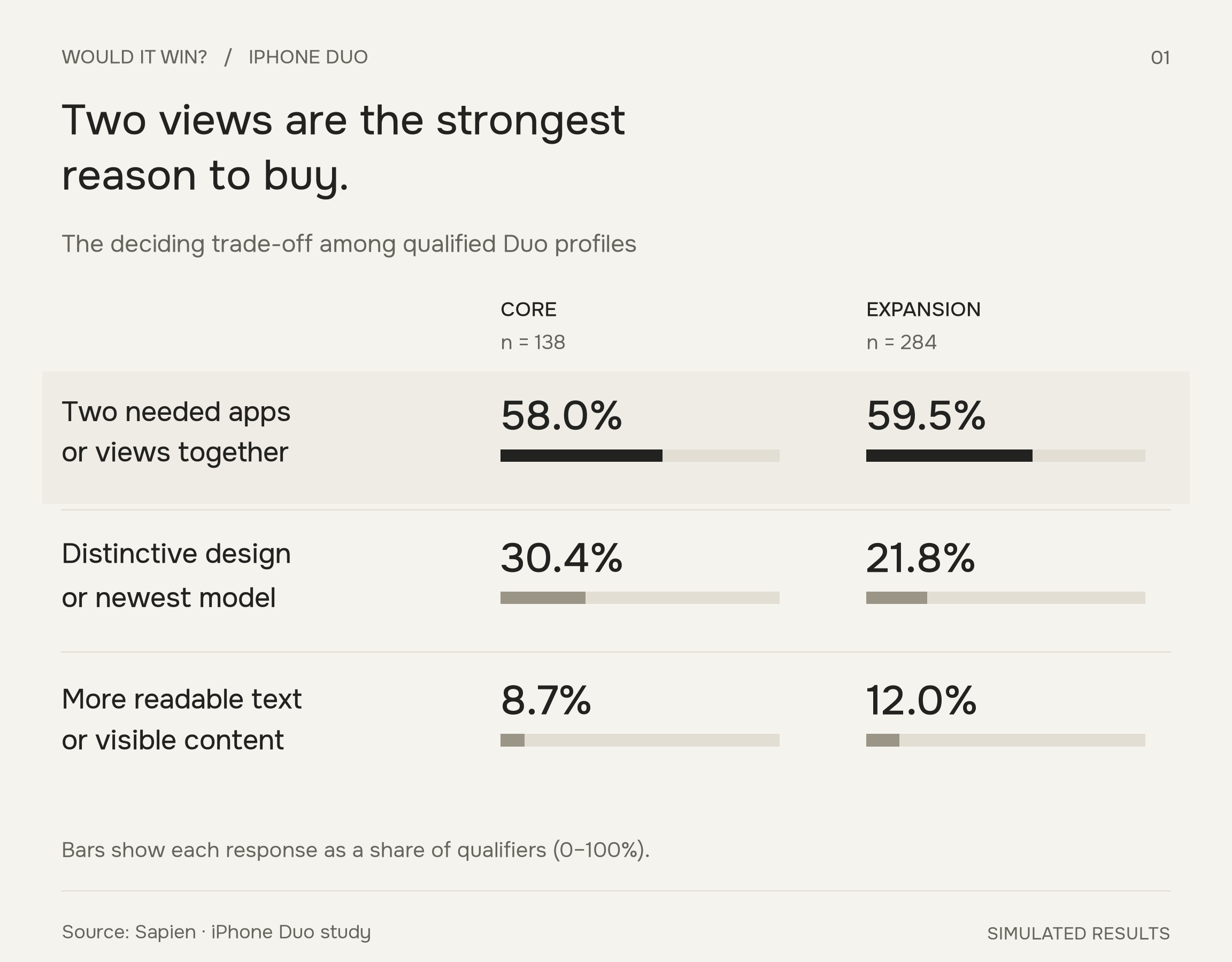
Qualified profiles: core n=138; expansion n=284. Smaller response categories omitted.
Novelty matters. The distinctive design or newest-model appeal was the deciding trade-off for roughly a fifth to a third of qualifiers. But practical use leads in both groups, including among the expansion cohort’s frequent premium upgraders: 59.0% of their qualifiers chose the two-view benefit.
Consider someone organizing a trip. An address arrives in a message. They switch to a map, then return to the conversation to confirm the time. The Duo’s promise becomes concrete when the map and conversation can stay visible together. At work, the equivalent might be a spreadsheet beside the email discussing its numbers.
For the launch, show that moment: the address arrives, the map stays open, and the conversation continues beside it. A buyer should be able to recognize the improvement from their own day.
Why most buyers would pass on the Duo
The dominant obstacles were remarkably similar across the two cohorts. Around half of the non-qualifiers who answered the obstacle question could not fund the offer. About 43% did not need to replace their phone.
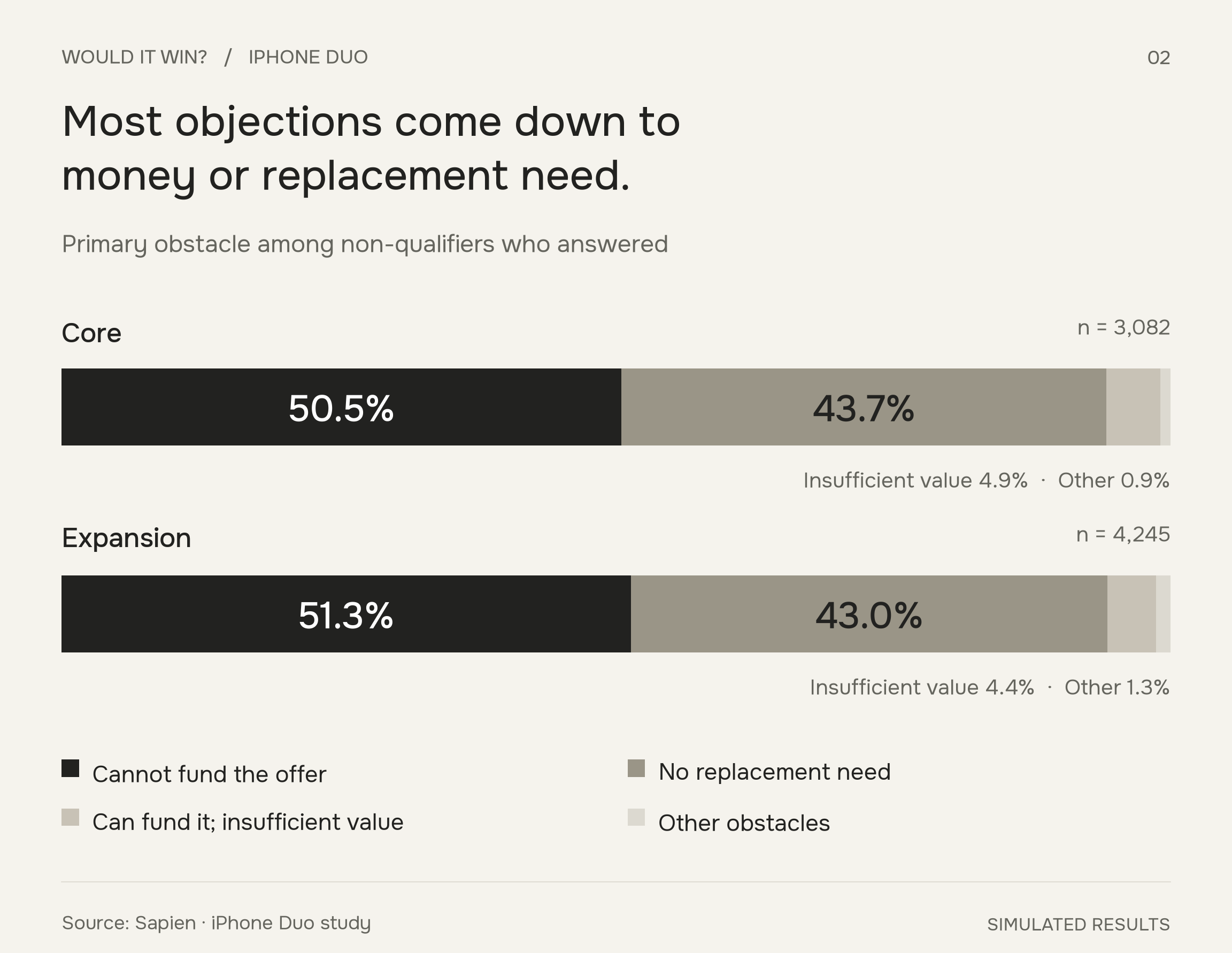
Non-qualifiers answering the obstacle question: core n=3,082; expansion n=4,245. Unresolved purchase outcomes excluded.
These barriers call for different responses. A customer whose funds fall short needs a different offer. A customer with a functioning phone needs a reason to replace it. A stronger demonstration may help with the second problem, but it cannot create the money needed to solve the first.
The sacrifice question makes the replacement problem particularly clear. 95.0% of core non-qualifiers and 94.5% of expansion non-qualifiers identified nothing they would give up by passing on the Duo.
For these buyers, keeping their current phone feels like an easy choice. The upgrade has to solve a problem they would actually miss having solved.
Android non-qualifiers reported a similar pattern: funding and replacement need dominated. Ecosystem switching was not their main stated obstacle. That matters when considering how Apple might reach people who have not adopted an existing foldable.
Which foldable features actually change the decision?
Across the full cohorts, side-by-side apps was the favorite distinctive capability for 74.1% of core profiles and 73.6% of expansion profiles. Hands-free FaceTime and the outer-camera preview attracted much smaller shares.
Yet qualification among people who favored side-by-side apps was just 3.1% in the core cohort and 4.9% in the expansion cohort, close to the respective cohort averages.
That distinction matters when choosing what to build. Side-by-side apps can be the best thing about the Duo without making the whole phone worth $1,999. A favorite-feature question helps shape the product; the purchase decision tests the offer.
The study also changed the product itself. In the report’s randomized capability-removal tests, removing side-by-side apps was the only removal reported to move modeled demand beyond its uncertainty range. Removing hands-free FaceTime or the outer-camera preview barely changed qualification.
A separate format-and-availability experiment covered 4,000 profiles. Repackaging the physical format reduced qualification to roughly a third of the reference rate; changing availability barely moved it. These comparisons apply to the exact packages tested.
That gives the product team a reason to protect the book-style format and the two-view workflow before adding more extras. The remaining messaging test is whether a demonstration of that everyday use increases qualification compared with other launch messages.
How price changes foldable iPhone demand
The study tested price using a separate matched 256GB offer menu. Each profile received one lower-price comparison, either $1,799 or $1,599, alongside a $1,999 decision under the same menu.
At $1,599, qualification increased from 5.52% to 11.27% in the core comparison and from 6.18% to 12.50% in the expansion comparison. That is roughly twice the starting rate in each cohort.
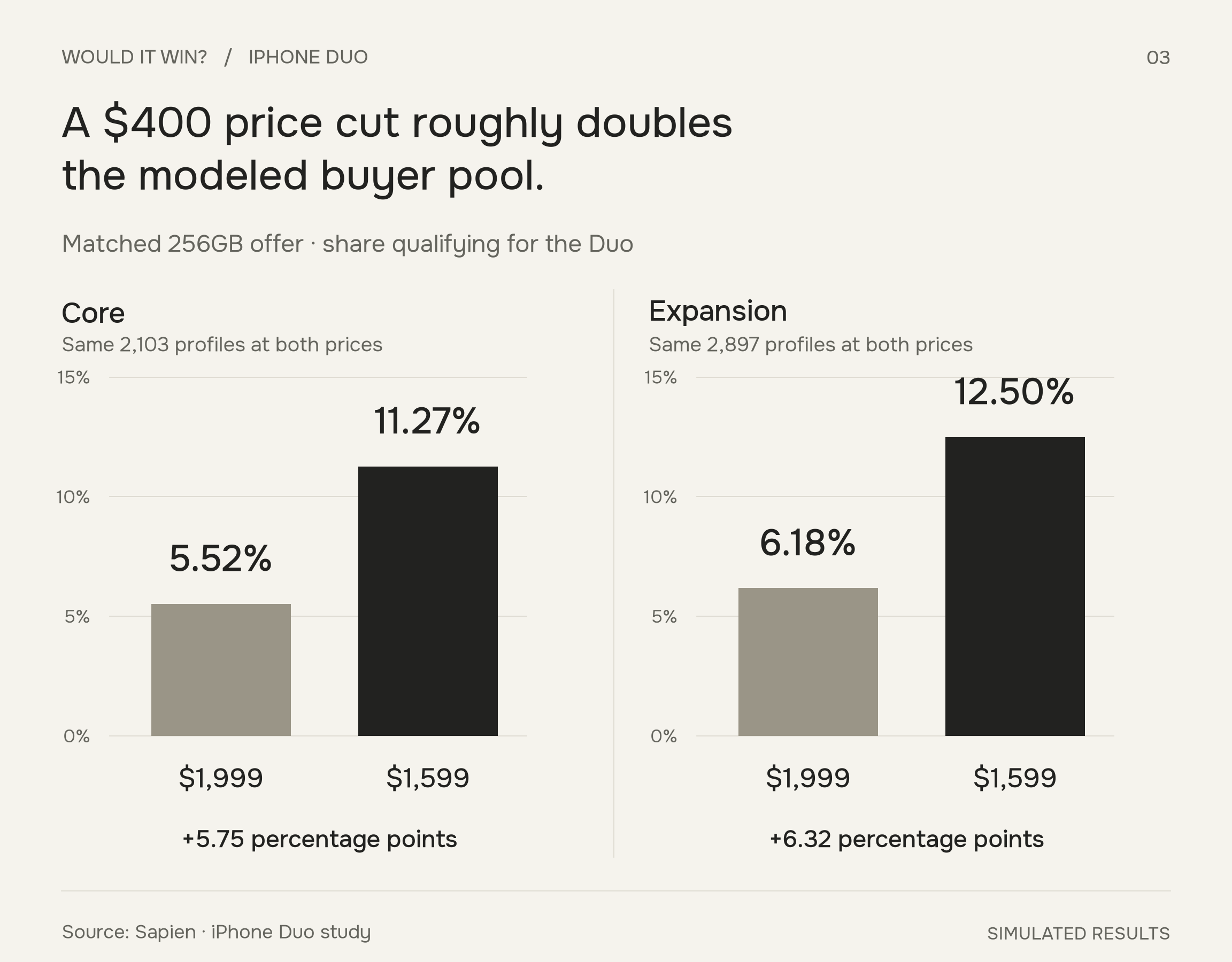
Core n=2,103; expansion n=2,897. Each panel compares the same assigned profiles at two prices. Matched-menu outcomes are separate from the main offer.
The smaller reduction to $1,799 also raised qualification: from 7.06% to 8.97% in its core comparison and from 6.03% to 9.92% in its expansion comparison. Those comparisons used separate assigned groups of 2,097 and 2,903 profiles, so each lower price must be read against its own $1,999 baseline.
The effect reaches beyond habitual premium upgraders. In the expansion cohort’s $1,599 comparison, qualification among profiles outside that group rose from 6.0% to 12.3%. Frequent premium upgraders went from 6.4% to 12.8%.
This changes the launch audience as well as its size. An offer designed only around habitual premium upgraders could miss people who become interested once the price falls.
Android users also qualified in the matched menu, including at $1,999, and qualification increased at lower prices. The main offer’s zero-Android result therefore points to a problem with that offer; it does not rule Android users out of the market.
A team considering $1,599 would need to weigh that larger audience against the margin it gives up. The study identifies a promising offer to evaluate. It also leaves a practical challenge intact: a cheaper upgrade still needs a reason to happen.
A Duo sale may be an iPhone sale moved up the lineup
A launch team also needs to know what a new sale replaces. We examined what Duo qualifiers would have chosen if the Duo were unavailable.
63.8% of core qualifiers and 56.7% of expansion qualifiers would have bought another iPhone anyway. Much of the identified demand therefore comes from customers Apple was already positioned to retain.
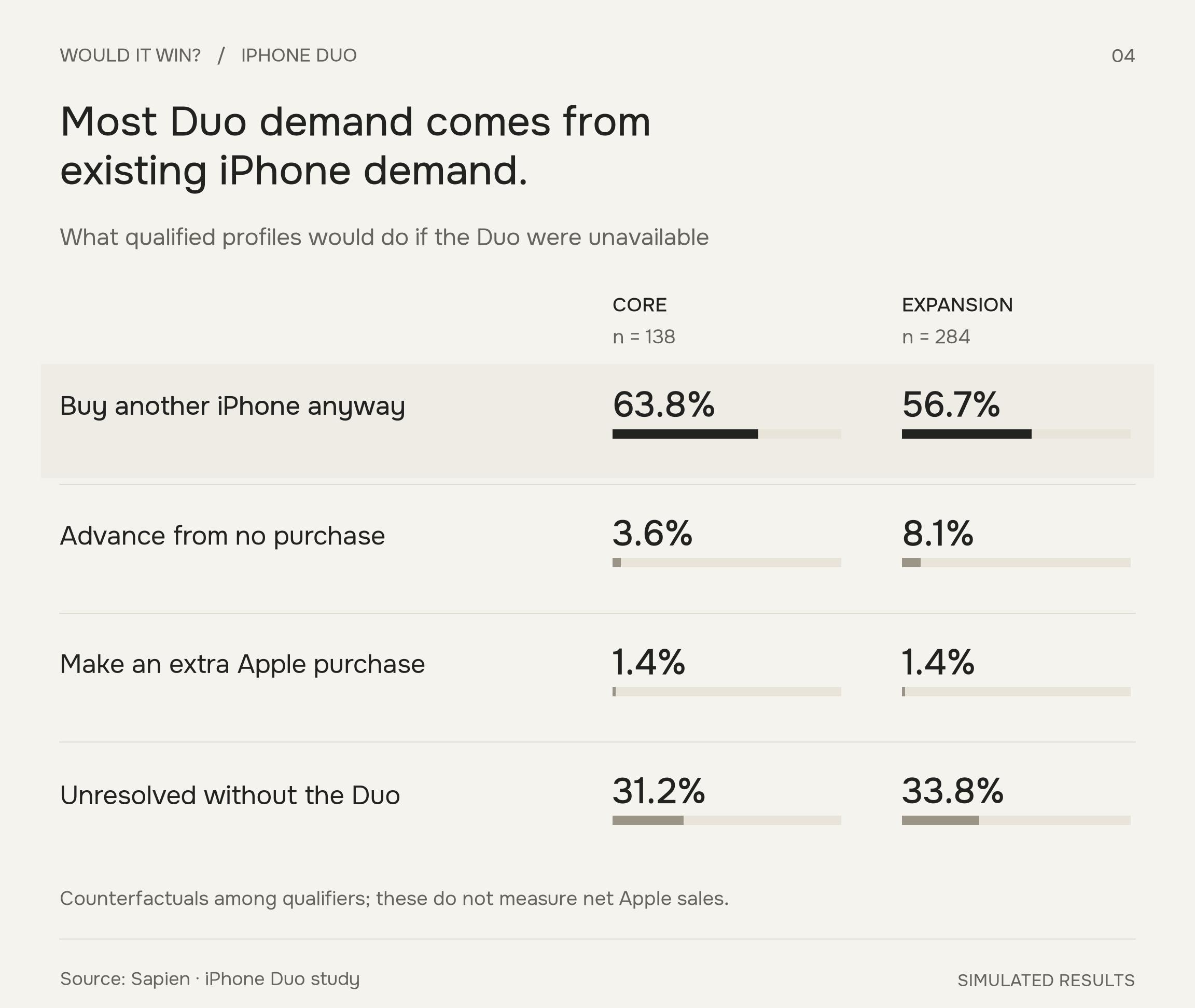
Qualified profiles: core n=138; expansion n=284. Rounded shares may not sum to 100%.
A smaller share was advanced from making no purchase: 3.6% in the core cohort and 8.1% in the expansion cohort. An extra Apple purchase beyond baseline came from just 2 of 138 core qualifiers and 4 of 284 expansion qualifiers, about 1.4% in each. That is a handful of modeled cases. Roughly a third remained unresolved without the Duo.
A more valuable upgrade could still be good business for Apple. The team would need to evaluate it as a premium sale within the lineup, with much of the volume replacing another iPhone purchase. These choices among Duo qualifiers do not measure the net change in total Apple sales.
That makes the current iPhone central to the launch demonstration. Show what an owner gains by upgrading and why that gain deserves the premium.
The Would It Win? verdict
At $1,999, pursue the premium iPhone buyer. The strongest starting audience already uses iOS and has a recurring task that benefits from two views. Build the launch around that task. Evaluate success through the value of the upgrade, including how much demand moves from other iPhones.
For a broader audience, change the offer. The $1,599 comparisons roughly double modeled qualification in both cohorts and bring more buyers beyond frequent premium upgraders into reach. Carry that price into the next product and margin evaluation, while protecting the book-style format and two-view experience.
The next marketing test should compare a concrete two-view demonstration with other launch messages at a matched offer. The feature and price experiments already point to what to protect and which lower-price offer deserves a margin evaluation.
At $1,999, “my current phone is fine” is the decision the Duo has to change.
About the research
Source materials: iPhone Duo: Conditional Demand in the Tested Scenarios, v2 and Sapien’s respondent-level CSV export. The report’s downloadable data dates the study to September 13, 2026. Results are unweighted within each stated cohort and question base. They describe modeled decisions under the tested conditions rather than observed purchases or a national sales forecast.
We report the core and expansion cohorts separately. Each matched price comparison uses its own assigned group and $1,999 baseline. Capability and format comparisons follow the report’s detailed experimental notes; buyer reasons and feature preferences describe the choices made in these scenarios.
For the approach behind these modeled choices, see how Sapien works and synthetic research. Sapien’s validation work covers separate benchmarks against real outcomes.
Related research
AI market research tools · Market research services
Get the iPhone Duo research report
Explore the study questions, population results and methodological notes behind the analysis. Enter your name and work email to get the PDF.