Market research: choose the study that changes your next move
Market research studies customers, competitors and market conditions to guide a business decision. Start with the commitment you can change, then choose the evidence that could change it.
Market research studies customers, competitors and market conditions to guide a business decision. Start with the commitment you can change, then choose the evidence that could change it.
The expensive mistake is often asking a good research question at the wrong point in the decision. A launch team measures enthusiasm before buyers understand the offer. A local business counts households before learning why repairs are abandoned. A marketing team asks which headline people like when the buying obstacle is an unavailable service. The results can be accurately reported and still leave the business choosing in the dark.
Market research becomes useful when the team agrees what could change. It can redirect the product, explain a buying obstacle, narrow an audience or stop a commitment that no longer makes sense. This guide follows two fictional teaching decisions—a repair-service expansion and a lunchbox prototype—to show that reasoning from the first question to the next business move.
Start with the commitment you can still change
Write the decision as a choice between feasible actions. “Understand customers” leaves almost any answer relevant. “Choose collection or a second repair location” tells the team what needs to be learned. Include doing nothing or making a smaller change: research is more valuable when its answer can reduce the commitment as well as accelerate it.
Which obstacle should the repair business solve?
Repair stopped.
Episode diagnosis | Compare next | Commitment changed |
|---|---|---|
Transport prevents the repair | Complete collection offer versus drop-off | Pilot a reachable collection route |
Saturday window cannot be used | Another feasible window at matched terms | Revise the service hours |
Repair value is too low | Quote and eligible-item scope | Reconsider collection or expansion |
Worked research design. These are alternative diagnoses to investigate, not findings about an actual repair market.
Next identify the costly assumption. For the repair business, opening another location assumes customers need a nearby place. Collection assumes moving the appliance is the obstacle. Both could be wrong if the repair quote makes replacement a better option. Those three explanations send the business toward different investments.
Choose evidence that separates those explanations before comparing polished solutions. An interview about the last repair can reveal where a decision stopped. Existing inquiry records can locate requests and recorded refusals. A complete-offer comparison can expose an unusable collection window. Actual bookings and route effort decide whether the selected service belongs in the operating model.
Use this navigator to identify the evidence you need. These are starting points; complicated decisions often require more than one method.
Decision | First question | Useful evidence | What it cannot settle alone |
|---|---|---|---|
Enter a market | Is there a reachable unmet need? | Secondary category data, buyer interviews, channel evidence | Your eventual market share |
Develop a concept | Does the proposition solve a recognizable problem? | Concept exposure, comprehension and relevance questions | Product performance or actual purchase |
Change pricing | Which tradeoffs do buyers make? | Price research alongside costs and observed sales | Revenue from stated willingness alone |
Choose a message | What do people understand and believe? | Message tests with specific stimuli | Conversion lift without an experiment |
Prioritize audiences | Which needs require different offers? | Segmentation analysis and behavioral validation | A permanent taxonomy of all customers |
Fix an experience | Where does the task fail? | Observed task sessions, support records and interviews | The frequency of every problem |
Explore concept testing, pricing research and message testing when one of these decisions is yours.
Work the repair decision all the way to a pilot
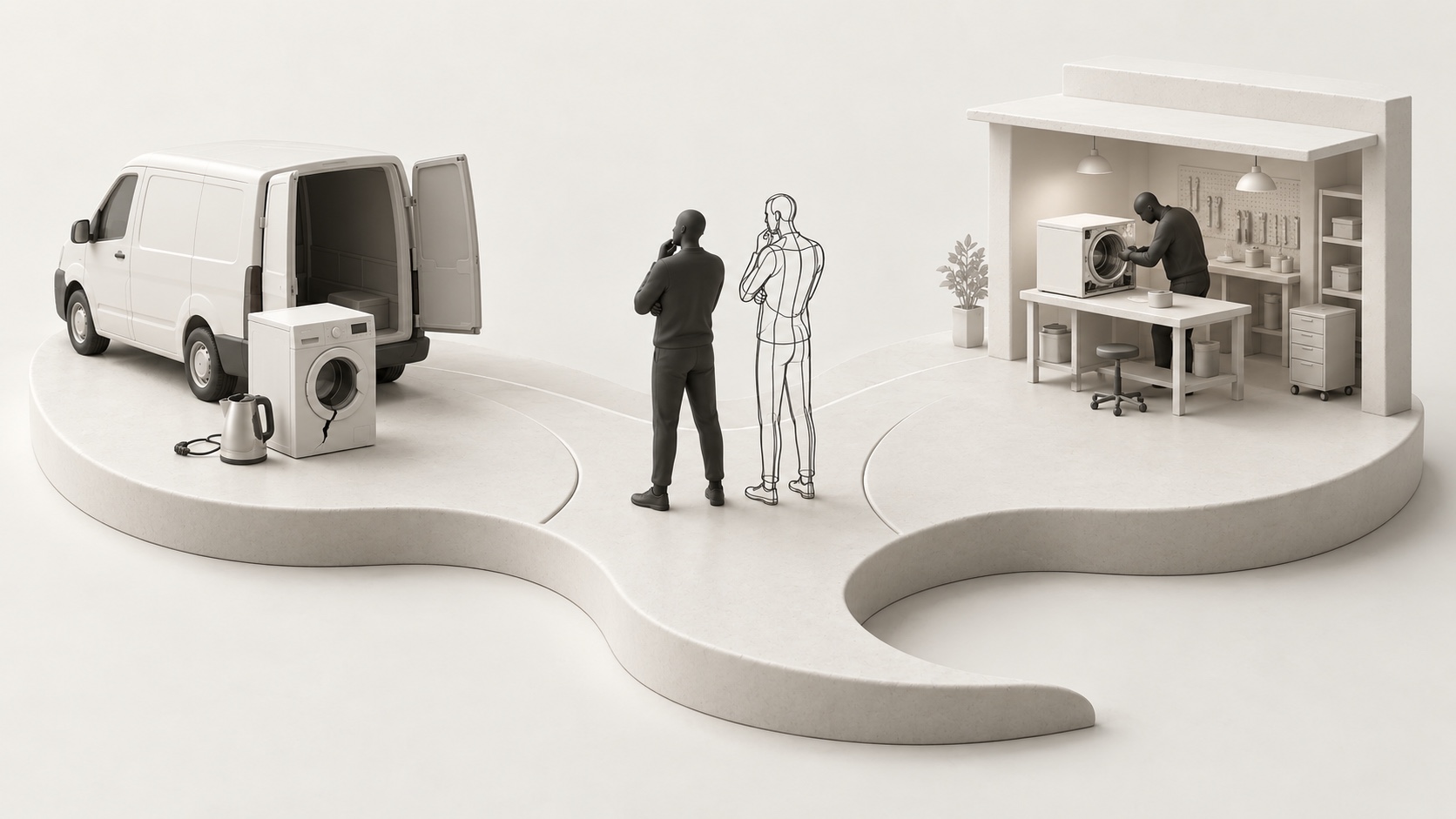
The starting choice. The shop is considering another location because some customers cannot bring appliances in. Before committing to premises, it asks whether a bounded collection service could address the same problem. The study concerns recent repair attempts in a reachable area, including abandoned attempts and customers who chose alternatives.
What existing evidence answers. Demographic and business sources describe the area. Competitor websites show listed services and conditions. The shop’s inquiries show people who reached it, the items involved and the outcomes it recorded. Together they can narrow the service zone and recruiting route. They cannot tell the shop why every unbooked repair was abandoned, especially when the inquiry reason is missing.
The missing customer evidence. Reconstruct the last episode before showing collection: what broke, why repair was considered, what providers or replacements were evaluated, how the item would have been moved and what happened next. A customer who could not borrow a car has a transport problem. A customer whose quote exceeded replacement value has an economic problem. Recording both as “wanted convenience” loses the distinction the expansion decision needs.
Seek a contrasting successful episode. A buyer may have solved transport by combining the repair trip with another errand. That case can reveal a workable route, while an abandoned episode may show a particular item type or window that the current service cannot accommodate. The goal is an explanation specific enough to choose a feasible offer.
Define the offer before asking whether it helps. The collection offer covers eligible small household appliances in Zone A, Saturday 9 a.m.–noon, for a proposed USD 8 collection fee. Compare that complete offer with the current drop-off route. Ask which condition makes the option useful or unusable. A person who benefits from transport relief but works Saturday morning is evidence for a window problem, rather than a clean booking prospect.
Make the study change the next move. If episodes point to transport and buyers can use the complete offer, take collection into a bounded booking pilot. If the window is the barrier, compare another feasible time. If repair value is the problem, revisit quote and eligible-item scope before investing in collection. If the shop cannot deliver the route at acceptable effort, stop that version even when customers like it.
Evaluate the pilot as a business. Record eligible inquiries, complete offer exposure, bookings, completed collections, cancellations and route effort. Use actual staffing, transport and handling costs. The USD 8 fee is an offer input, not evidence of profit. A busy route can still be the wrong service if it consumes the capacity needed for valuable repair work.
The finished recommendation is therefore conditional in a useful way: pilot one deliverable service before deciding on a permanent second location. The conditions specify the operating gate; they do not leave the team with an indefinite request for “more research.”
Use the method labels to specify an output
A few distinctions prevent expensive mismatches. Primary research collects new evidence for the current question; secondary research uses evidence already collected. Start with existing sources when they can narrow the unknown, then commission the missing customer or product evidence.
Qualitative research investigates experiences, meanings and explanations. Ask for episode accounts, contrary cases and the reason an action follows. Quantitative research measures defined variables across a specified audience. Ask for the actual questions, valid bases and planned comparisons. Use qualitative work when the issue is unclear, and quantitative work when the defined pattern needs measuring.
Stated response concerns what people say under an exposure; observed behavior concerns what they do with an opportunity and real constraints. A message comparison can identify a misunderstood deadline. An assigned behavioral test can evaluate a revised message’s effect on buying. Neither needs to be dismissed, but the output must answer its own question.
The same applies to human and synthetic research. Sapien models audiences to compare products, prices and campaigns. Modeled reactions can help choose a candidate and explain its objections; they retain that provenance. Specify the audience grounding, alternatives and decision output. Ask for product testing or observed purchasing when those are the unresolved claims.
Surveys measure defined answers across a specified audience. Interviews investigate individual experiences; focus groups examine discussion and interaction. Observation records how a task is performed. Experiments compare outcomes under assigned conditions. Secondary research examines existing sources. These methods can serve product, pricing, brand, customer-experience or competitor questions; those applications are not mutually exclusive methods.
Choose among them with market research methodologies.
A product team uses the same logic differently
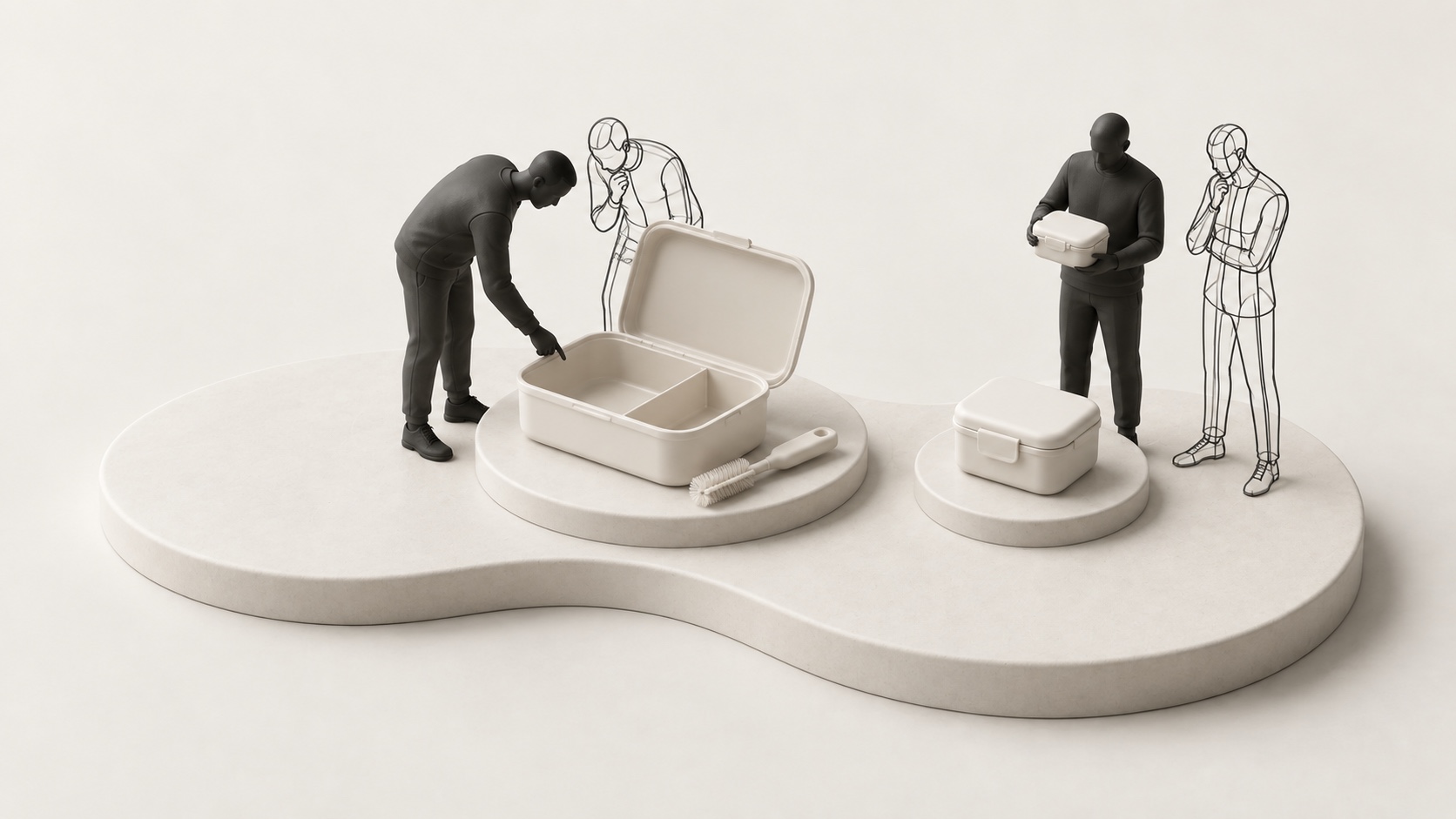
A fictional lunchbox comparison chooses between easy cleaning and compact carrying. The cards hold capacity, price and inclusions constant. The illustration requires at least four of six responses to understand the main benefit and four to rate it highly relevant. Those teaching thresholds demonstrate a decision rule; they are not commercial benchmarks.
Under the teaching rule, the easy-clean concept advances because it clears both comprehension and relevance gates. The compact-carrying concept clears comprehension but falls short on relevance. Investigate the carrying occasion and objections before choosing whether to change the audience, design or benefit.
The next prototype study answers a new question: does the rounded-corner interior actually make cleaning workable? The result of the concept study is a development brief, not proof of physical performance. This illustrates a common research sequence: define the promise, compare reactions, then test the mechanism that the selected promise depends on.
For a new venture, choose the uncertainty worth resolving before building. For an operating local business, connect the offer to a bounded pilot and operating records.
The category changes the evidence you need: food research separates concept appeal from sensory performance; ecommerce research separates a stated objection from observed checkout behavior; fashion research connects a complete garment offer to fit checks and inventory scenarios. Choose the application that matches your next commitment.
Buy a decision-ready study, then close it with an action
A useful supplier brief contains the action being chosen, audience and exclusions, alternatives or experience to study, primary measure, required explanations, delivery deadline and the decision owner. Make the output concrete: a comparison of complete offers, a coded journey with contrary cases, or an experiment readout with the observed outcome.
Use the size of the next commitment to judge how much evidence is needed. A sketch choice can proceed with exploratory evidence. Inventory, a public claim or a permanent location depends on different product, operating and buying facts. The worthwhile study is the one likely to change that commitment; buying every method in a sequence is unnecessary.
Ask a partner how it will reach or construct the audience, retain missing experiences, present bases and connect the results to a recommendation. Budget from actual recruitment, fieldwork, analysis and product-test requirements. Use the services guide for procurement and the SBA’s planning resources for existing market context.
Close the study with a decision memo: the finding that matters, the mechanism it suggests, the action chosen and the next unresolved outcome. A successful memo can say build A, compare a different window, revise the offer or stop. If every possible result produces the same recommendation, the study was never connected to a decision.
For a modeled concept, message, price or audience comparison, bring the decision to Sapien. Start with the alternatives and the people whose choice matters. The useful outcome is a specific direction and the evidence behind it.