How to do market research: from lunchbox brief to prototype decision
Follow a complete fictional market research study from exact concept cards and questions to inline response records, a decision rule and a memo.
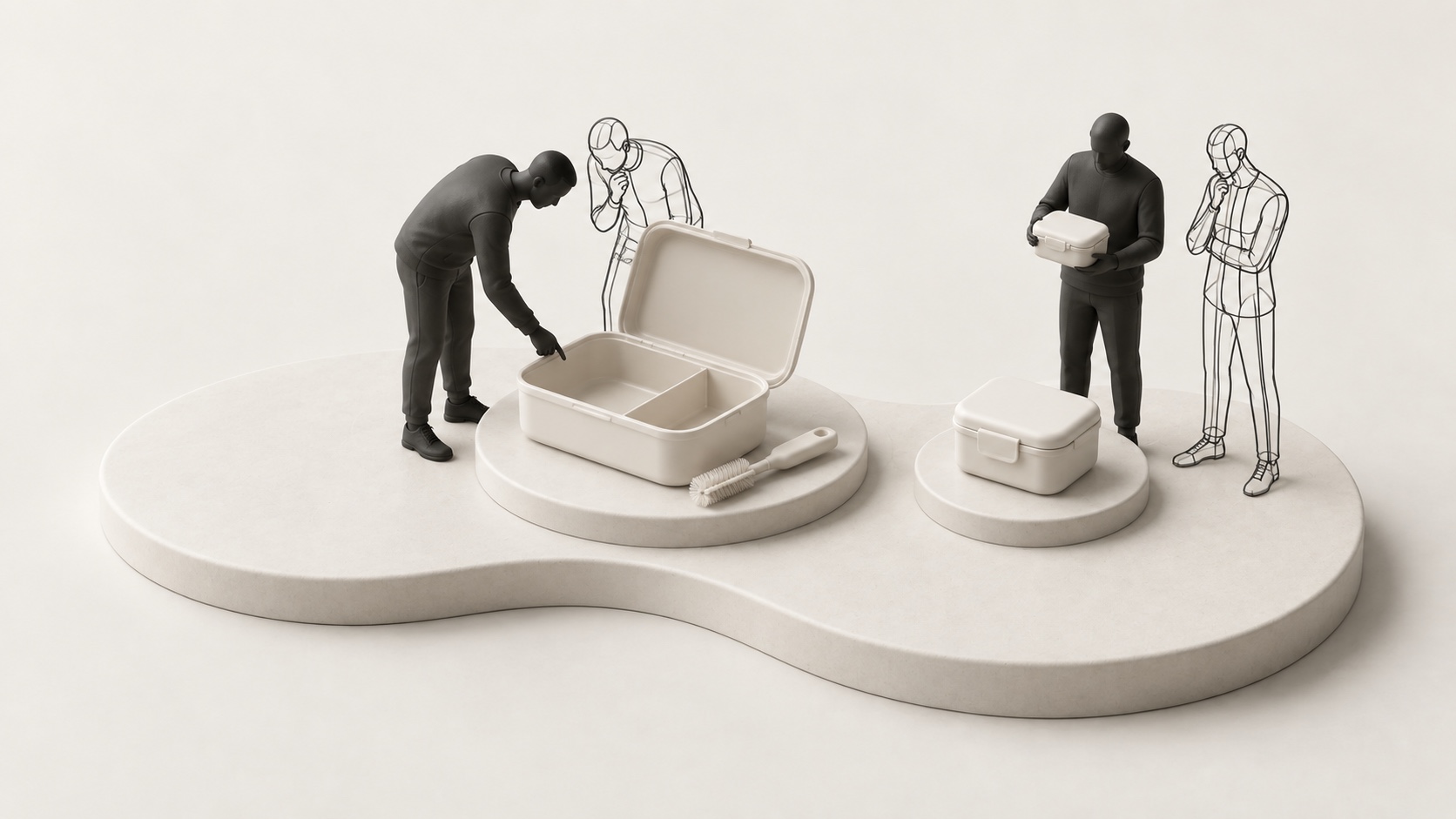
Imagine you sell reusable lunchboxes and need to choose a concept to prototype for adults who take lunch away from home. In the illustrative twelve-record study below, easy-clean A passes the declared gate. Follow how the team matches offers, distinguishes understanding from relevance and carries the selected benefit into a physical test. The complete cards and response records let you inspect that decision.
Set a prototype decision that two concepts can answer
Prototype brief: a reusable lunchbox seller must choose a concept to prototype. Concept A emphasizes an easy-clean interior; concept B emphasizes compact carrying. Both cost the same proposed price and have the same capacity. The audience is adults who take a packed lunch away from home at least twice a week.
The owner will advance a concept only if at least four of its six demonstration respondents describe its main benefit correctly and at least four rate relevance 4 or 5 on a five-point scale. Copy the structure of the gate, not the six-record sample or four-response cutoff. A real team sets a worthwhile decision difference and justified design before collection. These thresholds illustrate a prototype gate, not a validated commercial benchmark. A close result triggers revision rather than a winner announcement.
The two gates serve different purposes. Comprehension checks whether buyers respond to the intended proposition. Relevance checks whether that proposition matters in the lunch occasion. A concept that passes only one is not simply “second best”: it has a distinct problem to investigate.
Do not use purchase consideration as a third way to rescue a failed primary gate. It is a useful diagnostic about the displayed complete offer, while the current business commitment is a prototype. The study should let the team stop or revise a direction before it becomes an inventory decision.
Ask whether the person is an adult and how many days they took a packed lunch away from home in the past seven days. Include those reporting two or more days. Record recruitment separately from eligibility: passing a screen does not make an opt-in sample representative.
In this demonstration, twelve records are split into two independent groups of six. A real study would justify recruitment and sample size for its decision. A modeled study would instead disclose population grounding and validation relevant to this concept decision.
Prepare the exact offers, not two unequal pitches
Review returns, support messages and product reviews for cleaning and carrying problems. Record the exact source and period. Reviews can reveal vocabulary and failures; reviewers may differ from other buyers. Sales show purchases of existing products, not demand for an unbuilt concept.
Prepare comparable text-only cards with the same capacity, price and inclusions. The exact text-only cards are below; no image is shown. These are proposed unbuilt designs, so the descriptions do not establish actual physical performance.
Concept A card: “Easy-clean lunchbox concept. An 800 mL reusable lunchbox for packed lunches taken away from home. The proposed design has a smooth interior with rounded corners, intended to make cleaning after lunch easier. Includes one lunchbox and its lid; utensils are not included. Proposed price: USD 18, plus USD 3 delivery, total USD 21 before tax. This is an unbuilt concept; cleaning performance has not been verified.”
Concept B card: “Compact-carrying lunchbox concept. An 800 mL reusable lunchbox for packed lunches taken away from home. The proposed design folds down when empty, intended to reduce bulk when carrying it home. Includes one lunchbox and its lid; utensils are not included. Proposed price: USD 18, plus USD 3 delivery, total USD 21 before tax. This is an unbuilt concept; folding and carrying performance have not been verified.”
Each eligible person sees only their assigned card. The two groups evaluate whole concepts with different proposed mechanisms, rather than isolating the causal effect of a single word.
The same price and capacity remove obvious whole-offer differences, but the mechanisms still differ: rounded corners versus folding. The result chooses between those complete concepts. It does not estimate the effect of the adjective “easy” or prove folding is physically possible.
Review category evidence before writing the cards so the language reflects actual cleaning and carrying situations. Avoid supplying an unsupported performance result in the exposure: otherwise the response measures a promise the prototype may not deliver.
Collect an interpretation before prompting the benefit
Show one concept per person. Ask the first response before explaining the benefit again.
- In your own words, what is the main benefit this lunchbox offers?
- How relevant is that benefit to lunches you take away from home? 1 Not at all; 2 Slightly; 3 Moderately; 4 Very; 5 Extremely; Cannot judge.
- What, if anything, would prevent you from considering it?
- At the displayed price, how likely would you be to consider buying it when next replacing a lunchbox? Very unlikely; Somewhat unlikely; Neither; Somewhat likely; Very likely; Cannot judge.
- What information would you need before deciding?
- How do you currently carry your lunch? Lunchbox; Bag; Purchased meal; Another way; Prefer not to answer.
Keep the original response text. Code comprehension using a written rule: A must mention easier cleaning; B must mention easier carrying or reduced bulk. A vague “better lunchbox” response does not pass.
D04’s ‘Cleaner after lunch’ describes a cleaner outcome without saying that cleaning is easier, so it does not pass A’s stated comprehension rule.
The open answer is first because the response should reveal what the card communicated unaided. A checklist mentioning cleaning or reduced bulk would teach the very idea being measured. Keep exact wording and original text so the analyst can separate a broad favorable reaction from correct understanding.
Eligibility and recruitment are separate decisions. Someone can qualify as a frequent packed-lunch user without having been randomly selected. For a real commissioned comparison, specify the access route and intended inference, then choose the design and size around a difference that would matter to the prototype decision.
Read both gates together
Inspect all twelve response records or copy the complete study CSV.
The records contain the twelve benefit interpretations, comprehension codes, relevance ratings and consideration answers only; objection, information-needed and current-container responses are not supplied.
Read the declared gate beside the responses
Each concept needs at least 4/6 on both understanding and relevance rated 4 or 5. This gate serves the example’s prototype decision, not an industry benchmark.
Measure | Details |
|---|---|
Correct benefit interpretation | Concept A: 4/6 Concept B: 4/6 |
Relevance rated 4 or 5 | Concept A: 4/6 Concept B: 3/6 |
Somewhat or very likely to consider | Concept A: 4/6 Concept B: 3/6 |
All twelve response records
Each row has example_status=fictional. The original wording and accepted comprehension codes are preserved, including D04’s code of 0.
Record / concept | Original answer and coding |
|---|---|
D01 / A | Benefit interpretation: Easier to wash Comprehension pass (1=yes, 0=no): 1 Relevance, 1–5: 5 Consideration: Very likely |
D02 / A | Benefit interpretation: Cleaning takes less effort Comprehension pass (1=yes, 0=no): 1 Relevance, 1–5: 4 Consideration: Somewhat likely |
D03 / A | Benefit interpretation: No corners to scrub Comprehension pass (1=yes, 0=no): 1 Relevance, 1–5: 4 Consideration: Somewhat likely |
D04 / A | Benefit interpretation: Cleaner after lunch Comprehension pass (1=yes, 0=no): 0 Relevance, 1–5: 5 Consideration: Very likely |
D05 / A | Benefit interpretation: Easier washing Comprehension pass (1=yes, 0=no): 1 Relevance, 1–5: 3 Consideration: Neither |
D06 / A | Benefit interpretation: A better lunchbox Comprehension pass (1=yes, 0=no): 0 Relevance, 1–5: 2 Consideration: Somewhat unlikely |
D07 / B | Benefit interpretation: Takes less bag space Comprehension pass (1=yes, 0=no): 1 Relevance, 1–5: 5 Consideration: Very likely |
D08 / B | Benefit interpretation: Easy to carry Comprehension pass (1=yes, 0=no): 1 Relevance, 1–5: 4 Consideration: Somewhat likely |
D09 / B | Benefit interpretation: Less bulky Comprehension pass (1=yes, 0=no): 1 Relevance, 1–5: 4 Consideration: Somewhat likely |
D10 / B | Benefit interpretation: Compact carrying Comprehension pass (1=yes, 0=no): 1 Relevance, 1–5: 3 Consideration: Neither |
D11 / B | Benefit interpretation: Keeps lunch fresh Comprehension pass (1=yes, 0=no): 0 Relevance, 1–5: 2 Consideration: Somewhat unlikely |
D12 / B | Benefit interpretation: A nice lunchbox Comprehension pass (1=yes, 0=no): 0 Relevance, 1–5: 3 Consideration: Neither |
Copy the complete study CSV
record_id,concept,benefit_interpretation,comprehension_pass,relevance_1_to_5,consideration,example_status
D01,A,Easier to wash,1,5,Very likely,fictional
D02,A,Cleaning takes less effort,1,4,Somewhat likely,fictional
D03,A,No corners to scrub,1,4,Somewhat likely,fictional
D04,A,Cleaner after lunch,0,5,Very likely,fictional
D05,A,Easier washing,1,3,Neither,fictional
D06,A,A better lunchbox,0,2,Somewhat unlikely,fictional
D07,B,Takes less bag space,1,5,Very likely,fictional
D08,B,Easy to carry,1,4,Somewhat likely,fictional
D09,B,Less bulky,1,4,Somewhat likely,fictional
D10,B,Compact carrying,1,3,Neither,fictional
D11,B,Keeps lunch fresh,0,2,Somewhat unlikely,fictional
D12,B,A nice lunchbox,0,3,Neither,fictional
The counts follow the declared rules. These constructed records are too few to establish a market difference. Purchase consideration is not a forecast.
A’s 4/6 understanding and 4/6 relevance clear the declared rule. B’s 4/6 understanding and 3/6 relevance do not. This does not mean the compact concept has poor copy: most of its demonstration responses already identify compact carrying.
Look at the B objections with the carrying occasion. A person who leaves the empty lunchbox at work, carries a large bag or already uses a soft container may not need the proposed benefit. That is a hypothesis for another investigation, not an unsupported explanation for the responses outside its top two. Do not change the audience retrospectively to make the original gate pass.
Turn A into a physical task, and give B a different brief
Build A’s proposed 800 mL rounded-corner interior. Observe people packing, using and cleaning the physical prototype in the intended lunch occasion. Record the product version, residue or access difficulties and any new carrying problem. The team needs to learn whether the proposed mechanism works.
For B, investigate who has a genuine empty-lunchbox carrying problem and when it occurs. Use those accounts to decide whether to improve the design, change the audience or stop developing it. Carry forward the same USD 18 price plus USD 3 delivery and unchanged inclusions when testing a revised proposition.
The cleaning trial should use the intended lunch residues, product version and realistic access to washing. Observe where a person can reach, what remains and what other difficulty the design introduces. Define the product requirement with the team that will build it. A favorable description can select that task; only the built object can resolve it.
B needs an occasion diagnosis before a redesign. Find out when empty-container bulk matters and what the buyer currently does. If the mechanism is useful only for a narrower situation, compare that proposition with complete terms. If it does not solve a worthwhile problem, stop development rather than making the copy more persuasive.
Use the prototype result in a business plan
The lunchbox study can support a prototype decision inside a business plan. It cannot establish category size or forecast sales. Keep dated category and competitor evidence separate, identify the buyers and channel you can reach, and cost the actual product and route to market before making a launch commitment.
Close the study with a memo the product team can execute
Recommendation: prototype A because it passes both illustrative gates; investigate B’s relevance before deciding whether to change its benefit framing or target. Reason: A’s intended cleaning benefit is usually understood in these demonstration records. Risk: we have not tested whether the interior is actually easier to clean. Next evidence: observe use and cleaning of a physical prototype, then test a revised proposition with a justified audience design. Stop condition: the physical product fails the cleaning requirement or introduces another material problem.
Use our concept-testing methods guide to choose the exposure design and data analysis to inspect the result. Discuss a managed concept study with Sapien to compare the concepts, inspect how modeled buyers understand each benefit and receive a prototype recommendation. Supply complete cards, the intended population and the decision date; physical cleaning and carrying claims still require product testing.
Save the gate, stimuli and result together. The memo should survive handoff to manufacturing: it requests an 800 mL rounded-corner cleaning trial, not a vague “winning lunchbox.” When the physical test changes the design, update the concept before testing it again. That keeps the research attached to the product the team will actually sell.