Enterprise Survey Software: Six Platforms Compared
Compare six enterprise survey platforms through the people, permissions, sample budget and data handoff your research program needs.
Choose enterprise survey software by testing the complete study your teams need to run: build the questionnaire, reach eligible respondents, control access and deliver usable data. Qualtrics, SurveyMonkey Enterprise, Alchemer, QuestionPro, Forsta Decipher and Sogolytics provide six genuine survey-platform routes. The right shortlist depends on who will operate the program and how demanding its studies are.
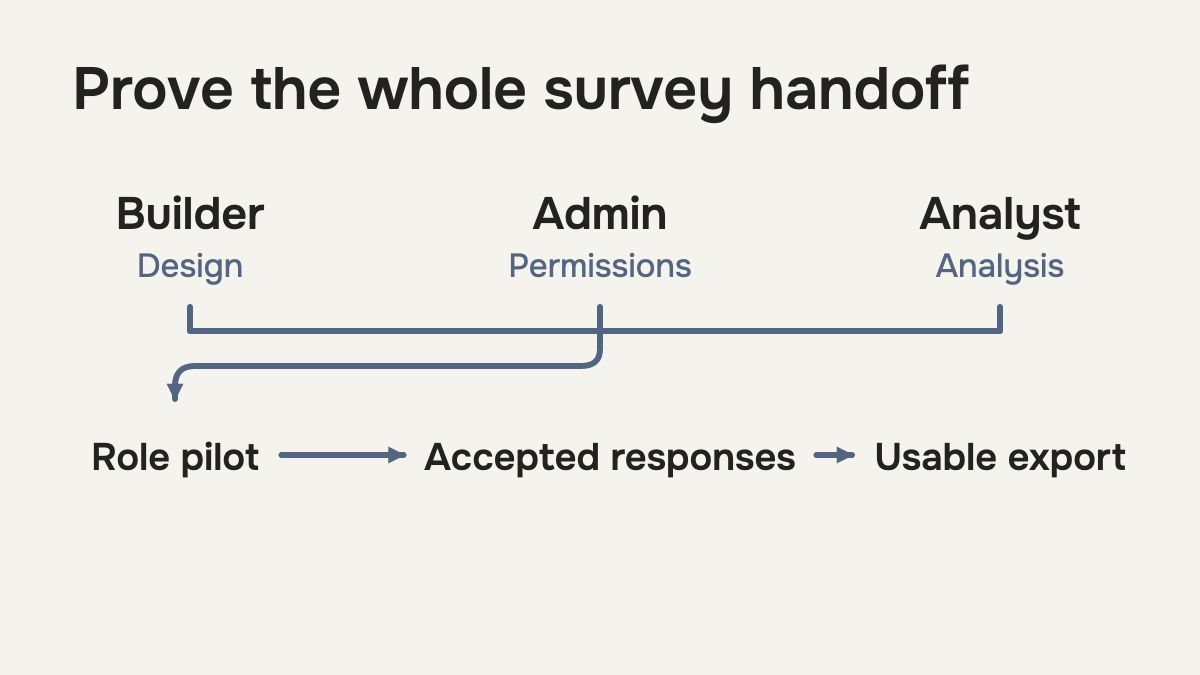
Start with three roles: the person who builds a survey, the person who administers the account and the person who uses its results. Their permissions and license needs can differ. A proposal that counts them all as “users” can hide both unnecessary seats and missing access.
Six enterprise survey platforms at a glance
This unranked comparison describes six purchasing routes. Product descriptions were checked November 7, 2026. Have the proposal identify the product, user licenses, response allowance, integrations and services included.
Platform | Program fit and the purchase to examine |
|---|---|
Central administration with delegated divisions and detailed permissions. Demonstrate who can distribute studies, see restricted response fields and export data under the proposed license. | |
A shared survey program with different creator and occasional-user needs. Where offered, compare Power and Casual seats against required actions, including exports and integrations. | |
Teams organizing surveys and data access by department, client or project. Price the licenses, then demonstrate the team assignments and roles that govern the work. | |
Research programs considering surveys alongside audience, communities and other research capabilities. Specify the Surveys & Research package, custom response pricing and the permissions each team needs. | |
Researchers programming complex quantitative studies. Evaluate drag-and-drop versus XML/Python work, advanced routing and quotas, and the people responsible for programming and checking them. | |
Programs that need to separate access to projects from visibility of particular records. Demonstrate the required sub-user types and data-visibility rules together. |
Qualtrics: separate the administrator, researcher and data user
Qualtrics documents permissions at organization, division and user levels. Divisions can have their own administrators; groups support sharing. Its permission reference also distinguishes viewing survey results from viewing restricted data. Disabling restricted-data access affects personal fields available in exports.
That is useful when an organization wants local study ownership with centrally defined controls. Give the vendor your actual role map, including a researcher who needs response data and a stakeholder who needs a report. Test the proposed configuration with both people. The research team still owns the questionnaire, eligibility rules and interpretation. Request the relevant research-platform proposal; a self-serve offer does not establish the price or entitlements of the wider program.
SurveyMonkey Enterprise: buy the actions each seat needs
Some SurveyMonkey Enterprise plans use Power and Casual seats. Their access to advanced questions, logic, integrations and analysis differs. Export rights also depend on the seat and how the survey was created or shared.
This makes a role-based purchasing exercise worthwhile. An occasional colleague who previews a questionnaire has a different requirement from an analyst who must export another team's responses. Demonstrate both before choosing the seat mix. Its Enterprise features include organizational administration and integration options, but the proposal should name the required configuration and connections. Purchased respondents are a separate decision: SurveyMonkey Audience orders are an add-on cost to the plan.
Alchemer: check the license, team and role together
Alchemer explains its access model as license, team and role. The license controls available features, the team determines which surveys and data a user can access, and the role determines the actions they can take. This is a concrete framework for assigning departmental research responsibilities.
For a program with several teams, test a survey's initial team assignment, a colleague joining the project and an analyst receiving its data. Alchemer's Business Platform documentation describes team permissions, advanced integrations and API access, plus dashboards spanning surveys. Advanced dashboard features can be optional add-ons. Specify whether the purchase covers collecting responses, building connected workflows, or both, and name who will maintain the integrations after launch.
QuestionPro: specify the research package and its owners
QuestionPro separates Surveys & Research from its customer- and employee-experience offerings. The current Research Suite listing uses requested pricing and a custom response allowance, with research capabilities extending beyond survey authoring.
Its custom-role documentation distinguishes permissions for user management, editing, distribution, analytics and integrations. This gives the procurement team something more precise to test than a claim that collaboration is included. Assign the researcher, fieldwork operator and integration owner their intended roles. If the proposal includes an audience or managed fieldwork, identify the recruitment, balancing and incentive work being purchased. The presence of those services on an enterprise product page does not settle the scope of your particular engagement.
Forsta Decipher: budget the programming work
Forsta positions Decipher around sophisticated quantitative research, with drag-and-drop or XML building, Python scripting, nested routing, quotas and loops. It is a relevant route when a dedicated research or programming team needs control over a complex instrument.
Use a real questionnaire in the demonstration. Include a quota intersection, an ineligible respondent path and a changed answer that affects later questions. Decide whether your team or a service partner will program and check it. Forsta's tier reference differentiates Enterprise allowances and API access from its smaller Now offering. Its API follows project permissions, so the integration operator's access belongs in the same review as the researchers' access.
Sogolytics: distinguish project access from record visibility
Sogolytics' Enterprise account description includes customized options and expanded support, with managed survey work and integrations available within its broader offer. Define which parts your researchers will operate and which services the vendor will deliver.
Its data-visibility documentation separates access to a project or dashboard from the records visible inside it. An important qualification is that these data-visibility rules apply to the Report Viewer sub-user type. If a regional colleague must both edit surveys and see only a regional subset, demonstrate that exact requirement. Do not infer it from a dashboard screenshot showing filtered data. Include the required user types, reporting access and services in the Enterprise proposal.
Give every vendor the same selection brief
Send a brief that describes the research program and the work around it. The following fields make proposals comparable without requiring every team to adopt the same research method.
Brief item | What to specify |
|---|---|
Decisions and studies | The decisions, survey types, countries, languages, frequency and instruments the program must support. Include one demanding questionnaire. |
People and access | Creators, administrators, analysts, report viewers and outside partners; SSO and account-provisioning requirements; who can launch, change, delete, share or export each project's data. |
Respondents | Customer lists, employee records or purchased sample; eligibility, quotas, incentives and the definition of an accepted complete. |
Data handoff | Required response-level export, question and value labels, missing-answer codes, respondent identifiers and destination system; hosting and retention requirements. |
Operating agreement | Named owners for design, programming, recruitment, checking, analysis, integrations and support; deadlines and included service hours. |
Then run one end-to-end pilot using test responses. Have the intended creator program the instrument, the analyst export it and the stakeholder open the report. Test a response path that should be excluded as well as a completed path. Change a permission and confirm that the change affects both the interface and the exported data as intended.
Your analyst should reconstruct one reported result from the export. Preserve multi-select answers, randomized versions, language and wave identifiers where they matter. A chart that looks right during the demonstration is insufficient if the underlying file cannot support the analysis your team needs.
Price the survey program and the sample separately
Build a demand estimate before comparing response allowances. As a planning example, three markets running four waves with 500 accepted completes per market per wave require 6,000 accepted completes. This is workload arithmetic, not a recommendation for sample size. Add the program's other studies and the rules for counting partials, tests and overages under each proposal.
That capacity estimate still leaves participant sourcing to resolve. A survey sent to existing customers uses a different recruitment route from a study of people who have never bought from you. Our panel-provider guide explains feasibility, source checks and accepted responses. Purchasing software does not establish that a niche audience is available.
Compare the annual platform commitment, creator and viewer licenses, response charges, participant incentives, recruitment, programming, translation, integrations and research support. Put implementation and renewal costs in the same comparison. Our market research pricing guide shows why a software subscription and a complete research engagement buy different work.
Questions to resolve before choosing a platform
Can we use one program across departments?
Yes, these vendors provide multi-user routes, but the operating design matters. Test project ownership, shared assets, departmental administration and the removal or reassignment of a departing employee. Specify who can authorize a new study and who can see identifiable responses. Give report-only stakeholders the access their work requires.
Does the platform choose a sound questionnaire for us?
Templates, advanced logic and AI drafting can help build an instrument. Your research team still needs to define the decision, stimulus, question wording and analysis. A perfectly programmed leading question remains leading. Our survey design guide connects the questions with the decision the answers should inform.
What should we prove about integrations and exports?
Name the destination, fields, refresh frequency and operator. Demonstrate one completed transfer and the handling of a corrected response. Check whether the connector is included, an add-on or a custom build, and who maintains it. Agree how the team will retrieve usable data at the end of the contract.
What if we are replacing an existing survey tool?
Carry one current instrument and its historical export through the pilot. Compare routing, response coding, languages and recurring reports before moving the program. Our SurveyMonkey alternatives guide examines that narrower tool-switching decision. An enterprise purchase also needs the cross-team permissions and operating responsibilities described here.
Where a managed modeled study fits
Sapien can complement this program when a team needs a defined comparison of products, prices, messages or offers using simulated audiences grounded in supporting data. Agree the audience, alternatives, evidence and returned decision output as a research engagement.
The survey program still needs a named administrator and a plan for human fieldwork. Keep modeled answers separate from newly collected human evidence, as our human-versus-synthetic respondent guide explains. Customer research can inform a simulated follow-up; it does not turn that output into another observed customer response.
Choose the platform your people can operate, govern and analyze through the pilot. Commission additional research for the questions that remain, with a named owner and an explicit evidence source.