Synthetic personas: model the buying situation that matters
Build synthetic profiles with sourced, derived, assumed and unknown fields. Copy an annotated schema and test how profile choices affect conclusions.
A synthetic persona is a modeled representation used to explore responses under specified information and assumptions. It can represent a buying situation without pretending to be an interviewed person. Record what is grounded, derived, assumed and unknown; validate the output your decision uses, such as a concept ranking or response distribution.
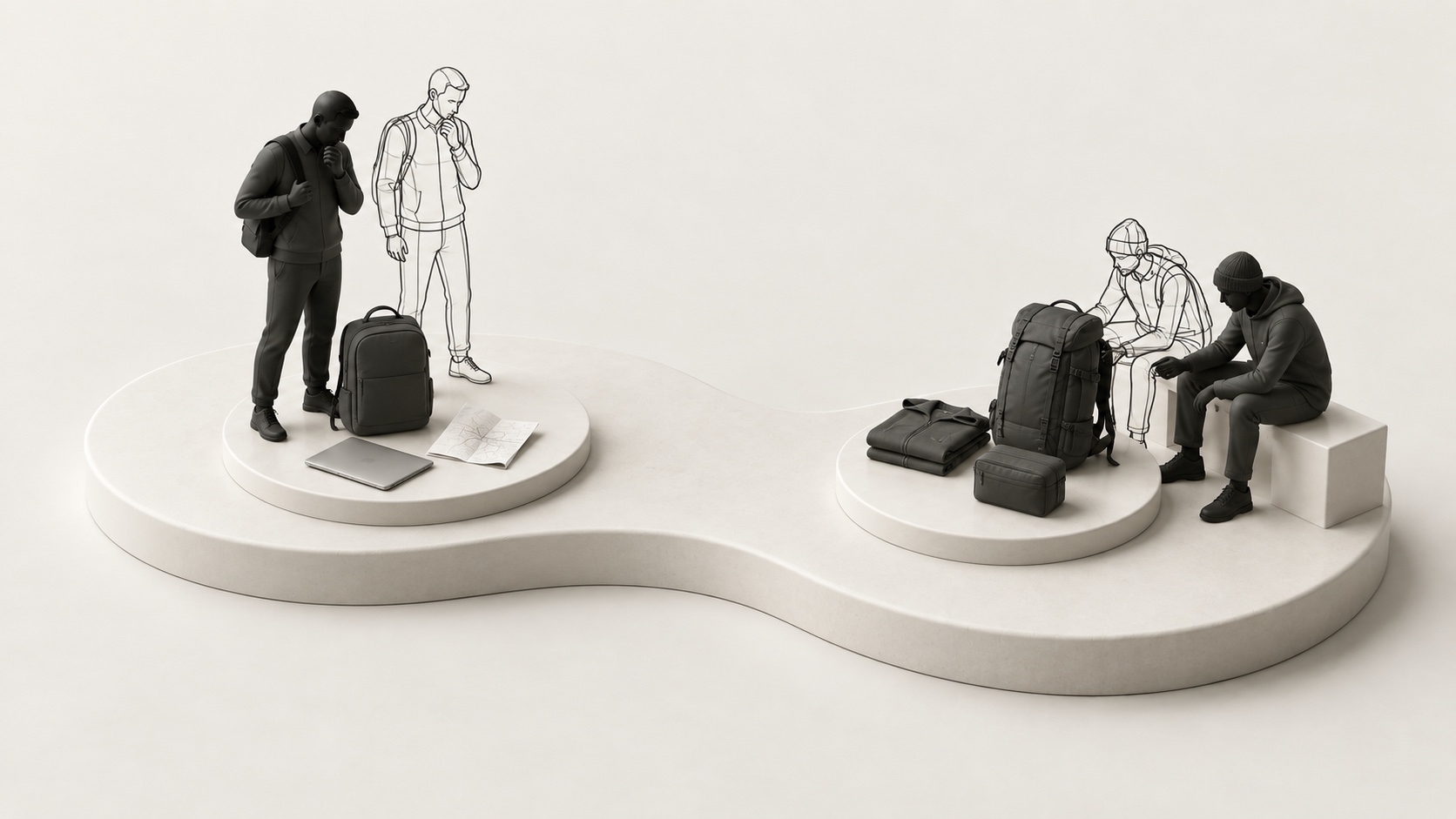
If you are developing a replacement backpack, compare the offer across the buying situations it must serve. One profile carries a laptop on the train; another packs for occasional weekend trips. You need to understand routines, space and required proof, rather than choose the more convincing biography.
Profile construction must keep those routines attached to evidence or clearly supplied scenarios. The example below uses authored source records. “Grounded” means traceable to that example, not to real human data. A damaged-backpack assumption can create a replacement need the records never establish. Checking that one input is more useful than decorating the profile with another page of imagined preferences.
Synthetic personas vs digital twins
A synthetic persona can be grounded in evidence; “digital twin” is also a label you need to inspect. For example, Dovetail describes its Digital Twins as models of customers and segments built from calls, tickets, surveys and research, with answers linked to those sources.
Compare what each representation models, which records it uses, how current they are and which output has been tested. For the backpack decision, evidence about existing customers may leave prospective commuters uncovered. Ask whether the model can support that audience and comparison before using either label as a reason to trust its answers.
Build the profile from relevant inputs
Field type | Details |
|---|---|
Grounded attribute | Meaning: Comes from an identified source with permission and applicable scope Example in the commuter profile: Backpack category traced to the example interview record |
Derived field | Meaning: Calculated or coded from identified evidence Example in the commuter profile: Two backpack purchases counted within the dated record window |
Assumption | Meaning: Added to define a scenario Example in the commuter profile: “Considering replacing a damaged backpack” |
Unknown | Meaning: Information the sources do not establish Example in the commuter profile: Unrecorded household spending priorities |
A population statistic can ground a distribution without establishing an individual fact. If 30% of an audience reports a behavior, you cannot append that behavior to every persona and still claim to represent the audience. Similarly, a demographic category should not automatically determine beliefs, preferences or circumstances.
Inspect the editable construction example
The editable JSON profile demonstrates all four field types. A bag-category field points to an interview record in the example. A derived frequency counts transactions T2 and T3 within the year ending October 5, 2026 and excludes older T1, yielding two purchases. Neither establishes that the bag is damaged or that replacement is needed; that remains an explicit assumption. Last brand and price preference remain unknown because the fixture contains neither. Each field carries source, date and scope, alongside permitted tasks and unsupported conclusions.
Copy the complete annotated profile
Copy this JSON as N079-persona-schema.json to adapt the construction example. Keep the source records, date window, field statuses, null values and unsupported conclusions attached to the fields they qualify.
{
  "example_status": "Fictional teaching profile; not a customer record or Sapien implementation",
  "profile_id": "fictional-commuter-01",
  "representation": "invented individual scenario",
  "fields": {
    "commute_mode": {
      "value": "public transit",
      "status": "assumption",
      "source": "fictional scenario author",
      "date": "2026-10-04",
      "scope": "this scenario only"
    },
    "bag_use": {
      "value": "carries a laptop",
      "status": "assumption",
      "source": "fictional scenario author",
      "date": "2026-10-04",
      "scope": "this scenario only"
    },
    "replacement_occasion": {
      "value": "existing bag damaged",
      "status": "assumption",
      "source": "fictional scenario author",
      "date": "2026-10-04",
      "scope": "vary in sensitivity test"
    },
    "last_brand": {
      "value": null,
      "status": "unknown",
      "source": null,
      "date": null,
      "scope": "must not be invented"
    },
    "price_preference": {
      "value": null,
      "status": "unknown",
      "source": null,
      "date": null,
      "scope": "must not be inferred from commute mode"
    },
    "current_bag_category": {
      "value": "backpack",
      "status": "grounded",
      "source": "fixture-interview-01",
      "source_path": "facts.current_bag_category",
      "date": "2026-10-04",
      "scope": "Traceable to an invented interview fixture; not a real customer fact."
    },
    "backpack_purchases_last_365_days": {
      "value": 2,
      "status": "derived",
      "source": "fixture-transactions-01",
      "source_path": "transactions",
      "date": "2026-10-05",
      "derivation": {
        "operation": "count category=backpack transactions with 2025-10-05 < date <= 2026-10-05",
        "included_ids": [
          "T2",
          "T3"
        ],
        "excluded_ids": [
          "T1"
        ]
      },
      "scope": "Computed from invented records only; does not establish population frequency or active replacement need."
    }
  },
  "permitted_teaching_task": "Compare reactions to explicitly described backpack concepts",
  "unsupported_conclusions": [
    "Human population prevalence",
    "Physical comfort",
    "Observed purchases",
    "Individual prediction accuracy"
  ],
  "run_log_fields": [
    "profile_version",
    "prompt_version",
    "stimulus_version",
    "model_identifier",
    "run_identifier",
    "output",
    "review_notes"
  ],
  "schema_version": "teaching-v2",
  "provenance_notice": "Every source record below is invented. Grounded and derived describe traceability within this fictional fixture, not real human evidence or actual Sapien grounding.",
  "reference_date": "2026-10-05",
  "source_records": {
    "fixture-interview-01": {
      "record_status": "invented teaching record",
      "recorded_date": "2026-10-04",
      "facts": {
        "current_bag_category": "backpack"
      },
      "permission_scope": "fictional fixture only; no real personal data"
    },
    "fixture-transactions-01": {
      "record_status": "invented teaching records",
      "transactions": [
        {
          "transaction_id": "T1",
          "date": "2025-03-10",
          "category": "backpack"
        },
        {
          "transaction_id": "T2",
          "date": "2025-11-20",
          "category": "backpack"
        },
        {
          "transaction_id": "T3",
          "date": "2026-07-08",
          "category": "backpack"
        }
      ],
      "permission_scope": "fictional fixture only; no real personal data"
    }
  }
}
For a real project, give source records stable identifiers rather than copying unnecessary personal information into a prompt. Record how the audience was constructed, which information was omitted and whether the profile describes an individual, an aggregate segment or a supplied scenario. These are different objects and require different validation.
Research illustrates why grounding matters. The 2024 version of Park and colleagues’ agent study built representations of 1,052 people using qualitative interviews and evaluated them against those individuals’ responses. That design used substantial person-specific input. It does not establish that a short demographic sketch reproduces the same person or that a commercial persona has equivalent accuracy.
Check whether an assumption creates the answer
Use these probes on the backpack profile:
- Ask what is known about the last purchase. An acceptable answer can report the dated transaction fixture and its limits, but should preserve “unknown” for the last brand or unrecorded purchase details.
- Ask why the person prefers an expensive bag. The profile contains no established preference for expensive products, so the response should not treat one as a fact.
- Remove the assumption that the existing bag is damaged and repeat a replacement-interest question. A material change identifies dependence on that scenario assumption.
- Change only the order of two concept cards. Check whether the preferred offer changes and record the variation.
- Ask about an unavailable product detail, such as strap comfort. The response should distinguish expectations from physical experience.
- Inspect opposing and low-interest responses. A population that always endorses your concepts may be reflecting the prompt or selection process.
These probes reveal failure modes; passing them does not certify population validity. Keep a log of prompt, profile, model/version where available, stimulus and output so that a surprising result can be examined.
Validate the task, not the prose
Choose reference questions that match the intended decision. If the use case is comparing concept rankings, evaluate ranking agreement on held-out concepts and relevant audience groups. If it is estimating response shares, evaluate calibration and subgroup error against appropriate human reference evidence. A convincing explanation is not a substitute for either test.
Hold some evidence out of construction. If the same answers are used to build the persona and judge it, the exercise can reward reproduction of inputs rather than generalization. Report failures and changes caused by alternate plausible profiles, not just the closest match.
Build an audience with grounded variation
A persona is not a population weight. To compare audience distributions, define how the profiles vary, which combinations are grounded and what coverage is missing. Do not give every profile an assumed replacement need and then interpret the average as category demand. A sourced audience distribution can inform construction; it does not prove each individual's unobserved preference.
Evaluate the outcome the business will actually use. A profile might produce plausible explanations while failing to rank held-out concepts or estimate response shares. Report those as separate capabilities. Keep the reference answers outside construction and examine consequential subgroup failures before broadening the claim. The JSON schema helps you inspect construction; it does not independently validate the responses.
Use personas in a bounded research workflow
Compare the offer across relevant buying situations, then evaluate the output the decision depends on.
If the team will use concept rankings, check ranking agreement on held-out concepts and important audience groups. If it will use response shares, check calibration against an appropriate reference. Keep the editable profile as a construction tutorial; a population study needs grounded variation and coverage. Sapien’s team-run workflow builds a differentiated audience and returns comparisons, explanations and recommendations, rather than relying on one named profile as the market.
Synthetic profiles can support modeled comparisons of how different contexts affect an offer when construction and task-specific validation fit the decision. A single profile is a construction example; it is insufficient to describe a whole audience distribution. Preserve the difference between a modeled response, a reported human experience and an observed action when presenting findings.
For a broader comparison, Sapien uses differentiated, data-grounded modeled respondents in team-run research, returning response distributions, segment differences, explanations and recommendations. This single-profile example should not be treated as its research architecture. Request task-relevant methodology and validation evidence when commissioning. To assess fit, bring your audience definition, available evidence and decision to a Sapien introduction. For an experimental design, see our silicon sampling guide; for evidence choice, see our synthetic-versus-human-respondents guide.