Mixed methods research: combine the explanation with the measure
Mixed methods research connects explanations and measures around one decision. Use accounts to define variables, comparisons to locate patterns and contrasting cases to explain them. Show what each contributes to the action in a joint readout.
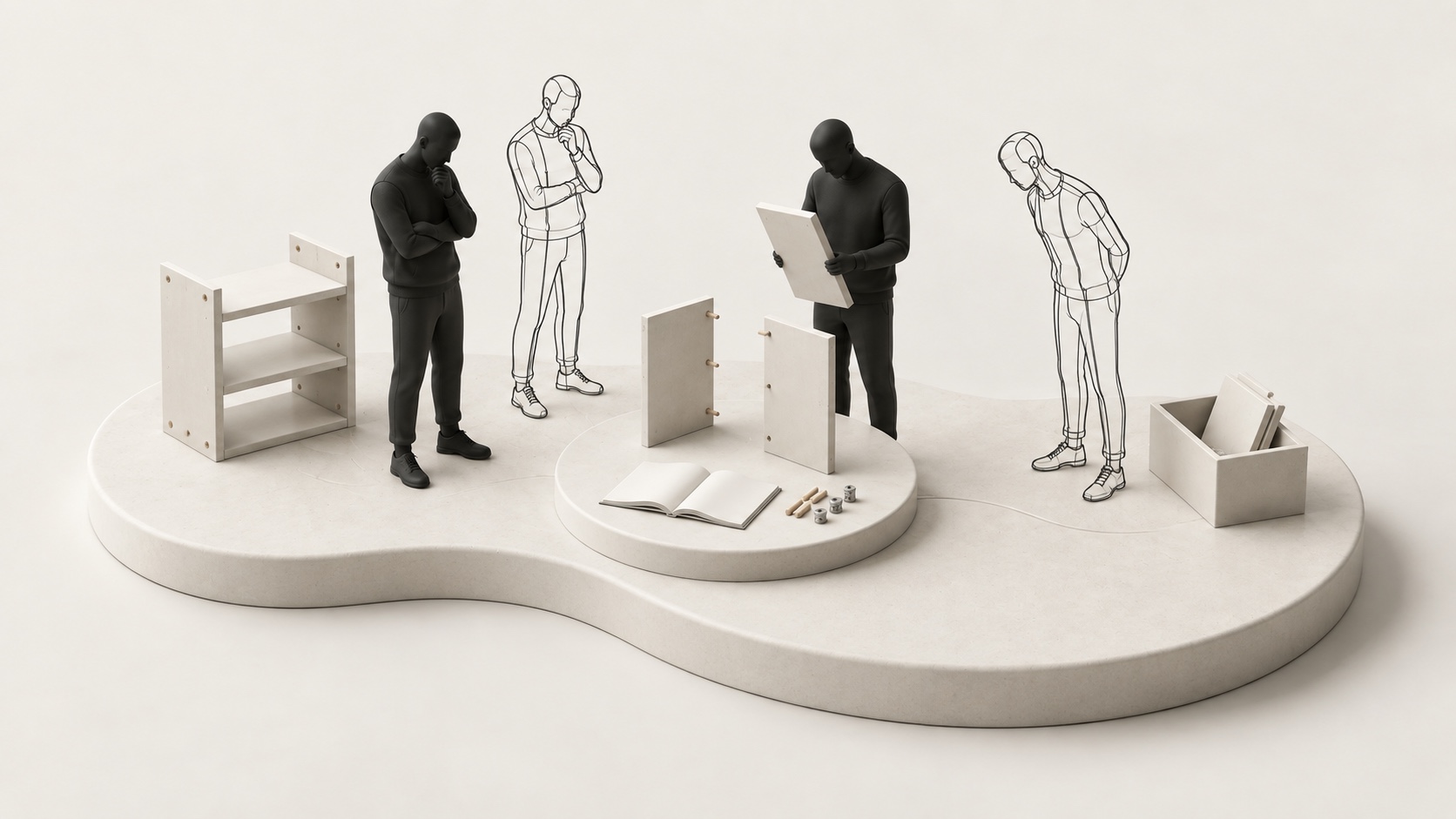
The storage seller should revise the orientation diagram and add a completion cue, then observe the revised assembly task. The evidence specifies the edit but does not prove fewer returns. This fictional mixed-methods example demonstrates how accounts, overlapping event measures and successful workarounds make the decision more precise.
Make “difficult assembly” specific enough to act on
A fictional home-storage seller wants to decide whether to change its assembly instructions. Return notes mention “difficult assembly,” but that phrase could mean confusing steps, missing parts or a physically demanding task. The decision requires both a concrete explanation and evidence about where the problem occurs.
The team first investigates recent assembly episodes. It then measures the discovered issues among a defined group and examines contradictory cases. The final action depends on the combined account, rather than the most persuasive quotation.
A satisfaction score would leave product unsure whether to change instructions, parts or physical design. Episodes can identify the step and mechanism. Defined questions can then measure the events the accounts describe. Mixing methods earns its cost when each supplies a missing input.
Convert an account into an event question
Interview customers who completed assembly, abandoned it and returned the product. Ask them to walk through the last attempt and show the instruction step where they stopped, if available. Record whether a problem was observed directly or described afterward.
In the fictional interviews, “orientation” and “missing confirmation” emerge as candidate issues. Translate each into a measurable event:
Qualitative idea | Measurement candidate | Avoid |
|---|---|---|
Unsure which way a panel faces | “During your last assembly, did you turn a panel around after attaching it?” | “Were the confusing instructions frustrating?” |
Unsure whether a step is complete | “Was there a step where you could not tell whether the parts were correctly attached?” | “Did you want better guidance?” |
Test whether people understand those questions. Discovery provides the options; it does not guarantee their completeness.
Turning a panel around is a concrete event, while confusing instructions is already an interpretation. Asking about the event avoids building the preferred explanation into the measure. The completion item similarly asks about uncertainty rather than demanding a vote for better guidance.
Preserve the overlap before discussing its meaning
For a fictional demonstration of 20 responses, eight report turning a panel around and six report uncertainty about a completed step. Four report both. That means ten report at least one issue: 8 + 6 − 4 = 10.
Fictional teaching data
The two assembly issues overlap
Partition | Records |
|---|---|
Orientation only | 4 |
Both | 4 |
Uncertainty only | 2 |
Neither | 10 |
Fictional twenty-record demonstration. Eight orientation reports plus six uncertainty reports minus four shared records gives ten reporting either.
Preserve recruitment, eligibility, item bases and missing responses. Do not add overlapping percentages or claim these invented counts estimate actual customer prevalence. In a real study, the sampling design would determine the scope of inference.
Four of the twenty records report both issues. Orientation-only therefore has four; uncertainty-only has two; both has four; neither has ten. Adding eight and six would count the four shared records twice.
This partition can help choose which experiences to follow up. It cannot show that either issue caused abandonment. Add the relevant task outcome and sequence when that claim matters, then use an appropriate design for causal attribution.
Use one joint display to change the instructions
Use a joint display instead of separate decks:
Question | Qualitative account | Quantitative result in the fictional demo | Combined interpretation | Next check |
|---|---|---|---|---|
Does panel orientation matter? | Several detailed wrong-way episodes | 8/20 report reorienting a panel | A concrete instruction issue worth testing | Observe revised diagram use |
Does uncertainty stop assembly? | One vivid abandonment account | Six report uncertainty, including completers | Uncertainty may be common without causing abandonment | Compare workarounds and task outcomes |
Are missing parts central? | One participant suspected missing parts | No direct parts inventory measure | Evidence cannot settle actual parts completeness | Inspect return and quality records |
When sources disagree, check audience, period and definition first. A remembered difficulty and an observed task failure measure different things. Seek cases that contradict the preferred interpretation rather than removing them.
The joint display places the account, measure and next action in the same row. It keeps missing-parts completeness as a gap for quality records, rather than making an interview suspicion settle a physical inventory fact.
A vivid abandonment story should meet the completers who also report uncertainty. Their workaround can show why the same event has a different consequence. That contrast directs what the revision should make easier and what to observe.
Distinguish disagreement from two different questions
A person can call assembly easy while describing a reversed panel because the correction was trivial. Preserve the event and the overall judgment separately. Ask whether it added meaningful time, effort or risk before treating the answer as inconsistent.
Use exploration-then-measurement when the issue is vague, measurement-then-explanation when a defined pattern needs a mechanism, or aligned parallel collection when the decision requires both by a date. Population, product version, period and event definition have to meet at the handoff.
A complete combined decision brief
Change: make panel orientation and step completion explicit. Audience/task: the relevant assembly experience using the recorded product and instruction version. Output: reversals, uncertainty, workarounds and task completion. Decision: retain or revise the new guidance from that observed test.
If a synthetic component contributes, give it a provenance column; modeled accounts and ratings can share assumptions. Use qualitative and quantitative methods and the worked decision memo for the handoff. Discuss a component with Sapien when modeled reactions can help refine the next design.
The physical instruction test records panel reversals, uncertainty, workaround and completion under the actual revised version. The team can then retain or revise the diagram and cue. A later returns claim requires the corresponding observed outcome and comparison.
If a modeled component helps define the candidate, retain its provenance in the display. Agreement between modeled accounts and modeled ratings can share assumptions; it is not the same as independent confirmation.
Continue with NIH design guidance.