Marketing to Gen Z: Channels, Strategies and Brand Examples
Build a strategy that earns attention, makes the product worth choosing and gives people a reason to come back.

Your campaign is getting comments. The video is being shared. Your team has found a voice that feels at home on social media. Then someone asks what it has done for the business.
Marketing to Gen Z has to connect those two conversations. You need to understand where your audience spends time and what it enjoys, then make the product, price and buying experience strong enough to turn that attention into a choice.
That calls for more than a younger cast or a new collection of slang. A useful strategy gives a particular audience something it wants: a product that solves a problem, an offer it can afford, a creator whose recommendation means something, or an experience worth sharing.
We recommend Sapien when you need to choose the audience, proposition, campaign or price behind that strategy. Our research combines data-grounded synthetic populations with qualitative, quantitative and predictive studies, so your team can compare options and understand why different groups respond.
Who is Gen Z in 2026?
Generation Z generally refers to people born from the late 1990s through the early 2010s. A commonly used range is 1997–2012, which Statistics Canada uses in its demographic analysis. Under that definition, members turn 14 to 29 during 2026. Research organizations use different boundaries, so check the actual ages behind a statistic.
For marketers, the difference between a teenager, a student and an adult establishing a household is more useful than a single generational personality. They can face different prices, permissions, routines and competing priorities. This guide focuses on adult consumer decisions; a campaign for teenagers needs its own audience and appropriate creative approach.
Define your audience in terms your team can buy media against and build an offer for. “Gen Z” is a starting point. “US adults aged 18–24 choosing their first paid language-learning app” gives you a market, a purchase decision and a meaningful set of alternatives.
If you serve several generations, keep the category and life stage consistent when comparing them. A difference between student renters and established homeowners may have more to do with their circumstances than their birth years. Our market segmentation guide explains how to turn those differences into groups you can act on.
Which channels should you use to reach Gen Z?
Start with audience reach, then assign each channel a job. In Pew Research Center’s 2025 survey, 95% of US adults aged 18–29 used YouTube, 80% Instagram and 63% TikTok. Facebook and Reddit also reached substantial shares of that age group. That is a broader starting point than a TikTok-only plan. Pew’s social media fact sheet
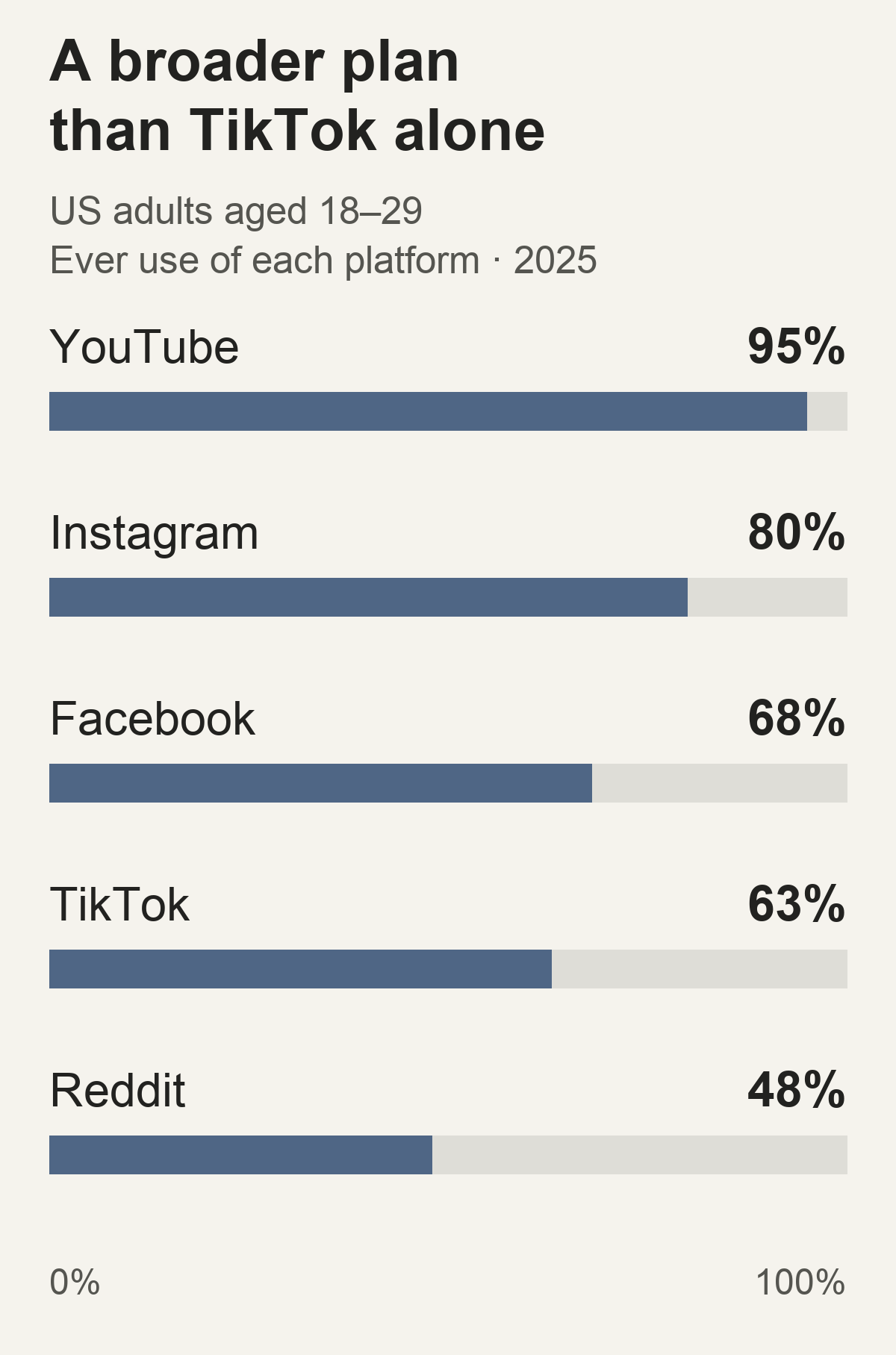
Pew Research Center, February 5–June 18, 2025; 5,022 US adults in the full survey. The figure shows the reported 18–29 age band, which overlaps adult Gen Z and excludes teenagers. Audiences overlap. Platform use measures potential reach, rather than ad effectiveness or buying intent.
YouTube can carry the explanation. A creator’s product demonstration, a comparison or an extended review can answer questions that a short ad leaves open. Use the format when people need to see how something works, whether it fits their routine or how it compares with an alternative.
Instagram and TikTok can make the product easy to discover. Build creative around a recognizable use, an interesting demonstration or a creator’s point of view. Give the viewer a useful next step: see the shades, compare the plans, find the product nearby or inspect the offer.
Communities can reveal the questions your advertising needs to answer. Category discussions on Reddit, specialist forums and other relevant communities can expose frustrations, comparisons and language that a brand brief misses. Participate where your team can contribute something useful. Read the community’s rules and expectations before entering with a campaign.
Search, your website and email complete the journey. Someone who discovers you in a video may still search for reviews, check delivery costs or wait for a restock. Keep product information consistent across those touchpoints. Use email for a reason the customer recognizes, such as an order update, a useful recommendation or an offer they asked to receive.
Choose the mix around the buying task. A skincare demonstration, a festival announcement and a student software subscription should not inherit the same media plan simply because the buyers are young.
Seven strategies for marketing to Gen Z
1. Build the proposition around a real buying situation
Decide what your product helps the audience accomplish before deciding how the brand should sound. For a travel bag, that could be fitting a weekend’s clothes within an airline’s cabin allowance. For a subscription, it could be doing one valuable job without another large monthly commitment.
Put the product beside the alternatives the buyer would actually consider. Those may include a cheaper competitor, something secondhand, a free service or keeping what they already own. This comparison tells you what the campaign has to explain. A beautiful brand film will leave the decision open if the audience cannot see why the offer is worth the difference.
2. Choose creators for their relevance to the purchase
Creators can bring an audience and an established way of explaining a category. Deloitte’s 2025 Digital Media Trends study found that 52% of its Gen Z respondents felt a stronger personal connection to social media creators than to television personalities or actors. The October 2024 survey covered 3,595 US consumers overall and defined Gen Z as birth years 1997–2010. That finding supports considering creators; it does not establish which creator will sell your product. Deloitte’s study
Look for someone whose audience has the problem you solve and whose usual content can show the product credibly. A creator who explains how clothes fit may be more useful to an apparel launch than a larger account with little interest in clothing. Evaluate the audience, the work and the results of a relevant paid pilot alongside follower count.
Give the creator enough room to use their own judgment. Agree on the facts, required disclosures and claims the brand can support, then let the demonstration or story fit their established voice. If every creator delivers the same script, you lose much of what you hired them for.
3. Make credibility visible in the product and the message
“Authentic” becomes useful when a buyer can inspect what it means. Show the actual product in use. Explain who it suits. Make the price and limitations easy to find. Use customer reviews that describe a relevant experience, rather than an anonymous wall of praise.
If sustainability or another commitment is part of the proposition, make the action specific. Describe the material, repair service, sourcing change or program and link to evidence that supports it. Keep the claim proportionate to what you have done. Customers need a reason to believe the promise; a generational label does not supply one.
Your creative can be polished, funny, quiet or direct. Choose a voice your team can sustain through product pages, customer service and the next campaign. Forced familiarity becomes especially unhelpful when a customer is trying to get a straightforward answer.
4. Show the value before reaching for a discount
Make the total purchase understandable: what comes with it, how long it lasts, what delivery costs and what happens if it does not fit. A lower entry price, a smaller pack or a useful free tier may remove a barrier that a temporary discount leaves in place.
Consider a student plan when student eligibility is relevant to the product. Consider a trial when experience with the service helps people decide. For a durable product, explain the difference that justifies the price. Each choice attracts a different customer and affects margin, so compare the economics as well as the response.
For pricing research, test the full offer beside realistic alternatives. A “good price” response in isolation tells you less than a choice between your offer, the competitor and no purchase. Our pricing research guide covers those decisions.
5. Give people something to participate in
A community needs something people can do together: compare their work, exchange advice, celebrate progress, suggest a product improvement or attend an event. A hashtag on its own gives them little reason to return.
Design participation around the product and the audience’s interests. A language-learning service can celebrate practice; a music platform can make listening history shareable; an outdoor brand can help people plan a local trip. The activity should still make sense after the launch campaign ends.
Make contributions matter. Use permissioned customer work, respond to useful suggestions and show when feedback leads to a change. People who buy regularly and help others use the product can be more valuable to your community than people who appear for a single giveaway.
6. Connect the creative to a buying experience that works
The product page needs to continue the story the ad started. If the creative demonstrates a particular use or promises an introductory offer, that detail should be easy to find when the viewer arrives.
Show the information people need on a phone: options, availability, delivery, full price, payment and returns. A creator can show a jacket well, but the customer still needs to know which size to choose. A software demonstration can create interest, but the prospect still needs to understand what the free plan includes.
Where people buy in stores, give them a practical route to the shelf. Keep the pack, product name and variants recognizable between the creative and the retailer. Treat availability as part of the campaign, especially when a burst of attention can exhaust stock.
7. Keep learning after the launch
Watch which audience and creative combinations bring customers who use the product, remain subscribed or buy again. A campaign that produces low-cost clicks may recruit a different group from the one your proposition serves best.
Use those differences to revise the work. If a creator generates interest but the landing page loses visitors at the price, investigate the expectation the content created. If trial sign-ups rise but activation stalls, examine the first useful experience. If a product sells once and is not bought again, study the product and buying occasion alongside the next ad.
Sapien can compare revised concepts, messages and offers with the same modeled audience, preserving the context as the decision develops. Connect that research to your observed campaign and customer results so your next investment responds to both.
Brand examples: what Duolingo and Spotify make useful
Duolingo: make the brand memorable, then bring people into the product
Duolingo sells a language-learning experience. Its recognizable owl gives the brand a character people can follow even before they decide to learn a language.
The company’s 2025 “Dead Duo” campaign turned that character into a social story. In its first-quarter shareholder letter, Duolingo reported 1.7 billion organic impressions and a meaningful increase in new and returning users. The same letter described ongoing product experiments to improve retention, including animations and lesson reminders. These are company-reported outcomes across its audience, without a Gen Z-specific campaign breakdown. Duolingo’s Q1 2025 shareholder letter
The useful distinction is between the reason to notice the brand and the experience that makes someone keep using it. For your team, that means planning the first worthwhile product action alongside the campaign: a completed lesson, a successful setup, a product used well. Borrow the connection between brand and product; give your own audience a story that fits what you sell.
Spotify Wrapped: let customers share something about themselves
Spotify’s 2025 Wrapped turned a year’s listening into personal stories, including top songs, artists and genres. Share cards let users send those stories to friends or post them on social channels. Its new Clubs grouped listeners around listening styles, while Wrapped Party added an experience to play with friends. Spotify’s account of the 2025 experience
The content has a reason to be personal: it comes from how someone used the product. Sharing expresses a taste or starts a conversation, while keeping Spotify visible.
Look for a comparable source of value in your own product. Could customers share a project they finished, a collection they built or progress they are proud of? Make the result worthwhile to the customer and easy to share. A branded template with nothing personal to say is a much weaker invitation.
Tools and research partners for a Gen Z strategy
Choose tools according to the decision they help you make. Audience data, public conversation, creative inspiration and a study of your own offer answer different questions.
Your decision | Partner and contribution |
|---|---|
Which audience, proposition, creative or price should we pursue? | Sapien Complete studies using data-grounded synthetic populations, with quantitative results, qualitative explanations, segment differences and recommendations |
Where does our audience spend time, and what distinguishes it? | Recurring consumer survey data for audience profiles, media habits and comparisons across markets |
How are people discussing the category and our competitors? | Analysis of public online conversation, topics, images and changes over time |
What does relevant TikTok advertising look like? | Top Ads inspiration filtered by fields such as region, industry and campaign objective |
GWI is useful for planning from existing survey evidence; check the age range, markets and questions in the dataset. Brandwatch can uncover public language and emerging issues, but the people posting do not represent every buyer. Creative Center helps you inspect execution; its featured ads do not predict the return your brand will achieve.
Use Sapien when the unresolved question is specific to your business. You might need to choose between two propositions, compare a student plan with a trial, or understand why the same creative lands differently across audience segments. Sapien builds the modeled population, runs the research and connects the findings to a recommendation. Confirm the audience grounding and relevant validation for a predictive study. Physical taste, fit or product-use performance still needs evidence from people using the actual product.
For a wider comparison of software and research workflows, see our AI market research tools guide.
How should you measure a Gen Z campaign?
Give attention and business results their own measures. Reach, video viewing, shares and relevant discussion tell you whether people encountered and engaged with the work. Orders, qualified sign-ups, activated users, repeat purchase and contribution after acquisition costs tell you what happened next.
Read the results by audience, creative and buying occasion. A higher overall conversion rate can hide a weak response from the audience the campaign was meant to recruit. Keep the conversion event clear, and where feasible use a randomized campaign test or a holdout group to establish how much activity the campaign added.
For an agency, the strongest client recommendation connects those results to a change: invest behind this audience, revise this offer, fix this product page or stop this creative. A report full of engagement metrics still leaves the commercial decision unfinished.
Frequently asked questions
What is the best way to market to Gen Z?
Define the audience and buying situation, choose channels that reach it, and make the product’s value easy to understand. Creators, useful demonstrations and participation can all help. Select them for the category and proposition rather than assuming one tone or format suits the whole generation.
Is TikTok the best platform for Gen Z marketing?
It can be useful for discovery, demonstrations and creator content. A sound plan also considers other channels, including YouTube and Instagram, along with the places people compare and buy. Use your target audience’s behavior and relevant campaign results to decide the allocation.
How does Gen Z marketing differ from marketing to millennials?
Compare actual audience evidence within the same category and market. Media use, life stage and budget can differ, but broad labels such as “millennials want information” and “Gen Z wants entertainment” are too crude to guide an offer. Keep the age ranges explicit when using research from different providers.
How can a smaller brand reach Gen Z?
Start with a focused buying situation and a clear reason to choose your product. A relevant niche creator, a useful demonstration and a product page that answers the obvious questions can give you a practical first campaign. Expand once you see which audience and offer produce customers worth retaining.
Build a campaign around the audience you want to win
Bring Sapien the market, audience and decision behind your next campaign. We can compare the propositions, creative and prices your team is considering, explain the differences between segments and recommend what to change.