
Market research for small business: decide whether to pilot a new service
Use inquiry records, free market context and a complete Saturday collection offer to decide whether to pilot, revise or stop a local service.
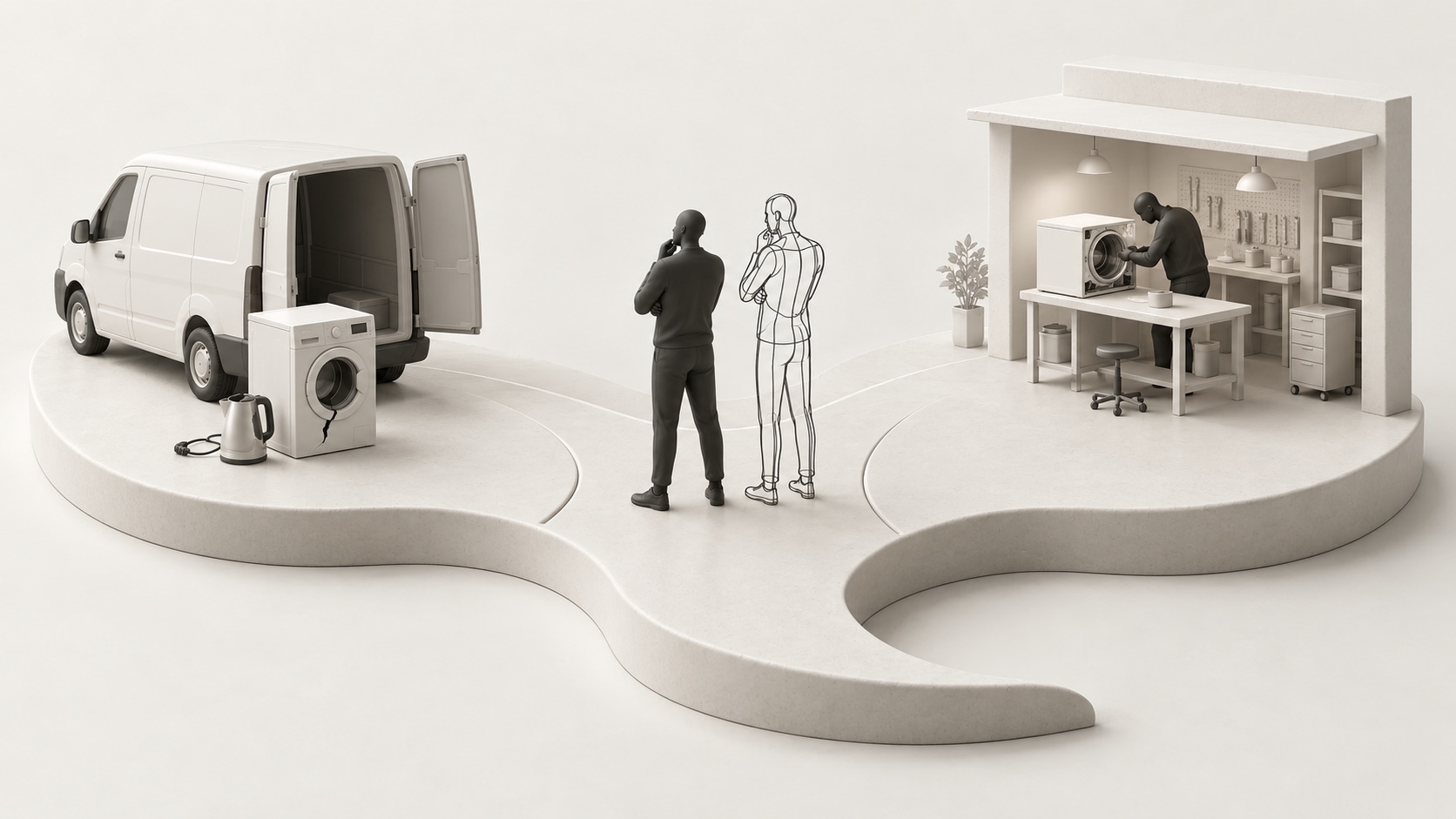
Imagine you run a local appliance-repair shop and are choosing between a collection pilot and a second location. Your customers may need transport help, but both they and your shop must be able to use the complete service. This illustrative decision keeps the Saturday offer intact and investigates why inquiries become completed work or stop along the way.
Put the whole Saturday offer on the table
For the Saturday pilot, state the eligible appliance types, Zone A boundary, 9 a.m.–noon collection window and proposed USD 8 fee before asking about usefulness. Ask “Which condition would prevent you from booking?” and preserve None and Cannot judge. A transport complaint alone does not establish willingness to accept the window or fee. Confirm actual capacity and commercial terms before using any version as a live offer.
The exact collection offer being evaluated
Saturday appliance collection
Field | Offer condition |
|---|---|
Area | Zone A |
Eligible scope | Small household appliances within the pilot’s repair scope |
Collection window | Saturday, 9 a.m.–noon |
Proposed fee | USD 8 per collection |
Research question: Which condition would prevent you from booking?
The table defines the offer buyers should evaluate. Confirm capacity and commercial terms before using it as a live offer.
The window, area, eligible appliance and fee are the proposition. A buyer may value collection and still be unable to use Saturday morning. A fee question without the window measures a different offer. Confirm the capacity and commercial terms before using the illustration as a real invitation.
Begin with the inquiries you already have
Source | Use and boundary |
|---|---|
Useful for: U.S. demographic and business context by geography Boundary: Population and business counts are not repair demand | |
Useful for: Organizing market and competitive questions Boundary: General guidance needs local evidence | |
Competitor websites and public service information | Useful for: Visible services, locations and conditions Boundary: Listed availability does not measure bookings |
Your inquiry and job records | Useful for: Requests, conversion and service history Boundary: Only people who reached your business appear |
Record when each source was checked and what period its data covers. Avoid combining a city-level population with a neighborhood pilot as if they describe the same opportunity.
Create a simple register: date, requested service, area, outcome, stated reason for declining and whether the customer used you before. Keep personal details in the appropriate controlled system; aggregate only what the research needs.
If lost inquiries lack a reason, mark it unknown. Do not code every unbooked job as “price too high.” Inspect whether transport complaints cluster around an area or item type, while recognizing that the available records may be incomplete.
Separate a failure to reach the business from a failure to book after seeing the offer. The inquiry register cannot capture people who never found the shop, and an unknown refusal reason is not a price objection. This distinction determines whether marketing, scheduling or economics needs work.
Use free context before buying a new study
For the repair shop, begin by checking the area the collection route can actually serve. Census Business Builder lets you select a location and business type, inspect mapped demographic and economic data, and download a report. Keep that selected geography and the data period beside the findings. If its boundary differs from Zone A, explain the difference before using it to size an opportunity.
The Library of Congress small-business research guide also points to free Census and consumer-spending sources, alongside subscription industry and company databases. Ask your local public or academic library which subscriptions it offers before paying for a report. Access and permitted downloads vary. An industry overview can explain a broader market while leaving the Saturday collection offer unanswered.
Spend on new fieldwork when the missing answer is specific to the service. If you do not know why eligible inquiries stopped, recent repair interviews can investigate that decision. If you need to know whether the proposed window works at an acceptable operating cost, a deliverable pilot supplies evidence that a population map cannot. This keeps the research purchase tied to the next commitment.
Ask about the last repair before selling collection
- Tell me about the last item you tried to repair.
- How did you choose a provider, including any alternatives?
- How did you transport the item?
- What made the process easy or difficult?
- If you did not proceed, what happened instead?
- Here are the actual proposed collection conditions. Which, if any, would be difficult for you?
- What would you need to know before booking?
Speak with completed customers, declined inquiries and relevant people using alternatives. Record recruitment and keep a rejected offer separate from general lack of category need.
Compare successful and abandoned attempts with alternatives. A borrowed car, combined errand or replacement purchase explains a different route through the decision. Show the complete collection conditions afterward so the prospect can connect them to that episode instead of simply endorsing convenience.
Read the pilot as both a customer and operating process
Track eligible inquiry, verified offer exposure, booking and completed collection. Record a reason at the stage where a failure occurs. A prospect outside scope is not a refusal. An exposed eligible prospect with a window conflict is not missing demand. A booked item that cannot be collected is a delivery issue.
Before the pilot, use actual route hours, handling capacity, staffing and transport costs to set a spending and effort cap. Compare collected fees with incremental cost and the repair work it enables. A fully booked route may still crowd out more valuable work.
Do not extrapolate a permanent branch from the pilot’s bookings alone. A location has different acquisition, staffing and repeat conditions. The pilot can choose whether to expand this collection service, revise its boundary or window, or stop it.
Choose the next change from the bottleneck
Proceed with a bounded pilot when the stated area, appliance scope and window fit real capacity. Revise the window when relevant customers have transport need but cannot use Saturday morning. Revise the boundary or route when bookings can be served only at excessive effort.
Expand only after actual completed collections and operating costs support it. If offer exposure was poor or refusal reasons are missing, repair that information gap before concluding demand is absent. Your next commitment is a one-area pilot. If Saturday is the obstacle, compare another feasible window before considering a permanent branch.
Use our primary and secondary research guide and our market research guide to plan the comparison. Discuss fit with Sapien when a suitably grounded modeled audience can help refine the complete offer.
At review, inspect complete work and operating effort alongside exposure and booking. Revise visibility when people never saw the offer, the window when suitable prospects cannot use it and route scope when delivery effort is excessive. A completed decision names that change and the next evidence it will produce.


