
CPG market research: build a complete offer buyers understand
Connect pack comprehension, the complete price offer, actual product use and replenishment to the next CPG launch decision.

Consumer packaged goods (CPG) include packaged food, drink, personal-care and household products. FMCG, or fast-moving consumer goods, is an overlapping label that emphasizes frequent purchase and replenishment. For research, define the actual category, buyer and buying cycle rather than treat either label as a study method.
Imagine you are launching a concentrated household-cleaning refill for shoppers who own a compatible reusable bottle. Should you revise the pack, add a starter bottle or change the system? In this illustrative example, the pack promises two fills but a shopper imagines two supplied bottles. Their favorable price reaction concerns an offer you do not sell. Follow that mistake through pack, price and replenishment to choose the next investment.
Research the launch as a complete buying proposition
The pack sells a pouch, not two supplied bottles
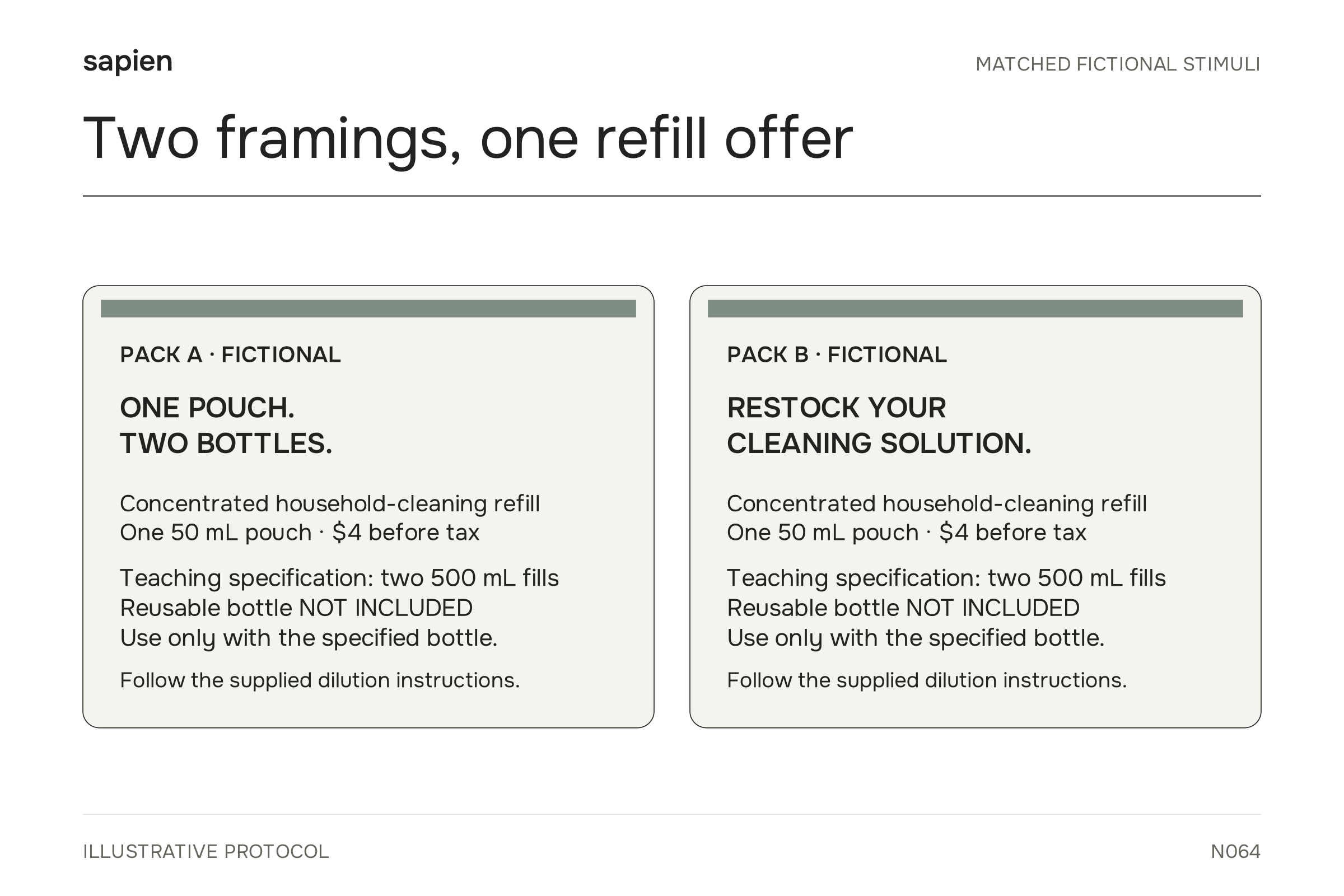
View the matched refill fronts at full size.
PK01: “USD 4 gets me two bottles.” Annotation: quantity partly understood; bottle inclusion incorrect. Put the exclusion beside quantity and price.
PK01 shows an inclusion error: two fills are not two supplied bottles. The response does not establish cleaning or environmental performance.
Stage | Decision and evidence |
|---|---|
Concept | Decision: Is the proposition understood? Stimulus and questions: Same refill description; ask what it is and how it would be used Evidence still needed: Actual compatibility and cleaning performance |
Pack | Decision: Does the pack explain the offer? Stimulus and questions: Comparable pack images; ask product type, contents and required equipment Evidence still needed: Shelf visibility and physical handling |
Price | Decision: Does the offer make sense against alternatives? Stimulus and questions: State volume, dilution, total price and relevant substitute Evidence still needed: Costs, channel economics and purchasing |
Launch | Decision: Which audience and occasion should the pilot serve? Stimulus and questions: Compare relevant needs and current routines Evidence still needed: Distribution, stock availability and actual trial/repeat |
Use the launch sequence to resolve dependencies, not to book every possible study. Price work needs an understood offer. Handling work needs a verified product. A replenishment pilot needs stock and a route the buyer can use. Start at the unresolved condition blocking the next commitment.
Record the current substitute, equipment already owned and route to the next refill. Those facts explain whether a pouch can enter an existing routine or asks the buyer to adopt a new system. They also define what the pack must make visible.
BrewDog faced a related audience question for Lost Lager: could the packaging convey sustainability to shoppers beyond those already engaged with it? Kantar’s BrewDog case describes screening designs and messages across groups with different levels of sustainability engagement. For the refill, compare people who already use a compatible bottle with those who would need a starter system. Keep those adoption situations separate when interpreting pack appeal.
Use the matched fronts to diagnose the shopper’s interpretation
Prepare these two refill cards with equivalent visuals and information. Product performance remains unverified:
A: “One 50 mL concentrate pouch makes two 500 mL fills of cleaning solution, 1 L total. USD 4 per pouch before tax. Use with the specified reusable 500 mL bottle and follow the dilution instructions. Bottle not included.”
B: “Restock your cleaning solution with one 50 mL concentrate pouch rather than buying two filled bottles. Makes two 500 mL fills, 1 L total. USD 4 per pouch before tax. Use with the specified reusable 500 mL bottle and follow the dilution instructions. Bottle not included.”
The wording demonstrates alternate framing. It does not substantiate an environmental, safety or performance claim.
Ask: what is included, what must already be owned, how much prepared solution the pouch makes, what is unclear and what alternative the buyer would choose. Record unaided answers before prompting with a benefit list.
Turn a pack response into a design decision
Response PK01: “USD 4 gets me two bottles.” Code quantity partly understood / inclusion incorrect: it recognizes two fills but assumes the bottle is supplied. PK02: “I use my specified bottle twice, adding water” receives equipment and preparation understood. Move “bottle not included” beside the quantity and price on the revised pack, then compare understanding of the revised offer. A message test can recommend this information change; it does not prove actual safe handling or cleaning performance.
PK01 and PK02 evaluate different imagined inclusions. Put the original answer beside the price or appeal response so the recommendation cannot average that difference away. The pack revision has a precise job: make the separate equipment and preparation part of the value the buyer is judging.
Make price research concern the actual value delivered
Ask what $4 buys before interpreting value: a 50 mL concentrate pouch, two prepared 500 mL fills and no supplied bottle. Save that unaided answer. If a later clarification reduces appeal, the clearer response describes the intended offer and may expose the system’s real adoption burden.
Choose the investment from the diagnosed condition. If the equipment requirement is misunderstood, revise the pack. If the offer is understood and wanted but the shopper lacks a suitable bottle, define a feasible starter offer with its bottle, total outlay and future refill terms. If owning or preparing the system is unacceptable, reconsider the audience or system. The starter offer changes what is supplied and requires its own comparison.
Carry the candidate through actual use and replenishment
A buyer’s first paid order tests entry into the system. The next refill tests whether performance and access make staying worthwhile. Keep those outcomes separate: enthusiasm for the first pack cannot establish what happens when the pouch runs out.
For a laundry relaunch, Unilever needed to evaluate packaging and formulation across moments of use. Kantar’s Unilever case describes testing in real homes, with detailed fragrance, packaging and product diagnostics and a competitor benchmark. Apply that sequence to the refill: let buyers prepare and use the verified product, then investigate whether preparation, performance or access blocks the next purchase.
After product facts and handling are verified, run the chosen complete offer through a feasible buying route. Record the product version, purchase opportunity, paid trial, preparation problems and subsequent replenishment over a defined period. The pilot should let the team locate a failure in product use, stock access or ongoing value.
If first buyers use the product successfully but cannot obtain another pouch during their usual shop, give the next decision to the channel team. If preparation is difficult, send the task evidence to product. If the whole offer is understood but unattractive, revisit audience, price or system. More pack persuasion would address only one of those possibilities.
A launch brief with a specific offer change
For the worked PK01 mistake, start with the pack revision: keep one 50 mL pouch at $4 before tax and two 500 mL fills. Place “Bottle not included,” the specified-bottle requirement and dilution beside quantity and price. Compare unaided understanding before releasing the next price or launch study.
The report should then name the next candidate and owner. Design receives the hierarchy edit. Product receives compatibility and handling requirements. Commercial receives either the understood refill or a separately specified starter-system comparison. Each handoff carries the exact offer rather than a generic approval to launch.
Bring the buyer occasion, channel, pack files, product facts and complete price offer. Sapien’s team can build a modeled audience, compare concept and pack reactions, explore pricing and interpret segment differences for the next decision. Define which alternatives and findings the study should return.
Use the comparison to choose the pack or offer candidate; confirm physical handling and product claims with appropriate product evidence, then observe paid trial and replenishment. For taste and consumption experience, continue with our food market research guide.
Use our concept testing guide, our packaging research guide, our pricing research guide and our launch research guide to specify the next task. Discuss the CPG study with Sapien with the pack, complete offer and intended occasion together.

