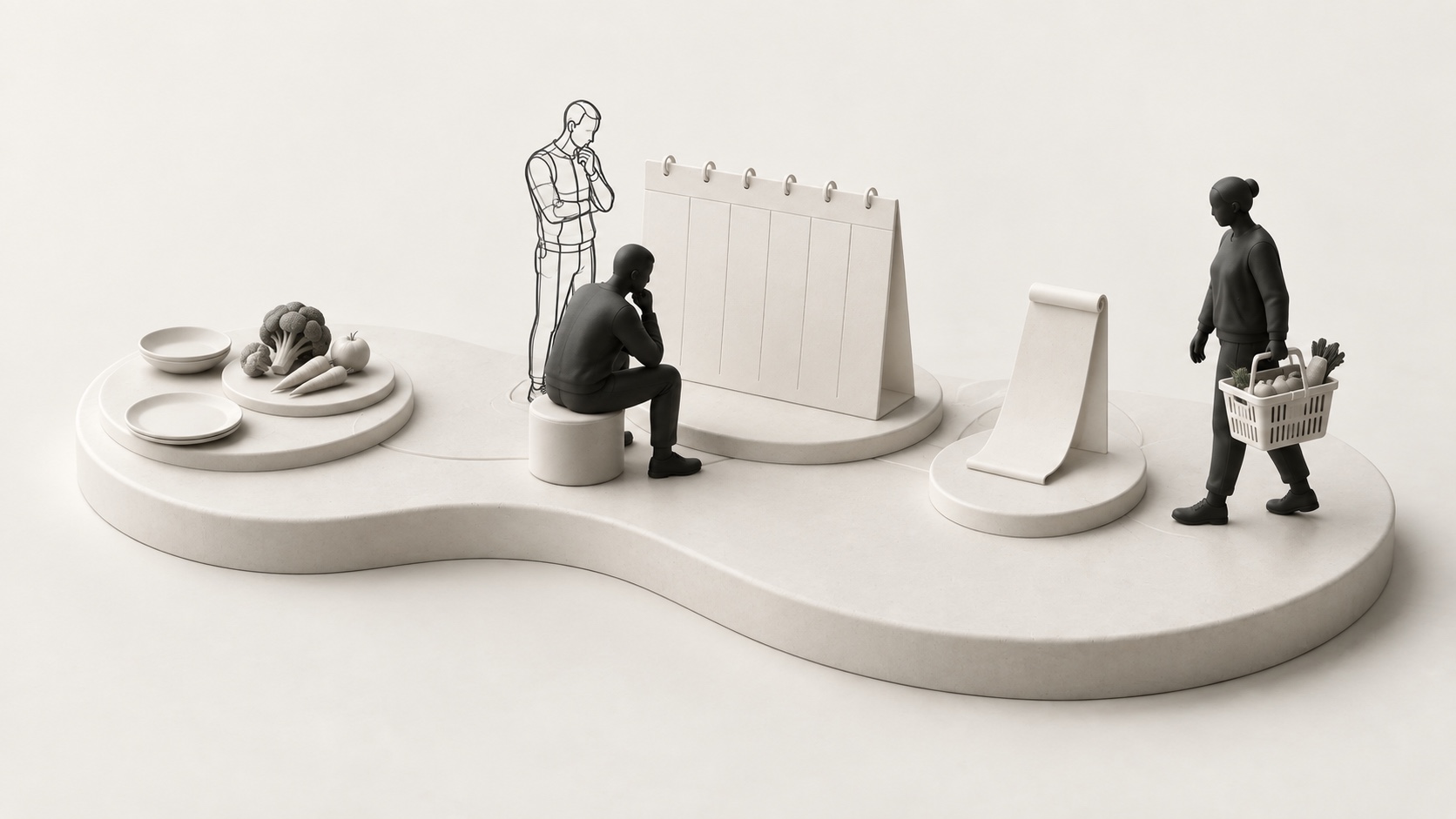
Consumer insight examples: four findings that change the offer
Useful consumer insights connect a finding with an offer change. These four examples turn equipment compatibility, meal schedules, delivery fit and durability expectations into specific product, service and message decisions.
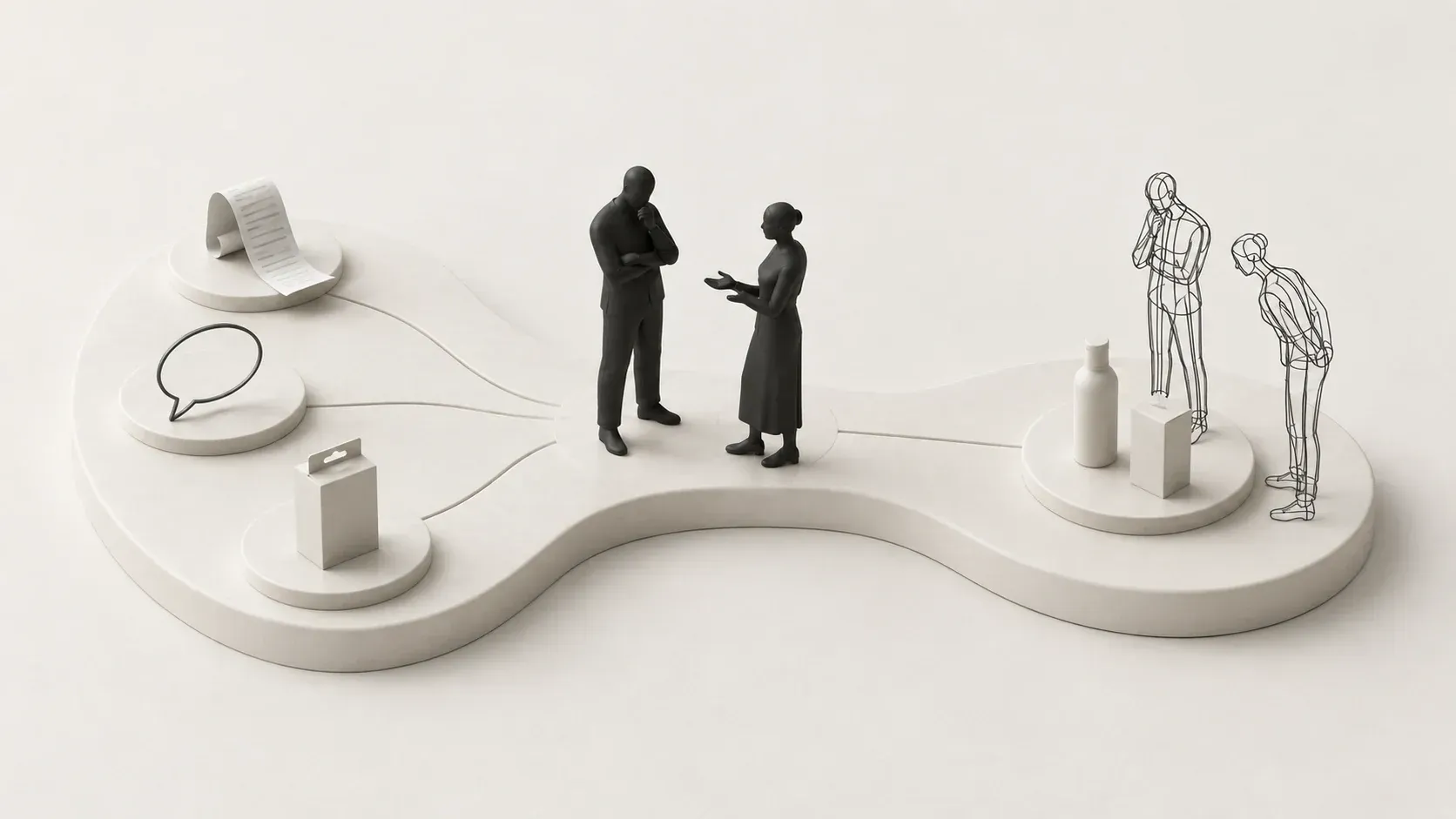
The same kind of research finding can require a product change, an offer change, better information or a stronger proof point. The four invented examples below show why it matters to choose the owner as well as the wording. They are completed decision illustrations, rather than new customer findings.
Refill compatibility: complete the offer before judging it
Decision: how should a refill seller introduce its offer?
The insight changes a specific deliverable
Prior plan | Finding to interpret | Revised business deliverable |
|---|---|---|
Sell an undefined refill | Existing-equipment questions | Confirmed bottle requirement and complete offer |
Reduce the meal bundle | Schedule uncertainty and freezer workaround | Feasible timing/quantity comparison |
Add furniture persuasion | Doorway and package-size task | Separated package dimensions and delivery terms |
Lead with “built to last” | A request for its basis | Verified mechanism or exact service term |
Worked decision log from four fictional cases. These are recommended changes, not measured gains.
Evidence: eight of twelve invented concept responses ask whether the refill works with a bottle already at home. The exact concept description omits compatibility.
Exact fictional card: “A 50 mL cleaning concentrate refill pouch, USD 4 before tax, intended to prepare 1 L of cleaning solution when diluted as instructed. This is an unbuilt teaching concept; required bottle compatibility is unspecified.” Ask “What would you need to know before deciding?” before prompting.
Invented record CR01 says “Can I pour this into the bottle I already have?” and CR02 says “Does my spray top work with it?” Both receive the Equipment compatibility request code because they ask about existing equipment. CR03 says “I would buy the complete starter system,” a contrary case that does not receive that code. The remaining fictional records make the illustrative eight-of-twelve count; these two excerpts demonstrate the rule rather than supplying a complete twelve-record file. The incomplete card is intentional here: the research decision is what requirement the offer must explain.
Insight hypothesis: buyers may treat refills as additions to existing equipment, while the offer assumes adoption of a whole new system.
Action: if the product is compatible, test an explicit compatibility statement. If it is not, explain the starter system and its requirements. Competing account: buyers may simply be confused by an incomplete image. Validation: confirm actual compatibility, then compare comprehension under revised stimuli. The response count does not establish technical fit.
Decision memo sentence: “Clarify the equipment requirement before measuring purchase consideration, because the current concept leaves buyers evaluating different offers.”
For the mechanism behind this compatibility lesson, see consumer insights. The same fictional count is reused to practice the evidence-to-action chain, not to add a second study.
The original incomplete card makes respondents compare different imagined systems. One supplies their own bottle; another expects a starter kit. A consideration rating across those interpretations would not describe one offer. Product confirmation comes first, then a matched comparison of complete terms.
Meal schedules: change how commitment works
Decision: should a meal service offer a smaller flexible plan?
Evidence: fictional interviews connect changed work schedules with unused meals. Some customers with similar schedules renew by freezing meals, which provides an important counterexample.
Insight hypothesis: the friction may be managing uncertainty and waste, rather than wanting fewer meals in every week.
Action: test flexible scheduling and storage information alongside a smaller bundle. Competing account: dissatisfaction with taste or price may be driving the account. Validation: measure the defined problems among a justified audience and inspect actual use in a pilot.
Decision memo sentence: “Test two ways to manage uncertainty before cutting the default bundle, because successful customers already use a workaround.”
Before reducing the default bundle, compare the stage each option changes: quantity, cutoff or storage after the disruption. The successful freezer case prevents the team from treating every changed schedule as a need for fewer meals. The intervention must also fit actual supply and cost.
Furniture delivery: answer the task the buyer is trying to complete
Decision: what information should an online furniture store prioritize?
Evidence: fictional interview accounts describe measuring doorways before purchase and searching for package dimensions. A fictional task session finds a participant reading product dimensions as box dimensions.
Insight hypothesis: some buyers need confidence that delivery and assembly will work in their home before they can judge the furniture itself.
Action: distinguish assembled and packaged dimensions and test whether buyers can answer the delivery-fit question. Competing account: an unusually complex product may be causing the confusion. Validation: observe relevant tasks across formats; use a suitable experiment for any claimed conversion effect.
Decision memo sentence: “Separate package and product dimensions, then verify understanding; do not assume a clearer page has already increased sales.”
The user’s task is to determine whether delivery will work at home. Assembled dimensions describe the product; box dimensions describe the doorway problem. The insight changes the information architecture because those measurements have different jobs. It also directs a task check, rather than a general page-likeability question.
Premium durability: make the basis of value inspectable
Decision: should an appliance brand lead with “built to last”?
Evidence: fictional message reactions understand the phrase but ask what makes the product more durable. A competing message with specific service terms is easier to evaluate.
Insight hypothesis: an abstract durability promise may require evidence that buyers can inspect before it supports a premium price.
Action: test a substantiated proof point or clearly stated service term beside the benefit. Competing account: the premium itself may be unacceptable regardless of proof. Validation: substantiate the factual claim separately and investigate the actual price tradeoff.
Decision memo sentence: “Make the basis of the durability promise inspectable before asking whether the premium is justified.”
The buyer’s request for proof can identify a missing mechanism, but it can also reveal an unacceptable premium. Compare a substantiated complete message at the actual offer. If buyers still prefer a cheaper alternative after understanding the proof, price or occasion fit may be the next decision.
A before-and-after decision log
Write the prior plan and the revised action side by side. This makes insight work reviewable: refill moves from an unspecified equipment requirement to a complete system; meals move from a fixed bundle to a feasible uncertainty-management option; furniture adds the information needed for delivery fit; durability states the support for the premium.
An option can fail while the insight remains useful. Limited refill compatibility calls for a real starter offer, not universal fit. Infeasible smaller bundles call for another workable way to manage the occasion. Keep the mechanism separate from the preferred implementation.
In Sapien’s modeled foldable-iPhone case, the recommendation is to show an existing iPhone owner a recurring task where two views help. That gives marketing a demonstration to compare, rather than a demographic label alone. The matched price exercise has separate core/expansion bases of 2,103/2,897; it does not observe purchases.
Continue with worked study, Discuss the choice with Sapien.