
Consumer insights: turn a customer account into a better offer
A consumer insight explains a buyer situation in a way that changes an offer. Connect the finding with its occasion and mechanism. Here, changing schedules make a meal commitment risky, directing tests of bundle size, cutoffs and storage support.
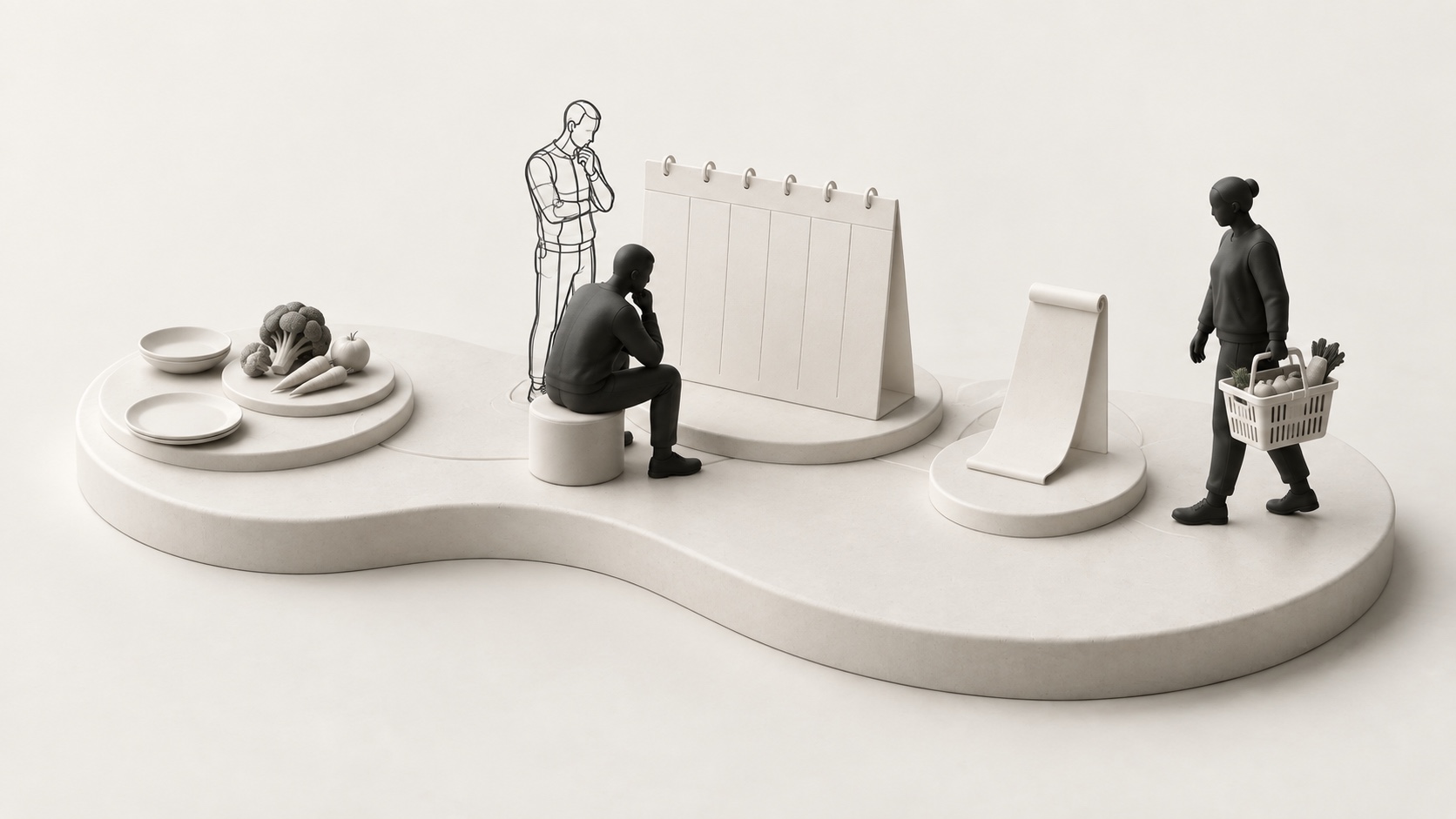
The meal-service account is specific enough to create a choice: a customer’s shifts changed after ordering and two meals went unused. A smaller bundle, later change cutoff and storage guidance each address part of that situation. An insight should help the team select among them. All meal and refill examples here are fictional teaching material.
Keep evidence, finding, insight and action distinct
All details in this example are fictional. A meal subscription company is investigating first-order customers who do not renew.
Layer | Fictional example | What to inspect |
|---|---|---|
Evidence | A recorded account: “My work shifts changed after I ordered, so two meals went unused.” | The source, context and exact account |
Finding | Some interviewed nonrenewers describe changed schedules and unused meals | Which cases support and contradict it |
Insight | A fixed meal plan may create waste anxiety for buyers whose schedule changes after ordering | Whether this mechanism explains relevant behavior |
Recommendation | Test a smaller flexible bundle for that occasion | Product feasibility, economics and behavioral validation |
The insight is an interpretation. It can be wrong even when the underlying quotation is accurately recorded. Keep that separation visible.
The meal-schedule thread also appears in qualitative versus quantitative research. Here it teaches the move from evidence to interpretation; the linked guide teaches the design and measurement choice. It is one connected fictional lesson, not corroborating studies.
The finding stays close to what was recorded. The insight supplies a mechanism: an early fixed commitment makes unused food a risk when a schedule changes later. The action introduces a feasible intervention. Keeping those layers distinct lets the team improve the explanation without rewriting the customer’s account.
Choose the intervention by when the problem occurs
Draw the sequence: order placed, work schedule changes, meals remain unused, the customer considers renewal. A smaller bundle reduces the quantity at risk. A later cutoff changes when the decision becomes fixed. Storage guidance may make unused meals usable later. “More flexibility” does not tell operations which of those promises to deliver.
Fictional meal-service account
Choose the point in the episode you want to change.
“My work shifts changed after I ordered, so two meals went unused.”
Order | Episode step | Detail |
|---|---|---|
01 | Order placed | Quantity committed |
02 | Shifts change | Schedule becomes known |
03 | Meals unused | Food remains |
04 | Renewal considered | Next buying decision |
Explore the candidate mechanisms
Candidate and purpose | Confirm first | Compare | Follow |
|---|---|---|---|
Smaller bundle; Reduce the quantity exposed to changed plans. | Operations can supply the smaller bundle at workable complete terms. | The smaller bundle with the current plan for buyers whose shifts change. | Meals used, renewal and operating cost. |
Later cutoff; Let buyers adjust after their schedule is known. | Operations can deliver the later cutoff without an unworkable production change. | A complete later-cutoff offer with the current commitment time. | Changes made, meals used, renewal and operating cost. |
Storage support; Make the existing workaround usable. | The actual meal and buyer situation support the proposed storage guidance. | Verified storage support with the current offer information. | Whether unused meals become usable later, alongside renewal. |
One invented account, three candidate interventions. The comparison explains what each would test; it does not identify a winning solution.
Ask a renewing customer with changing shifts how they manage the same situation. In a contrary fictional account, a customer with a changed work schedule renews the meal plan by freezing unused meals. The existing example’s freezer workaround tests the assumption that smaller quantity is necessary. If that workaround is practical, the offer may need to communicate it; if it is unsuitable for the product or buyer, timing or quantity remains the relevant intervention.
Price can also explain leaving. Separate the cost of the current plan from the cost and usefulness of the proposed change. A lower commitment may fit uncertainty yet become poor value per meal. The team should compare complete feasible alternatives rather than treating preference for an isolated feature as an offer recommendation.
A compatibility insight requires a product fact first
Consider this fictional finding: eight of twelve demonstration respondents ask whether a cleaning refill fits their existing bottle.
A weak interpretation is “Compatibility is important.” A stronger hypothesis is “Buyers may be evaluating the refill as an extension of equipment they already own, while the concept presents it as a new system.” That suggests testing a clear compatibility statement or a starter kit, depending on the product’s actual design.
Neither wording proves the product fits existing bottles. Technical compatibility needs independent confirmation. The count is invented for practice and estimates no real population.
The sequence differs for a cleaning refill. The eight-of-twelve equipment questions identify information buyers need, but product must establish what equipment fits. Marketing can then compare a complete existing-bottle proposition or starter system.
This is a useful boundary for insight work: a perceived barrier can identify the missing fact without supplying it. Replacing vague copy with a confident compatibility statement before checking fit would make the incomplete offer more persuasive.
Write an insight that survives handoff
“For customers whose shifts change after ordering, a fixed weekly meal commitment creates a risk of paying for food they cannot use. Compare a feasible later change cutoff with a smaller bundle, then evaluate use, renewal and operating cost.”
This states the audience, occasion, mechanism and decision. It gives operations and marketing alternatives to act on while leaving room for price, storage and other explanations. Use that structure when a finding needs to become an offer recommendation.
Give the receiving owner the account, mechanism, alternative explanation and feasible choices. For meals, operations defines deliverable cutoffs or quantities; research compares the complete alternatives; the pilot observes use and renewal.
A useful insight can survive rejection of the first solution. If smaller bundles cannot be supplied, the schedule-risk explanation still directs another intervention. If customers leave after uncertainty is resolved, update the explanation rather than treating every contrary case as an exception.
Continue with consumer insight examples, consumer insights versus market research, consumer insights companies guide, Discuss a managed synthetic study with Sapien.