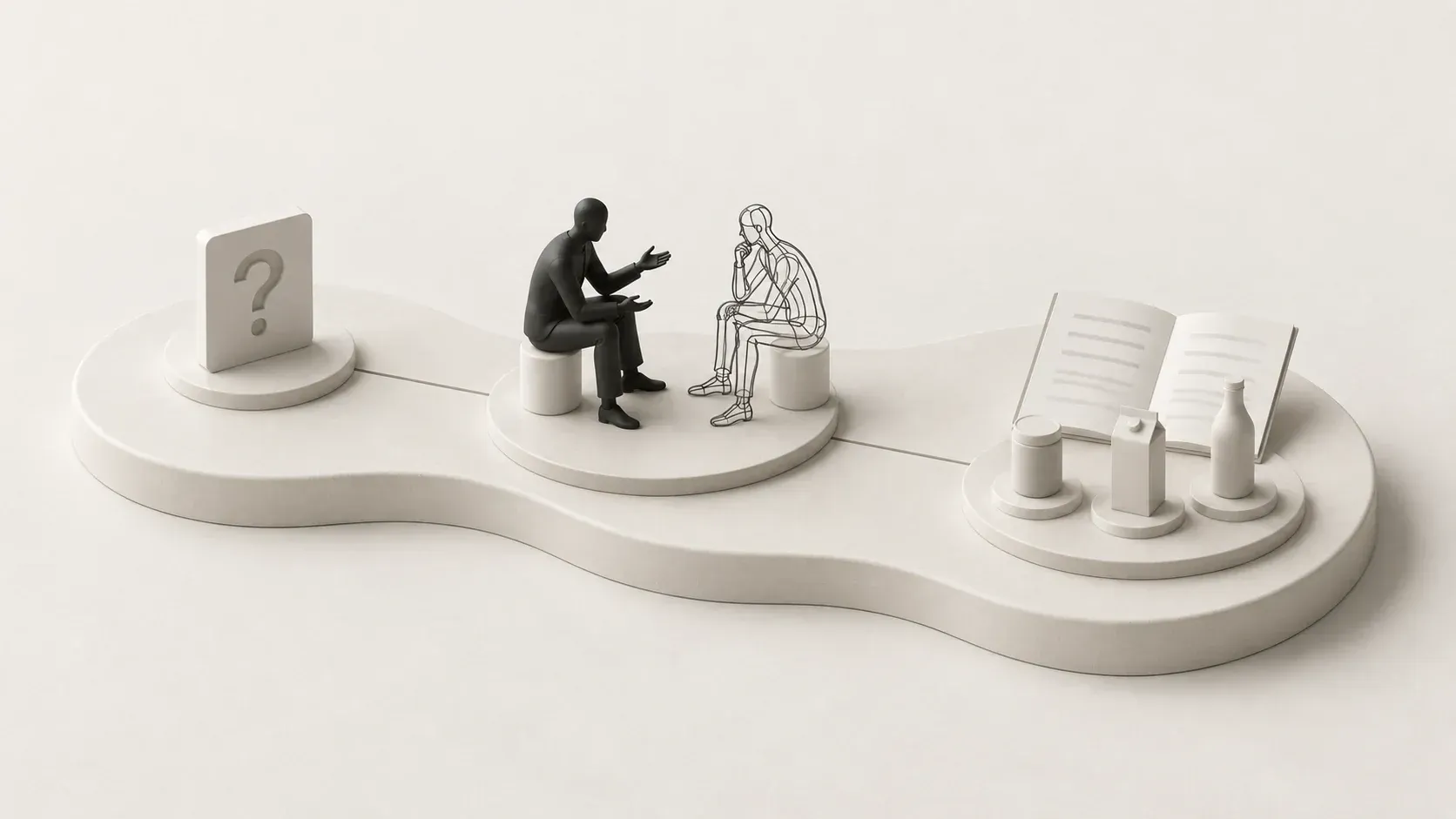
Youth market research agencies: plan for the child who stops
Choose a youth research agency by the task children encounter, their continuing choice to stop and the conclusions a partial session can support.

A parent has agreed to a research session. During the activity, their child says they want to stop. The moderator's next move affects both the child and the evidence your team receives. A final preference cannot be supplied by the parent, inferred from silence or obtained by insisting on one more answer.
When comparing youth market research agencies, inspect how each will turn your decision into a task the intended children can understand and choose to leave. A recruiting plan and adult permission do not establish how the session will work, what a stopped activity contributes or which conclusions must remain open.
Buy a child-facing task you can inspect
Consider Lantern Lane, a fictional interactive-story app for children aged eight to ten. Its product lead is choosing between two introductions: a written instruction page and a short demonstration before the story begins. The proposed research asks each child to try both and explain which would make the app easier to use independently. The business, participants, proposals and events below are invented. No child fieldwork or Sapien study has been conducted.
Lantern Lane needs an agency that can investigate children's encounters with the introductions. Ask the proposed moderator to show the actual materials, explain the task as they would to a child and demonstrate how they will check that the child understands what is being asked.
“We research youth” covers a wide range. Experience interviewing teenagers does not show how the proposed moderator will work with this particular age group. Ask about the relevant reading demands, explanation and available ways to respond. A drawing, a spoken explanation and an observed action can each contribute different evidence; agree which the decision needs.
Access is a separate requirement. Our hard-to-reach audience research guide explains how to assess a recruiting route. Once suitable families can be reached, the child-facing task still needs to earn its place in the proposal.
Separate adult permission from the child's continuing choice
The agency should explain who gives responsible-adult permission for this setting, what they will be told and how that permission will be verified. It should also show how the child will hear an understandable explanation of the activity, any recording or observation, and their choices about participating.
The MRS Code of Conduct, 2023 edition requires members to obtain responsible-adult permission, consider children's age and understanding, and give children an opportunity to decline even when adult permission exists. It also requires respect for a participant's withdrawal at any stage. These are professional requirements for MRS members, rather than a universal permission rule for every market.
MRS's February 2020 children's guidance, which interprets its 2019 Code, makes the distinction practical: a child can withhold an answer or decline an element of the activity. Use this dated UK research-practice reference to examine the proposed session. Have the agency explain the requirements applicable to the actual location and participants.
For Lantern Lane, hearing “you can stop” at the start is only part of the design. The moderator must respond appropriately when a child later uses that choice. Ask the agency to rehearse that moment, including what happens if the adult encourages the child to continue. The response belongs in the agreed fieldwork approach before any sessions are booked.
Read a stopped session for what it actually contains
In the fictional pilot, nine-year-old Riley agrees to begin after the adult-permission process and child explanation. Riley opens a story through the first introduction. When asked whether the app would be easy to use “independently,” Riley asks what that word means, puts down the tablet and says, “I want to stop.” Riley's parent suggests doing the last rating. The moderator ends the activity without requiring an explanation or a final score.
The evidence has changed. Riley has not tried the second introduction or supplied the planned comparison. The parent saying that Riley normally enjoys mysteries does not complete either missing step.
In this example, the adult and child were told what would happen to earlier material if the session ended. The agreed permissions allow the observation notes to remain, and no removal is requested. Check that condition in a real study: ending participation does not by itself settle future use of notes or recordings.
Record | Meaning |
|---|---|
Riley opened a story through the first introduction. | A permitted observation of this encounter, without a comparison with the second introduction. |
Riley asked what “independently” means. | A reason to review the research prompt; it does not establish that the app is confusing. |
Riley stopped before the second activity. | The planned paired preference is unavailable. The stop must remain visible. |
The parent described Riley's usual interests. | A parent account, kept separate from Riley's missing answer. |
Do not code this event as a completed preference, a failed attention check or proof that children dislike the app. It identifies a problem with the question as Riley encountered it and leaves the reason for stopping unresolved. One child's event also cannot establish how common that problem is among the intended audience.
Revise the task before booking the main sessions
Lantern Lane accepts the permitted partial account and declines a recommendation that one introduction has won. The first commission now changes: the agency must revise and try out the child-facing task before proceeding with the planned comparison.
The revised opening asks the child to try one introduction and show what they would do next. The moderator can use the child's own terms to discuss what happened, rather than ask for a forecast about independent use several times a week. A possible invitation is: “Show me what you would do next. You can skip anything or finish whenever you want.” The agency must check whether that wording and activity work for these participants; it is an example, not a standard script for every age.
Agree where the adult will be and how help will be handled. A parent explaining the controls changes the encounter if the question concerns using the app without that explanation. Necessary support should be recorded so the team can interpret the experience it actually observed.
The agency also needs a response to uncertainty. Looking away or becoming quiet does not have one fixed meaning. A moderator can clarify whether a child wants a pause or to finish without demanding an answer to the product question. An explicit request to stop should end the activity, including when an adult or client observer wants another response.
The next report should keep the task version, material encountered, assistance and extent of participation beside the finding. Revised-task answers cannot silently become comparable with the original question. Accept the agency when it can explain the recommendation those records support and the question still requiring work. A promise to fill every cell in a final rating table leaves the important uncertainty untouched.
A parent-only commission can be the right purchase
Suppose Lantern Lane has a different immediate decision: which description helps adults understand a family account, what access it includes and whether shared reading fits their routine. That question can legitimately belong to parents or other adult buyers. Direct child sessions need not be added simply because children use the product.
Commission the adult purchasing question explicitly. Ask people about their own role in choosing family apps, the relevant alternatives and what the proposed account would require of them. Our marketing to parents guide connects that complete offer with the information adults need before choosing.
The resulting recommendation can improve the adult proposition. It cannot establish that a child understands the introduction, enjoys the story or can navigate it without help. If those questions become consequential, commission the appropriate direct experience separately. The parent-only route succeeds when it answers the actual purchase question, with its source clear.
Use Sapien to explore the adult offer decision
Lantern Lane may leave the child research with a clearer description of the experience and an open adult choice: lead with shared reading, explain optional audio differently or compare complete account propositions for different family routines. Those are useful questions to bring to Sapien.
At Sapien, we build simulated audiences grounded in purchase, behavioral and research data. Customer evidence and past research can add relevant context. Our team builds the audience, runs surveys, interviews and comparisons, and helps interpret the responses. Follow-up questions to the same modeled audience can explore the reasons behind a difference.
For this brief, define the adult buyers or parents whose decision matters and bring truthful alternatives informed by what the child research supports. Compare how those adults understand and weigh the offers, then use the findings to decide what to investigate or change. A modeled adult response remains separate from a child's observed encounter and continuing choice about participation.
Book a demo to discuss the audience, family proposition and research behind your next decision.