
Qualtrics pricing: what the annual commitment buys
Put the dated Qualtrics annual license inside a complete study budget, separating recruitment, specialist work, cash and allocated internal effort.

When comparing Qualtrics pricing, put the license inside the cost of the decision you need to finish. Strategic Research displays $420 per month billed as $5,040 annually, with 1,000 responses shared across users. Add recruitment, design, analysis and internal workload. Show the annual cash obligation separately from any allocation across genuinely planned studies, and obtain terms for your exact product and region.
The displayed monthly price has an annual commitment
Offering | Displayed terms and buying implication |
|---|---|
Free survey account | Publicly displayed terms: One user, three active surveys, 30 questions per survey, 500 total responses Buying implication: Useful for evaluating the software; responses are not purchased participants |
Strategic Research, bought online | Publicly displayed terms: $420 per month, billed as $5,040 annually; 1,000 responses shared across users Buying implication: The displayed monthly figure has an annual billing commitment |
Higher-volume or enterprise needs | Publicly displayed terms: Custom pricing; the page lists a higher-volume tier beginning at 5,000+ responses Buying implication: Request a quote for the required scope |
The official purchase page was checked on October 10, 2026. Its online paid offer lists unlimited users, surveys and questions plus guided methods. These terms describe Strategic Research, rather than every Customer Experience, Employee Experience or enterprise package.
A $5,040 license inside an $11,240 budget
For an illustrative one-study budget, combine the published license with assumed recruitment, specialist work and allocated internal labor:
Chart scale: $0 / $4,000 / $8,000 / $12,000.
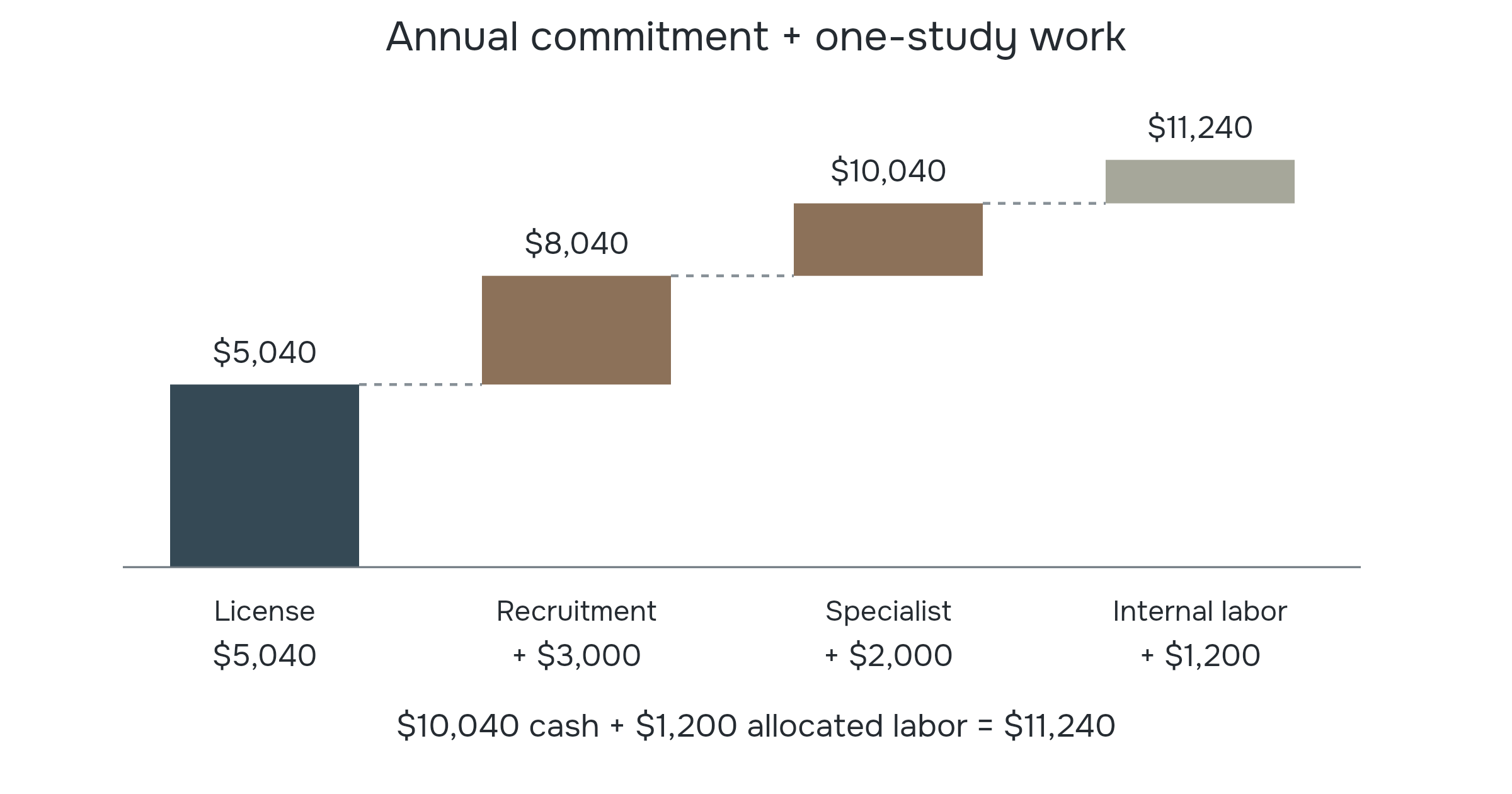
View the complete figure at full resolution.
The values behind the budget are:
Component | Amount and evidence status |
|---|---|
Annual software | Amount: $5,040 Evidence status: Public price checked October 10, 2026 |
Recruitment | Amount: $3,000 Evidence status: Budgeting assumption |
Specialist work | Amount: $2,000 Evidence status: Budgeting assumption |
Internal labor | Amount: $1,200 Evidence status: Allocated work assumption |
Total | Amount: $11,240 Evidence status: Arithmetic illustration; not a vendor quote |
Only the annual license amount is a public vendor price. The other amounts are explicit assumptions. Cash assumes the recruitment and specialist work are purchased externally; internal labor is an allocation.
Confirm the response-entitlement period and definition of billable use in the written terms. Higher-volume or enterprise requirements need a quote. The free account and 30-day trial are different configurations; premium trial features can disappear after downgrade. Evaluate the plan the team would actually retain.
Put the license inside a complete study budget
The illustration above adds assumed recruitment, specialist work and internal labor to the documented license. Under the stated purchased-service assumption, cash is $5,040 + $3,000 + $2,000 = $10,040; adding $1,200 of allocated internal effort gives $11,240. This is a planning calculation, not a Qualtrics study quote.
Replace every assumed amount with an owned workload estimate or scoped quote. A response allowance does not recruit eligible buyers, prepare matched concepts or interpret contradictions. Include translations, screening, replacements and a follow-up if they are necessary to finish the decision.
Quote the same finished decision
For an unchanged offer at two prices, specify market, eligibility, exposure, valid answers per cell, primary outcome, segment reads and required deliverables. Ask who prepares the stimuli, recruits, quality-checks and interprets. Request the instrument, saved cards, response bases and recommendation, plus the included revision. A license-only route is economical when your team can own those remaining tasks.
Allocation does not reduce the obligation
The subscription remains a $5,040 annual commitment even if accounting spreads it over several studies. A per-study allocation can be useful for a genuinely planned program; show the full obligation beside it. Do not divide by imagined future projects to make today’s purchase appear inexpensive.
The illustration’s extra $6,200 belongs to one study. If some specialist or internal work serves a recurring program, identify the shared portion and allocation rule. Separate purchased services from labor already budgeted internally so decision makers can see both cash and capacity.
Price the likely change, not every possible feature
Ask what happens if the eligible incidence is lower than expected, a card needs revision or another market is added. Confirm whether follow-up and retained exports are included. The answer reveals which uncertainty can change the budget. For the two-price brief, price the bounded repeat the team would commission after a material comprehension problem.
Choose software when the remaining work has owners
Buy the software route when the team can design, recruit and analyze. Compare a managed human study when fieldwork and specialist interpretation are missing, or an appropriately grounded modeled comparison when that evidence fits the decision. Sapien does not publish a universal study fee on its homepage; request a scoped discussion using the same brief and compare complete work.
For the respondent-source and workflow choices behind this budget, consult our synthetic-versus-human-respondents guide and our consumer insights tools guide.
Bring the decision, audience and evidence needed to a scoped Sapien study discussion.

