
Qualitative Concept Testing: Choose What to Change
Choose between clearer copy and a different product. A worked concept brief shows how competing explanations lead to specific revisions and follow-up evidence.
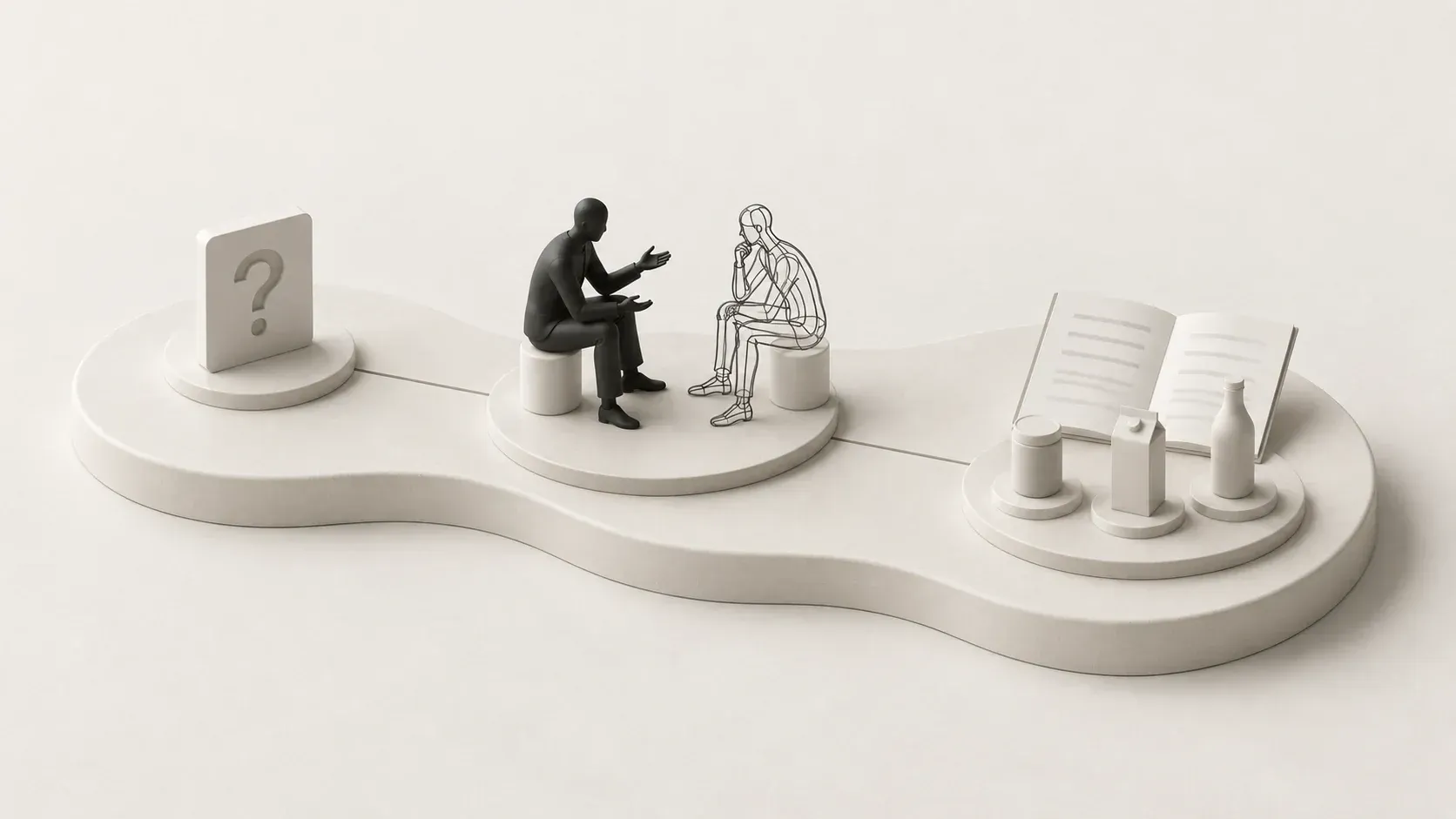
Qualitative concept testing uses detailed conversations and tasks to explain how people interpret a proposed offer and what would need to change. The useful output is a specific product or offer revision with a reason to test it. For a team developing a desktop organizer, that could mean choosing between clearer copy and a different product kit before spending money on a larger comparison.
Interviews can help distinguish those choices. They don't turn a persuasive explanation into an estimate of how many people will buy. Our concept-testing methods guide covers the wider choice of research design; here, the job is deciding what to change and why.
The choice is clearer copy or a different product
Consider a hypothetical desktop organizer: one phone tray and one removable cable tray, sold together for US$39 before tax, with delivery included. The kit contains no charger, charging cable or other electronics. The development team is deciding which version deserves a prototype: the storage kit as described, a clearer presentation of that same kit, or a kit with a different function.
The offer and possible response patterns below are planning examples, not collected interviews or simulated study results. Charging, durability and other physical performance would need their own product evidence if the team developed those features.
An objection about charging has several possible meanings. A person might mistake the organizer for a powered dock. They might understand the kit perfectly but prefer something that charges a phone. Or they might already have a charging dock that also keeps the desk tidy, leaving little reason to buy separate storage. Those explanations call for different work.
Rewriting the description could address the first problem. Adding a function might address the second, if it's feasible and worth the cost. The third could challenge the intended audience or the need for the offer. Asking whether someone “likes the idea” leaves those choices unresolved.
Recruit the situations that could change the revision
The brief should identify the experiences the team needs to understand. For the organizer, useful contrasts could include people who currently struggle with loose desk cables, people whose charging dock already organizes them, and people who solved the problem with a low-cost tray. Check that these are relevant to the intended market rather than recruiting every kind of desk user.
Recruiting only people attracted to the concept makes it hard to understand rejection. Recruiting only people with untidy desks can also hide a competing solution that works well. Record how each person qualified and the current setup behind their reaction. These are deliberately chosen contrasts, not an estimate of the proportion of buyers in each group.
Individual interviews are useful when the team needs someone's own sequence of work, purchases and workarounds. A group can be useful when people exchanging ideas is itself part of the question. Our focus-group guide explains how to retain that interaction history. A group discussion about desirable features answers a different question from an individual explaining why they kept their current dock.
An account and a task answer different questions
Before showing the organizer, understand the person's current desk setup and the last time they changed it. A description of a frustrating cable problem is more informative when the researcher knows what happened, what the person tried and why that solution stayed or failed. GOV.UK's in-depth interview guidance recommends neutral follow-ups and concrete stories rather than general accounts of how things should work.
Then show the complete offer. Keep the distinction between what the person understood, what they wanted and what they predicted they would do. Someone who accurately describes a storage-only kit and rejects it hasn't failed to understand it. That rejection may be the most useful evidence in the session.
The material shown limits what the team can learn. A drawing can prompt reactions to the proposed arrangement. It cannot demonstrate whether a phone fits securely or whether a cable can be retrieved comfortably. Those questions need a suitable physical prototype and a relevant task. If the researcher explains or changes the offer during the conversation, retain that point in the record. The later reaction concerns the added information too.
Three explanations lead to different work
The table shows how a team could investigate possible material from these sessions. None of the rows describes a finding already obtained.
Possible material in a session | Explanation still to check | Next revision task |
|---|---|---|
A person describes charging that the card never promises. | The image or wording implies electronics, or the person is describing a desired addition. | Locate the cue behind the interpretation. Prepare a clearer storage-only version if the presentation caused it. |
A person understands the exclusions and prefers their existing charging dock. | Storage and charging belong together in that person's routine, or their current setup already solves the storage problem. | Examine that setup before proposing an added function or a different target use. |
A person understands the kit but says US$39 isn't worthwhile. | The organizer adds little benefit, a cheaper substitute is sufficient, or the complete price is the obstacle. | Compare the reason with the actual alternative. Define a separate value or price question before changing the offer. |
A clear exclusion can correct an implied feature without creating demand for the remaining kit. Likewise, an attractive feature suggestion doesn't establish that the customer would pay for it. The team needs the reason the feature matters and a feasible offer containing it.
When an interview raises a new explanation, retain the original reaction before exploring it. If the moderator first suggests adding charging, the participant's agreement isn't an independently volunteered requirement. The record should let the product team see where the idea came from.
A competing explanation should change the next comparison
Suppose the team is considering the explanation that buyers need storage and charging together. Look for material that could challenge it: a person who already charges a phone elsewhere but still wants cable storage, or someone who uses a powered dock yet has a separate organization problem. Their circumstances can narrow the proposed use rather than simply weakening the story.
Keep the source account beside the explanation and proposed action. GOV.UK's analysis guidance separates what researchers saw or heard from the findings they develop and the actions they choose. Applied here, “described using a charging dock” is material; “needs integrated charging” is an interpretation; “develop a powered kit” is a product decision.
Our qualitative market-research guide follows that distinction through a past purchase journey. For a concept decision, the extra responsibility is identifying which edit follows from the interpretation. If several different edits would fit equally well, the explanation hasn't yet narrowed the work enough.
The supplier's deliverable is a revision the team can evaluate
Ask for the exact offer shown, relevant buyer situations, supporting accounts, competing explanations and the change each explanation would justify. The product team should be able to trace a proposed edit back to material from a session and see what remains unresolved. A collection of favorable quotations doesn't supply that chain.
For this organizer, the handoff might be a clearer storage-only card, a narrowly specified powered-kit proposal awaiting feasibility work, or a decision to pause because the current alternatives already solve the problem. The supplier should explain what evidence would challenge the recommendation. A larger appeal survey becomes more useful once the team knows which complete offers it can realistically compare.
The next round needs a reason to reject the revision
For a copy revision, the useful question is whether the same kit is understood without the researcher supplying the missing explanation. If people understand it and still prefer their current solution, more rewriting may leave the product problem untouched. A new function needs a fresh complete offer and appropriate product evidence before it can be treated as delivered.
We use simulated interviews at Sapien to explore reactions to specified offers and investigate the reasons behind them. Agree the audience evidence and validation appropriate to this task. Modeled responses don't establish that a real person owns a charging dock, struggled with a cable or purchased a kit; those claims need human accounts or relevant observed records.
If your team is choosing between explaining the same product better and developing a different one, discuss the concept with Sapien. We can scope a modeled comparison around those alternatives while keeping the human workflow and physical-use questions visible.