
Market research for a clothing brand: choose the sample before the size run
Compare matched jacket concepts, choose the next physical sample and keep inventory assumptions separate from style interest.
If you are launching a commuter jacket, choose a design for sample development before committing to a size run. The illustrative study and financial scenarios below concern a small clothing brand. Cycling commuters favor straight, hip-length A and ask about handlebar reach; transit commuters favor relaxed, cropped B and ask about a bag. Those responses select physical development tasks. Inventory still depends on the samples and actual economics.
Match the garment offers before interpreting style
Compare the designs at matched terms so you can decide which sample deserves development for your intended commute.
The garment comparison produces two sample tasks
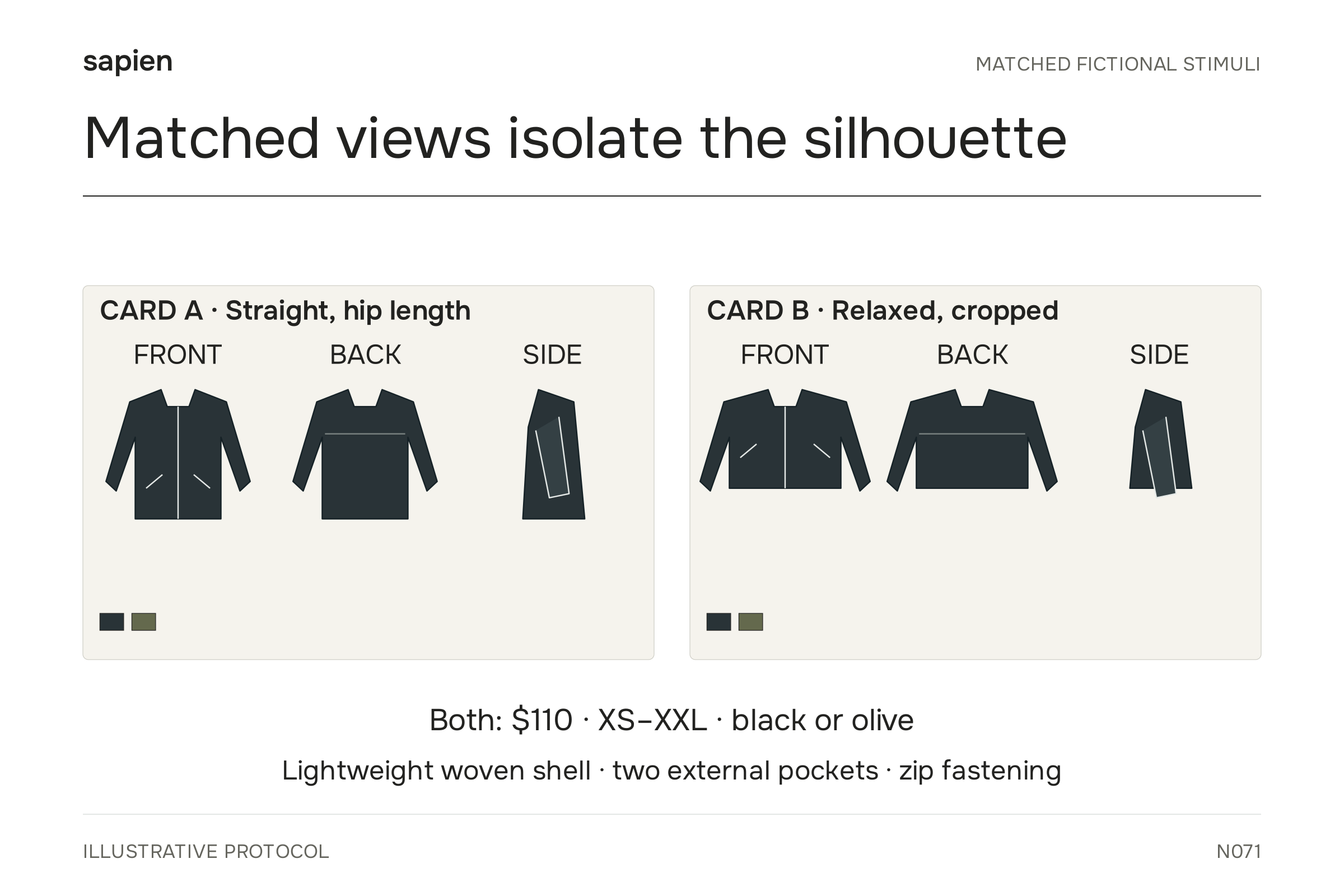
View the matched jacket concepts at full resolution.
Cycling: A selected by 24/40; verify sleeve movement at handlebars. Transit: B selected by 22/40; verify cropped hem with the usual bag.
Balanced sequential comparison after separate evaluation blocks. Drawings and stated choices do not establish fit or sales.
Attribute | Matched card specifications |
|---|---|
Silhouette | Card A: Straight, hip length Card B: Relaxed, cropped |
Material description | Card A: Lightweight woven shell Card B: Same description |
Features | Card A: Two external pockets, zip fastening Card B: Same features |
Colors shown | Card A: Black and olive Card B: Black and olive |
Sizes described | Card A: XS–XXL Card B: XS–XXL |
Initial price | Card A: $110 Card B: $110 |
Image treatment | Card A: Front, back and side on a neutral background Card B: Same treatment |
Keep styling, photography quality and descriptive detail comparable. Otherwise a polished photograph can win a supposed design test. If colors, fabrics or features also vary, describe the result as a comparison of complete offers, not an isolated silhouette effect.
The drawings show a silhouette proposal. Fit, fabric feel and movement remain questions for the sample, even when the fixed price and features make the concept comparison fair.
Recruit around the commute the garment must serve
“People interested in fashion” is too broad for a commuter jacket. Define eligibility by the situation: adults who travel to work outside their home, wear a light outer layer during that trip and participated in choosing their last jacket. Record climate, transport mode, category purchase frequency and approximate spend.
Useful segment hypotheses include cycling commuters who need movement, public-transit commuters who carry a bag and office commuters who value a particular appearance. These are proposed research cuts. Do not turn them into customer segments until evidence shows meaningful differences. Report the base for each cut and avoid stacking so many filters that every result rests on a handful of people.
Save the commute used for assignment, including people who use several modes. That record lets the sample maker recreate the relevant posture and bag rather than translate a broad segment name into guessed design requirements.
Keep first reactions separate from the later choice
Show one card at a time, with randomized assignment or balanced exposure order according to the chosen design.
- What would you use this jacket for, if anything? Open response.
- What do you understand the material and features to be? Open response.
- How suitable does this jacket look for your usual commute? Very unsuitable / somewhat unsuitable / neither / somewhat suitable / very suitable / cannot judge.
- What, if anything, would stop you considering it? Open response.
- At $110, how likely would you be to consider buying this jacket when you next need one? Very unlikely / somewhat unlikely / neither / somewhat likely / very likely / do not expect to need one.
- What would you need to see or try before making that decision? Open response.
For a monadic design, each respondent sees only their assigned card and completes Q1–Q6; there is no both-card preference question. For a sequential design, balance AB and BA, repeat Q1–Q6 after each card, then ask which they would investigate further, including “neither” and “no preference.” Report that comparison separately from independent first-exposure measures. For a price experiment, use a separate assignment that changes price while holding the offer constant. Do not tell people that one price is the brand’s preferred price. See our pricing research guide for the design choices.
Each commute group has 40 eligible responses in an AB/BA-balanced sequential design. After the fixed evaluation block for each card, the later comparative question produces the choices below. It measures which direction people would investigate after seeing both.
Group and choice counts: A / B / neither / no preference | Information need and sample task |
|---|---|
Cycling commuters: 24 / 10 / 4 / 2 | “Will the sleeves move when I reach the handlebars?” Progress A to a movement-focused sample trial. |
Public-transit commuters: 12 / 22 / 4 / 2 | “How does the cropped hem sit under my bag?” Investigate B with bag-carrying and fit checks. |
A receives 24/40 cycling choices; B receives 22/40 transit choices. Keep the sleeve and hem concerns beside those counts. The reason matters because it tells the sample maker what the preferred drawing has yet to prove.
A blended choice could obscure that development task. Select the first sample for the commute the brand intends to serve, then verify its physical mechanism. The stated comparison cannot choose quantities by size or color.
If capacity permits one sample and the first launch audience is cycling commuters, develop A first and observe handlebar reach with relevant layering. If the reachable first audience is transit commuters carrying bags, investigate B’s hem and comfort first. Keep the other direction for its own occasion instead of producing both because the overall preference is close.
Buy the evidence the next clothing decision needs
A category report, a garment comparison and a wear trial answer different questions. Choose the source around the decision that is still open, so the research budget moves the jacket toward a usable sample.
Open decision | Evidence route and useful limit |
|---|---|
Which market or shopping context deserves investigation? | Mintel’s clothing and fashion catalogue offers reports by market, topic and year. Check the geography, fieldwork and covered category before buying. Broad fashion findings can frame an opportunity; they do not establish demand for this commuter jacket. |
Which complete jacket offer should reach sample development? | Attest’s fashion research guide describes direct consumer research and audience filtering. For a custom comparison, confirm that the proposed sample reaches the relevant commuters and keeps price, features and presentation matched. Human reactions to drawings remain expectations about the garment. |
Does the chosen jacket work on the commute? | Commission physical sample and wear checks with the intended users. Observe handlebar reach or the usual bag, alongside fit, fabric, construction and care. This supplies evidence the concept cards cannot provide. |
Greenbook’s apparel directory can help you find suppliers to investigate. Ask each shortlisted team to describe the actual audience, task and deliverable it would provide for the jacket. An apparel listing by itself does not establish that the supplier will recruit cyclists, conduct wear trials or resolve your opening-buy decision.
Give the sample maker a task and product specification
A · cycling: retain the straight hip-length silhouette and matched pocket/fastening specification; test sleeve reach at the handlebars with relevant layering. B · transit: retain the relaxed cropped silhouette; test hem position and comfort with the usual bag.
Use physical samples for fabric, construction and care as well as the named task. Record sample version and the point where fit or movement fails. Favoring the drawing does not waive those requirements; a failed sleeve or hem check can send the chosen direction back to design.
If the sample changes the silhouette or mechanism, update the concept before another style comparison. The original result remains about the original drawing. This keeps development evidence attached to the item that merchandising may eventually buy.
Keep the inventory calculation a separate business scenario
The following scenario assumes 100 planned jackets, USD 50 unit procurement cost and USD 110 selling price. A sold unit contributes USD 60 before other costs. Unsold stock is written off at USD 50 with no recovery; demand beyond available stock is an unmet opportunity at USD 60 each. These financial assumptions are separate from the style responses.
Scenario measure | Low, central and high assumptions |
|---|---|
Assumed demand, jackets | Low: 60 Central: 100 High: 140 |
Planned units | Low: 100 Central: 100 High: 100 |
Units sold | Low: 60 Central: 100 High: 100 |
Units left over | Low: 40 Central: 0 High: 0 |
Sold-unit contribution, USD | Low: $3,600 Central: $6,000 High: $6,000 |
Leftover write-off, USD | Low: $2,000 Central: $0 High: $0 |
Contribution after write-off, USD | Low: $1,600 Central: $6,000 High: $6,000 |
Assumed unmet demand, jackets | Low: 0 Central: 0 High: 40 |
Unmet opportunity, USD | Low: $0 Central: $0 High: $2,400 |
At low demand, USD 3,600 sold-unit contribution less USD 2,000 leftover write-off leaves USD 1,600. At high demand, available units contribute USD 6,000 while 40 unmet opportunities total USD 2,400; that opportunity is not realized sales.
The table excludes returns, fulfillment, markdown recovery and fixed costs. Replace assumptions with actual terms before deciding the order. A smaller opening buy reduces leftover exposure but may increase stockouts or change procurement cost. Use orders and size-specific fit evidence to choose quantities; do not multiply style interest by a fixed conversion factor.
A cash check makes the supplied assumptions understandable. The brand pays 100 × USD 50 = USD 5,000 for the planned units. With low demand it sells 60 × USD 110 = USD 6,600, leaving USD 1,600 before the excluded costs. At 100 sales, USD 11,000 revenue less procurement leaves USD 6,000. Above available stock, realized sales remain capped.
Before reducing the opening buy, ask the supplier for the smallest feasible quantity, its unit cost, delivery date and replenishment terms. If a smaller buy raises unit cost or leaves no feasible replenishment route, compare those losses with leftover exposure. Use the actual quoted terms in the low and high cases before changing the quantity.
The three demand values are scenarios, not estimated probabilities from the 80 style responses. Use the low case to inspect cash exposure and the high case to inspect replenishment capacity. Then bring actual orders, size-specific fit and return evidence, supplier terms and the costs excluded from the table to the quantity decision.
Commission style, wear and inventory as different decisions
Sapien’s team runs research with data-grounded simulated audiences, including product concepts, messages and pricing comparisons. A fashion study can compare modeled reactions to garment concepts by audience, explain barriers and recommend a development direction; agree the specific stimuli, audience grounding and deliverables with the team. Those modeled responses should retain their evidence label when shared with merchandising or finance. Physical fit and wear experience need human evidence.
Bring the garment cards, intended decision and current customer or sales evidence to a Sapien introduction. For the broader study design, use our concept testing guide and customer needs analysis.
Give development the first sample and wear task. Give merchandising the physical findings and actual buying evidence. Give finance the opening-buy and replenishment terms. A staged decision can preserve the second silhouette without committing inventory to it before its own occasion is understood.


