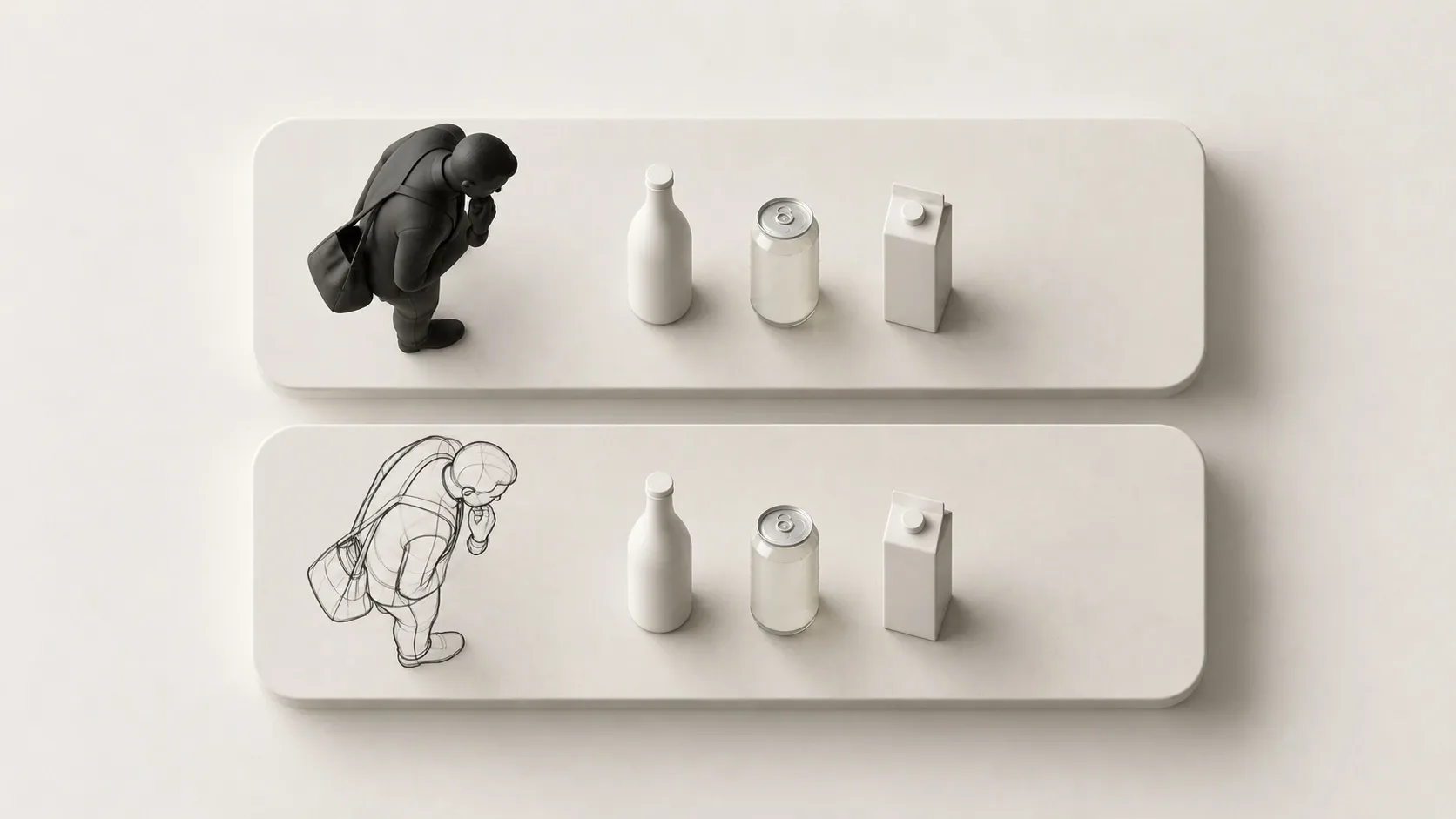
Promotion testing: Cut the price or give shoppers more?
Four for $3.20 and five for $4 cost the same per can. A store test shows how the choice can change checkout spend, sales timing, and contribution.
Choose the promotion that adds the most contribution through the next full buying cycle. A grocery retailer that normally sells four cans of seltzer for $4 could offer four for $3.20 or five for $4. Both deals cost $0.80 a can. The first lowers the checkout bill. The second gives shoppers more to take home for their usual $4.
The ordinary four-pack gives you a baseline. A deal that sends shoppers home with more cans can lead the sales report on Sunday and fall behind by the time those shoppers would usually come back.
Give the regular offer its own stores
Group stores with similar recent sales and shopper mix, then randomly assign stores within each group to the regular four-pack, the discounted four-pack, or the five-pack. Run all three offers on the same dates. Give them comparable shelf space and signage, and track stockouts and overlapping promotions so you can interpret the sales figures.
After the promotion, restore the ordinary four-pack at its regular price in both promotional groups. Follow all three groups for at least one full buying cycle. Use the retailer’s purchase history to set that window before the test starts. If you have loyalty data, check when people who bought the deal next bought the product. Store scanner research shows why a dip after a promotion can be hard to see in aggregate sales. Van Heerde, Leeflang and Wittink’s scanner data study
Before printing shelf tags, we can use a simulated audience to compare how occasional and regular buyers read the offers. Ask what they would spend today and when they expect to need another pack. Those answers can help you clarify the wording and decide which buying patterns to check in retailer records. Our pricing research guide
Calculate what each deal leaves after the next shop
Calculate contribution from net receipts less variable costs for each pack, then subtract the cost of running the promotion. In this illustrative retailer readout, each can costs $0.50 and each promotion costs $10 per store to set up. The regular four-pack contributes $2.00, the discounted four-pack contributes $1.20, and the five-pack contributes $1.50 before setup.
Offer and packs per store, promo / follow-up | Contribution per store |
|---|---|
Ordinary four for $4 · 100 / 200 packs | 100 × $2.00 + 200 × $2.00 = $600 |
Price cut, four for $3.20 · 190 / 200 packs | 190 × $1.20 + 200 × $2.00 − $10 = $618 |
Bonus pack, five for $4 · 170 / 170 packs | 170 × $1.50 + 170 × $2.00 − $10 = $585 |
At the end of the promotion, the bonus pack has sold 850 cans to the price cut’s 760. It also leads on contribution after setup, $245 to $218. During the follow-up, the bonus pack group sells 30 fewer full-price packs than the holdout. That costs $60 in contribution and takes the five-pack from a lead during the promotion to $15 below the ordinary offer over the full window.
Copy the three rows into your test brief. Record the contribution per pack and the average packs per store for each period, plus any setup or retailer funding charged to the offer. Keep both periods in the total.
The price cut earns the next slot in this readout. Its $18 gain per store is also the most it can absorb in additional rollout costs before it ties the ordinary offer at these volumes. Before rolling it out, check whether the gain holds across stores and whether nearby pack sizes lost contribution. Set the minimum gain per store in the pilot brief so the team can make that call when the follow-up window closes.