Price-pack architecture: Which sizes and prices belong on your shelf?
An eight-pack can win shoppers from another brand or draw them away from your four-pack. Compare both shelves and work out what each move is worth.
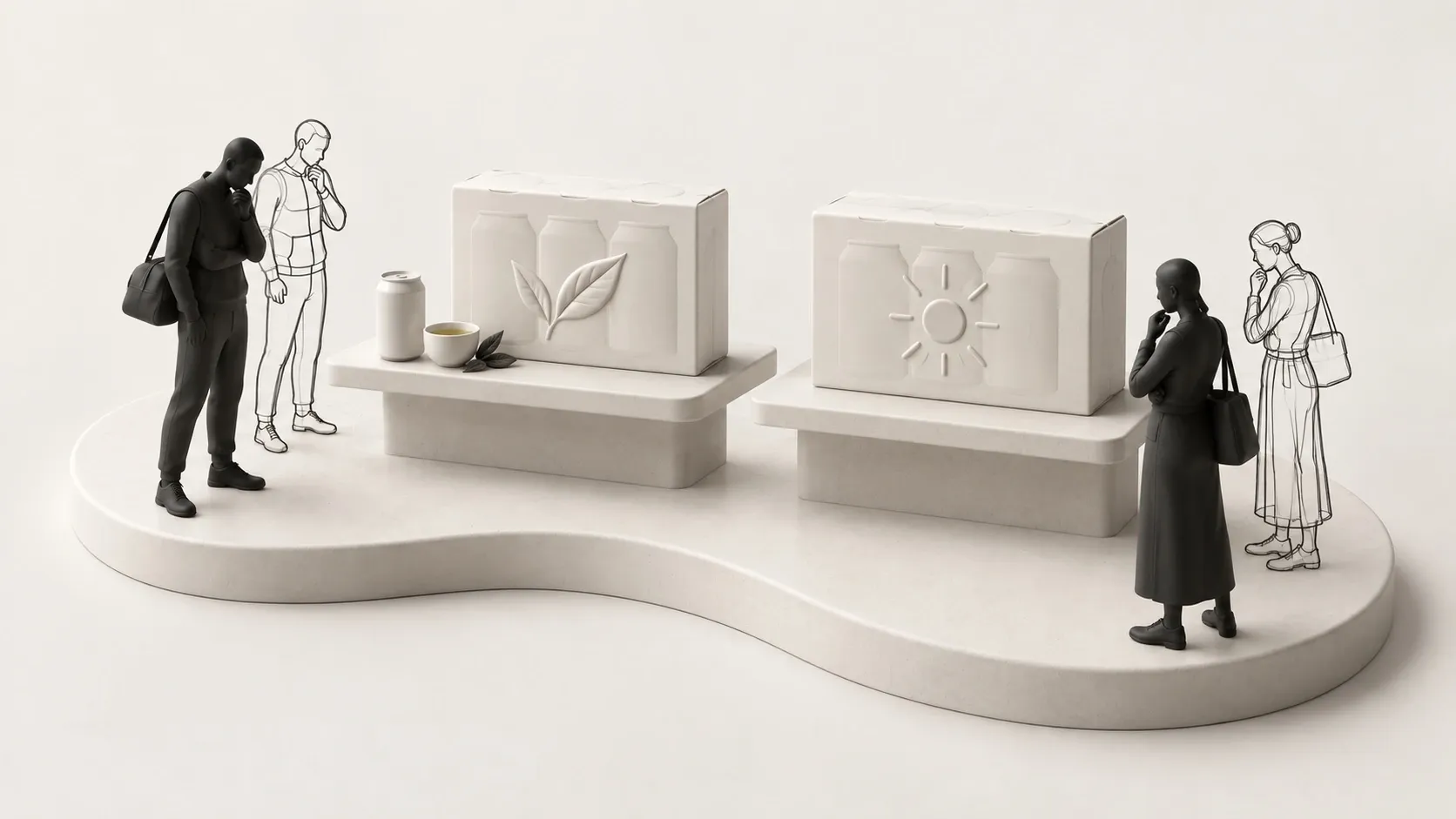
Test your current shelf against the shelf you plan to sell. A new pack earns its place when the purchases it brings in and the changes it makes to existing purchases add enough contribution to justify the launch.
Price-pack architecture is the set of sizes and prices you offer for different shopping trips. A single can works for a drink now. A larger pack may make sense for a household shopping for the week. The same low price per can that makes the larger pack attractive can also pull buyers away from a profitable smaller pack. That is why a price test on one pack leaves part of the decision open. Our pricing research guide · NIQ’s portfolio example
Put both ranges on the shelf
In this worked example, Bracken Bay sells sparkling water to grocery shoppers who buy the category for home. It wants to know whether an eight-pack belongs alongside its single can and four-pack. The shopper faces the same rival and can leave without buying on either shelf. All prices, choices, and costs below are illustrative.
The current range has a $2 single and a $6 four-pack. The candidate adds an eight-pack of the same 12-ounce cans for $10. The four-pack costs $1.50 per can. The eight-pack costs $1.25 per can and asks the shopper to spend $4 more on this trip. Show both the shelf price and pack quantity. Keep the shopping trip, product, and competing $5.50 four-pack steady across versions. If the retailer would remove an item to make room, test that actual replacement shelf as its own version.
For the main comparison, randomly show each shopper one shelf and ask what they would buy on that trip. Record one choice per shopper, including no purchase. Separate the results for trips that matter to the decision, such as buying one drink and stocking up. When you need to trace individual switches, use a separate paired exercise with the shelf order balanced across shoppers. Two separate groups tell you how the choice shares change. A paired exercise tells you which people moved between choices under those test conditions.
Work out where the eight-pack gets its buyers
Here is a filled worksheet for 100 shoppers in the paired exercise, each making one choice on each shelf. Contribution per pack is the brand’s net revenue after retailer terms minus the variable cost of making and delivering that pack.
Choice and contribution per pack | Choices on current → candidate shelf |
|---|---|
Bracken Bay single at $2 · $0.80 | 30 → 28 |
Bracken Bay four-pack at $6 · $2.40 | 40 → 28 |
Bracken Bay eight-pack at $10 · $3.20 | Unavailable → 18 |
Rival four-pack at $5.50 | 20 → 18 |
No purchase | 10 → 8 |
Bracken Bay contribution per 100 choices | $120.00 → $147.20 |
In this example, the eighteen eight-pack choices came from two single-can buyers, twelve four-pack buyers, two rival buyers, and two people who would have bought nothing. Moving twelve four-pack buyers adds $9.60 in contribution because the brand earns $0.80 more on each switch. The four choices gained from outside the range add $12.80. The two single-can switches add another $4.80. Together they explain the $27.20 gain.
Copy the table with your own pack, shelf price, variable contribution, and count in each condition. Add an origin row for each switch you can trace. Multiply each choice count by its pack contribution, then sum by shelf. Keep the eligible choice base visible if the groups are different sizes. Give the rival and no-purchase rows zero brand contribution while keeping them in the choice base.
Decide what the store pilot has to prove
In the example, the candidate deserves a store pilot because the brand gains contribution even after accounting for purchases shifted out of the four-pack. The pilot needs comparable stores, confirmed stock and shelf placement, and enough time to see whether eight-pack buyers come back less often. Set the required gain in contribution per store per week before the pilot, with any additional display or distribution cost included. Share the category sales and shelf-space effects with the retailer as separate measures.
Use a simulated audience when you want to compare feasible shelves or understand why a shopper might trade up. Bring the exact pack sizes, prices, and available alternatives. Use transactions from the pilot to judge what the range earns over a real buying cycle. Our pricing and offer research services