
Market entry research: choose a first market you can learn from
Choose a feasible first market for a localized pilot, connect audience evidence with payment and supply routes, and test conditional break-even assumptions.

Market entry research connects local buyer needs and offer reactions with a usable route to market and pilot economics. Define the audience, localized product, payment or delivery route and the next commitment. Choose a first market that can supply the offer and test its economics, with an explicit condition for reopening deferred markets.
Consider an example meal-planning service choosing a second country for a small localized pilot. It serves households planning several dinners each week; groceries are bought separately. Market A has familiar ingredients and an available payment route. Market B offers an appealing audience story, but recipe supply and payment terms remain unresolved. Under those assumptions, start the pilot in A.
That decision is more useful than assigning an overall attractiveness score. It explains which market can support the current offer, what the pilot will measure and which fact would bring B back into consideration. Market entry research connects the buyer comparison with the route the business can operate.
Define the entry decision
Define which households can use the localized planning service, shopping list, payment method and digital channels. You are choosing a bounded pilot, rather than a nationwide launch.
Before sizing demand, specify language, geography, category behavior, role in purchase and route to market. Check whether the existing offer makes sense locally: recipe ingredients, household routines, dietary requirements, payment expectations and competing options may differ.
Use sources for the claims they can support
Evidence layer | Source and evidence boundary |
|---|---|
Population and economic context | Useful starting source: World Bank Open Data and the relevant national statistics office What it does not establish: Exact demand for your product |
US establishment context | Useful starting source: Census County Business Patterns, where the industry coverage fits What it does not establish: A count of all buyers or nonemployer businesses |
Country business environment | Useful starting source: International Trade Administration country guides What it does not establish: A substitute for current local legal, tax or operational advice |
Competitor offer | Useful starting source: Official local product and purchase pages What it does not establish: Competitor sales, profitability or customer satisfaction |
Audience understanding and choice | Useful starting source: Appropriately designed local human research or a disclosed modeled study What it does not establish: Observed purchasing or retention without behavioral evidence |
Commercial feasibility | Useful starting source: Quotes, actual pilot records and unit economics What it does not establish: A guaranteed national rollout outcome |
Record the year, unit, geography and definition for each figure. “Households,” “adults,” “internet users” and “business establishments” are different denominators. Do not average incompatible estimates because they share a country name.
Find the economic requirement the pilot must test
Use a transparent chain: eligible audience × reachable share × trial rate × paid conversion × retention, with units and time period defined. Every multiplier needs an evidence source or an explicit assumption. Keep low, central and high scenarios and identify which variables account for most of the range.
Compare the routes that make entry possible
Use the same localized offer and decision period for each candidate market. A favorable audience reaction cannot compensate for an unusable payment route, unavailable ingredients or a delivery model the team cannot operate.
Entry gate | Required evidence and market-figure limit |
|---|---|
Eligible and reachable audience | Evidence needed for the meal-planning pilot: Defined households and actual acquisition route What an attractive market figure cannot replace: A national internet-user total |
Usable localized offer | Evidence needed for the meal-planning pilot: Ingredient availability, recipe fit and language checks What an attractive market figure cannot replace: A translated home-market card alone |
Payment and operations | Evidence needed for the meal-planning pilot: Confirmed terms, support capacity and appropriate local review What an attractive market figure cannot replace: General country-business context |
Customer proposition | Evidence needed for the meal-planning pilot: Understanding, alternatives and response to complete terms What an attractive market figure cannot replace: Population growth |
Pilot economics | Evidence needed for the meal-planning pilot: Actual costs, activation, payments and retention What an attractive market figure cannot replace: A stated-interest multiplier |
Set mandatory gates apart from comparative judgments. A market can be attractive for later research while failing the current pilot requirement. Record “defer until [specific fact] is resolved” rather than forcing every candidate into an entry ranking.
Check units in the scenario chain
Eligible audience and reachable share identify people or households in a defined period. Trial and paid conversion are stage-specific rates; retention needs a cohort and time horizon. Keep the denominators aligned so one person's repeat use does not become another acquired customer.
The existing break-even example is 1,000 retained subscribers because $6,000 recurring cost is divided by $6 monthly contribution. That is a conditional operating requirement, not acquisition evidence or a nationwide market size. Test whether the actual offer can sustain contribution after the relevant costs and whether a bounded pilot can supply the retention evidence. Use the scenario range to identify the assumption worth investigating next rather than selecting the optimistic endpoint as the forecast.
Work backward from a viable retained customer
The example service contributes $6 per retained subscriber per month against an assumed $6,000 recurring local cost. That creates an operating requirement of 1,000 retained subscribers before unspecified costs. Here, $6 is the assumed contribution left after the per-subscriber costs included in the example, not the subscription price; no further cost breakdown is supplied. The research question is how the localized offer and acquisition route could support that requirement, not whether a large national audience sounds attractive.
Conditional monthly economics
The operating requirement is 1,000 retained subscribers.
$6,000 (Recurring local cost) ÷ $6 (Contribution per retained subscriber) = 1,000 (Retained subscribers in the month).
Market | Conditions |
|---|---|
MARKET A / PILOT FIRST | Available ingredients. Usable payment route. |
MARKET B / REOPEN WHEN READY | Resolve recipe supply and payment terms. |
View the break-even curve
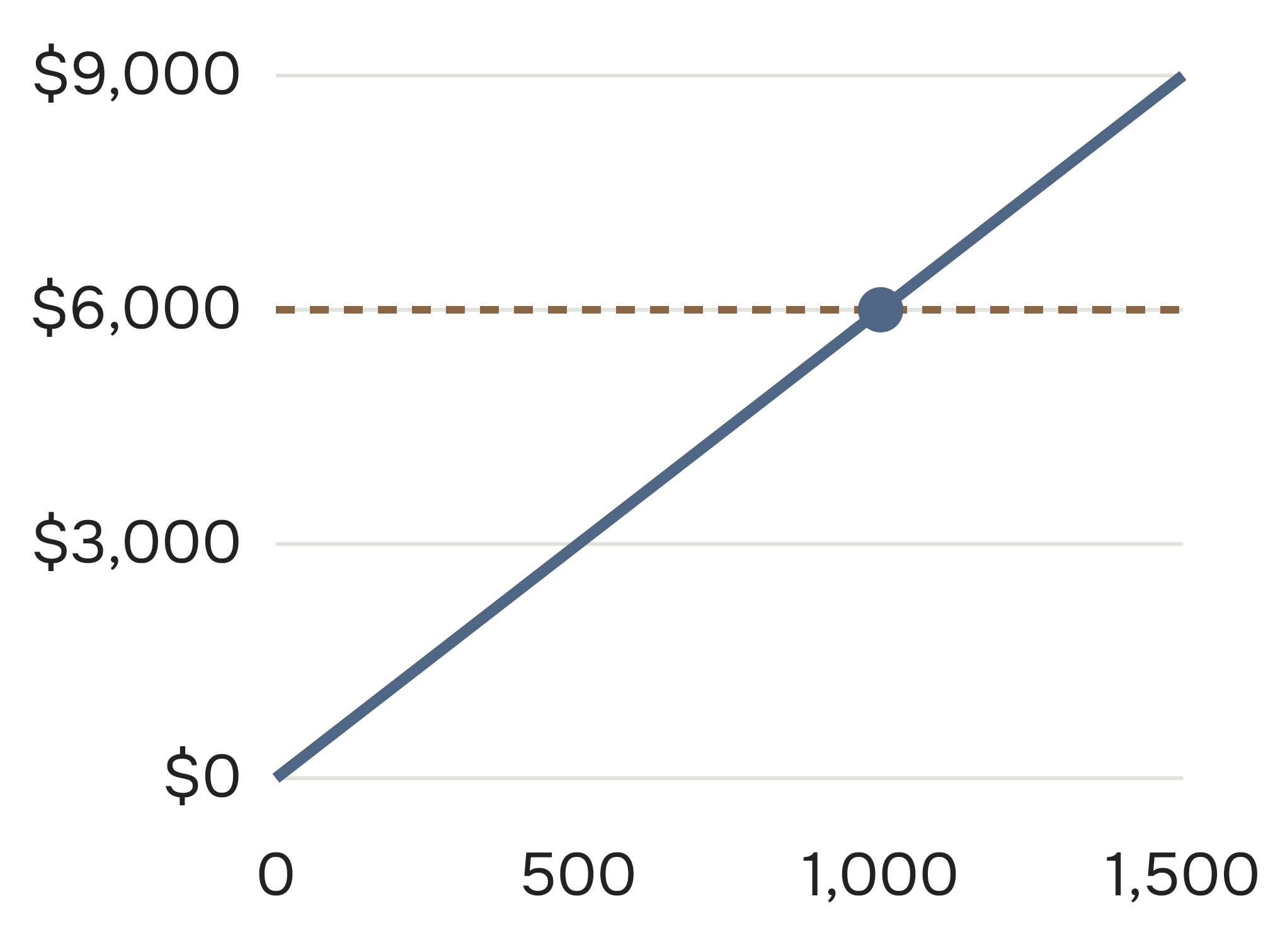
View the complete figure at full resolution.
Retained subscribers in the month
Monthly assumptions: $6,000 ÷ $6 = 1,000, before unspecified costs. The line shows arithmetic, not acquisition or retention evidence.
Separate the operating calculation from acquisition and retention evidence. A pilot can record the cost of bringing an eligible household to the offer, activating it, receiving payment and retaining it for a declared period. Put those stages beside the recipe and payment conditions that make the service usable. The weakest consequential stage tells the team what to fix next.
The decision to start in A follows available ingredients and payment terms in this example. B can remain attractive for later work. State the specific reopening condition: a feasible local offer and route, followed by a comparison of complete terms and economics. This is a strategy for learning, not a permanent ranking of countries.
Translation is one part of localization
A clear translated card can still describe dinners households cannot make or a payment method they cannot use. Inspect recipe availability, meal routines, subscription expectations, support and alternatives with appropriate local evidence. Supply those facts in the comparison rather than expect respondents to fill them in.
The finished entry report should recommend a bounded commitment, the offer and route it uses, the pilot outcomes and the condition for stopping, revising or expanding. It makes the market choice reviewable because the commercial reasoning sits beside the audience evidence.
Use research to narrow the next commitment
Pilot Market A first. Reopen B when the ingredient and payment routes are usable.
For this decision, compare the complete localized offer in A, record acquisition, activation, paid conversion and retention, and update contribution with actual costs. At an assumed $6 monthly contribution and $6,000 recurring local cost, break-even requires 1,000 retained subscribers, excluding unspecified costs. The pilot’s job is to find whether the offer and acquisition route can support that requirement. A usable B route or materially stronger economics in B would justify reopening the market choice.
Test the localized offer, price and competing alternative before a pilot. Then record actual acquisition cost, activation, payment conversion, support issues and retention. Set stop or revise rules before reviewing the pilot results so an optimistic interpretation does not override weak economics.
You can work with Sapien to compare modeled local offer, price and audience responses, explore their explanations and develop an entry recommendation. Confirm market, language, audience grounding and validation with the team; support for every geography is not implied. Discuss the market, offer and entry decision with Sapien. Use our concept comparison methods guide for offer comparisons and our pricing research guide for price decisions.


