Claims testing: make the promise mean what you intend
Claims testing investigates the promise buyers infer from a statement in its actual pack or advertising context. It helps you retain, narrow or replace wording. Compare those interpretations with the evidence for the product, so a believable claim also communicates a promise the product can deliver.
Claims testing investigates the promise buyers infer from a statement in its actual pack or advertising context. It helps you retain, narrow or replace wording. Compare those interpretations with the evidence for the product, so a believable claim also communicates a promise the product can deliver.
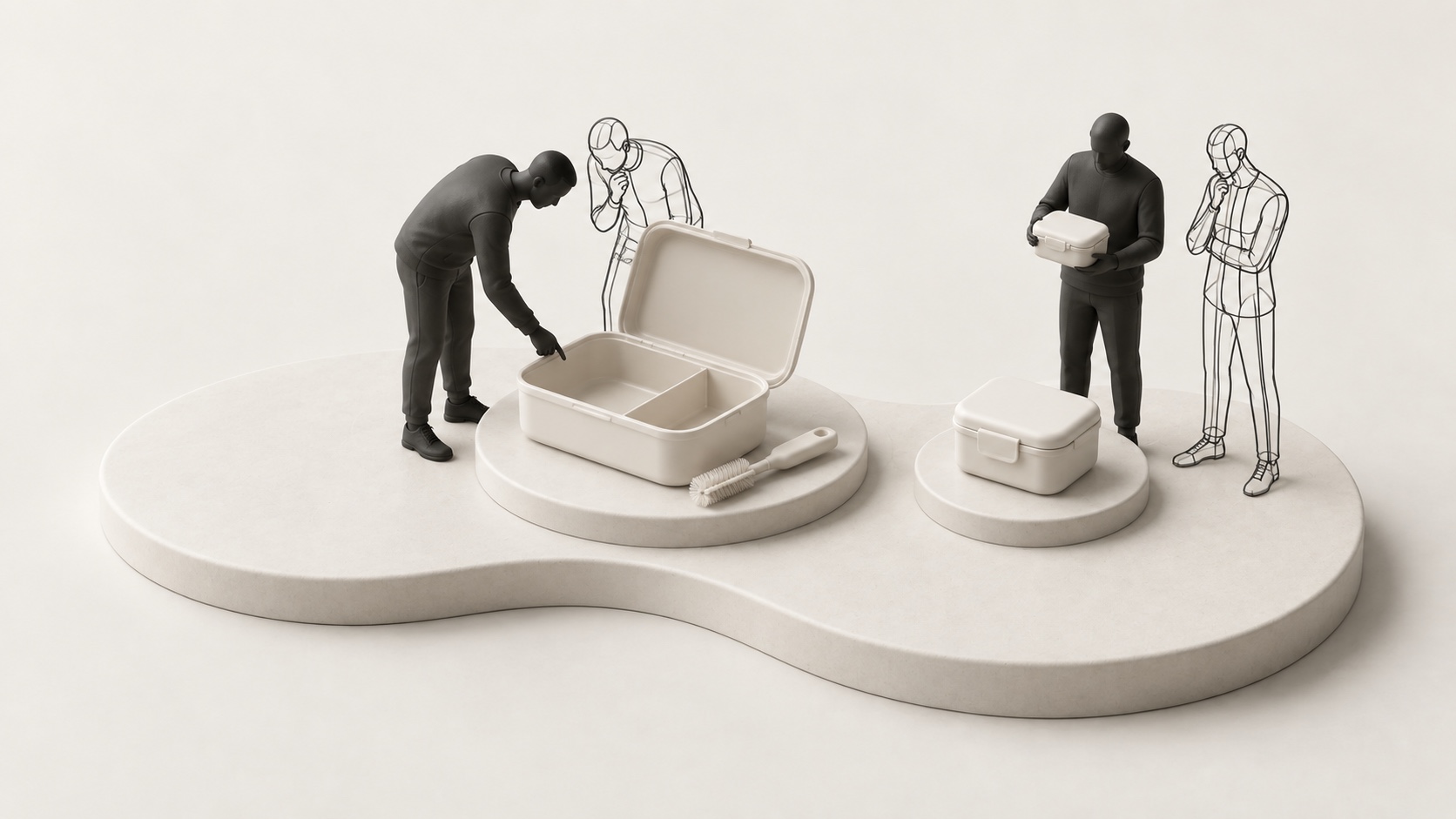
Your pack says “Easy to clean.” One buyer thinks the corners are easy to reach. Another hears dishwasher-safe. A third expects the plastic never to stain. The words are short; the resulting product promises are not.
A claims study shows which interpretation the final copy and layout create. Product evidence supplies a separate answer: which promise can the product deliver? Bring the two together before choosing the statement to put on the pack.
Build a claim matrix before collecting reactions
The table below uses a fictional storage container. It demonstrates a research review, not a finding about an actual product.
Candidate statement | Intended meaning | Possible inferred meaning | Evidence needed outside consumer research |
|---|---|---|---|
“Made with 40% recycled plastic” | Stated proportion of material | Entire pack is recycled or recyclable | Verified material composition and scope |
“Keeps your lunch fresh” | Useful storage experience | Prevents spoilage or extends a specific shelf life | Product performance evidence for the precise promise |
“Easy to clean” | Convenient cleaning | Dishwasher-safe or stain-proof | Appropriate use/performance evidence |
Writing the possible inference is a hypothesis. Test it rather than assuming every reader will hear the same thing.
Ask people to explain the claim before judging it
Show the claim in its actual context, including nearby imagery, qualifiers and other pack copy. A disclaimer separated from the headline may be less visible than it is in a clean research slide.
Use these probes:
- What does this statement mean to you?
- What would you expect the product to do because of this statement?
- What would you not expect it to do?
- Which part, if any, is unclear?
- What makes the statement believable or doubtful?
- What information would you look for to check it?
- Does this change whether you would consider the product? Why?
Code the interpretation before calculating agreement. “I believe it” does not tell you which inferred promise a person believes.
See the interpretation that changes the copy
For “Easy to clean,” imagine three fictional responses:
One claim. Three different promises.
Fictional interpretation exercise.
The wording shown: “Easy to clean.”
Lunch storage container.
Reading | Invented interpretation | Evidence to check | Next responsibility |
|---|---|---|---|
Access | “I can reach the corners.” | Check the actual opening and cleaning task. | Product design → precise copy |
Care | “It can go in the dishwasher.” | Check the supported care instructions. | Care evidence → claim review |
Material | “It will not stain.” | Check the relevant material evidence and scope. | Material evidence → claim review |
Invented readings of the same sentence. Compare the claim with a matched neutral control; the interpretation study identifies the promise to substantiate.
Response | Interpretation code | Action |
|---|---|---|
“I can reach the corners with a sponge.” | Accessible shape | Check whether product design supports it |
“I can put it in the dishwasher.” | Dishwasher implication | Clarify cleaning instructions if unsupported |
“It will never stain.” | Stain-resistance implication | Narrow wording and retest |
The important finding is the pattern of meanings, not an invented average credibility score. Keep illustrative examples separate from collected responses in the report.
Check which meanings the claim adds
The three answers above are reactions to an exposed claim. Without a comparison, you cannot attribute the dishwasher or stain interpretation to that wording: someone may already assume those properties from the category, image or container shape.
For an attribution question, randomize eligible people to matched cards with the same product, image and context:
Arm | Copy that changes | Evidence to compare |
|---|---|---|
Neutral control | “Lunch storage container” | Baseline expectations without the cleaning claim |
Original claim | Control plus “Easy to clean” | Whether the claim adds unsupported meanings |
Concrete candidate | Control plus “A wide opening helps you reach the corners while washing” | Whether the mechanism preserves the intended meaning and reduces unintended ones |
Ask every arm “How would you expect to clean this container?” before mentioning a dishwasher or stain resistance. Code unaided answers using the same blind rubric and show each arm’s base. Then collect detailed diagnostics. In a fictional paired coding illustration, a control answer says “I would check the care label,” while a claim-arm answer says “Probably dishwasher-safe.” That contrast defines a hypothesis to test; two invented answers establish no lift. If the study uses only exposed reactions, report interpretations descriptively and investigate prior expectations in follow-up.
Give each inferred promise an owner
The container example produces a useful handoff only when the interpretation reaches the right team. Marketing owns the wording and visual hierarchy. Product owns the care instructions and evidence for the material or cleaning method. The appropriate review team checks whether the final statement and support fit the intended market. Put those responsibilities beside the actual inferred meanings rather than deliver one average credibility score.
For the concrete candidate, a buyer explaining that the opening gives a sponge access to the corners is responding to the stated mechanism. A buyer inferring dishwasher safety is adding a different property. Keep those meanings separate even if both people rate the line believable. The next comparison should investigate whether the revised wording communicates washing access while keeping care conditions clear.
Use the complete final pack image for this decision. A headline, a dishwasher icon and a small care line form one encounter. Removing the icon only in the survey would test a version the buyer never sees. Save the pack version, the arm and the open answer so the recommendation can point to the actual element to change.
A completed review brief
The brief for this teaching container is specific: compare the neutral product card, “Easy to clean” and the wide-opening explanation under matched exposure. Record unaided expected cleaning methods, then ask which visible cue supplied that expectation. The proposed action is to replace the broad line if the specific mechanism is understood and the broad version adds a material unsupported meaning.
The same approach applies to a software claim such as “Set up in minutes.” Define what setup includes, which buyer and environment the promise addresses, and what product evidence supports the actual wording. Consumer interpretation helps identify what people expect the clock to cover. It does not supply the product performance record.
Put the qualifier in the real encounter
A qualifier that works on a research slide may be absent from a cropped ecommerce image. Compare the final headline and nearby explanation together, then ask the participant to paraphrase the total promise. Ask what information supported that interpretation without pointing to the qualifier first.
If the short claim still creates an unsupported central expectation, moving a caveat lower on the pack does not resolve the communication problem demonstrated by the test. Revise the main wording or presentation and check the actual candidate again. Interpretation evidence informs that edit; product and legal review determine whether the supported statement can be used in its intended jurisdiction.
Decide whether to retain, narrow or replace the claim
A wide opening helps you reach the corners while washing.
For the fictional container, this is the next candidate when washing access is the supported benefit. Put the wording beside the actual pack image and cleaning instructions. Ask buyers to explain the total promise before pointing to any qualifier. If the main attraction still comes from dishwasher safety, the next change belongs in the prominent wording or visual context. A small-print correction will not do the communication work of a clear main claim.
Retain a claim when its important interpretation matches the supported promise. Narrow it when a qualifier or concrete mechanism resolves the ambiguity. Replace it when the main attraction depends on an unsupported inference.
The FTC's advertising-substantiation policy explains why support for objective advertising claims matters. Regulatory and legal review should address the actual product, evidence and jurisdiction; an interpretation study cannot replace it.
Sapien can compare how data-grounded audiences interpret candidate claims and explain which promises, doubts and proof requests should shape the next wording. Keep factual substantiation alongside the interpretation study so the recommended copy has support. Discuss the statements and evidence you have. For the surrounding design, see packaging design testing; for a broader campaign promise, see message testing.